By: E Hernández/ D León
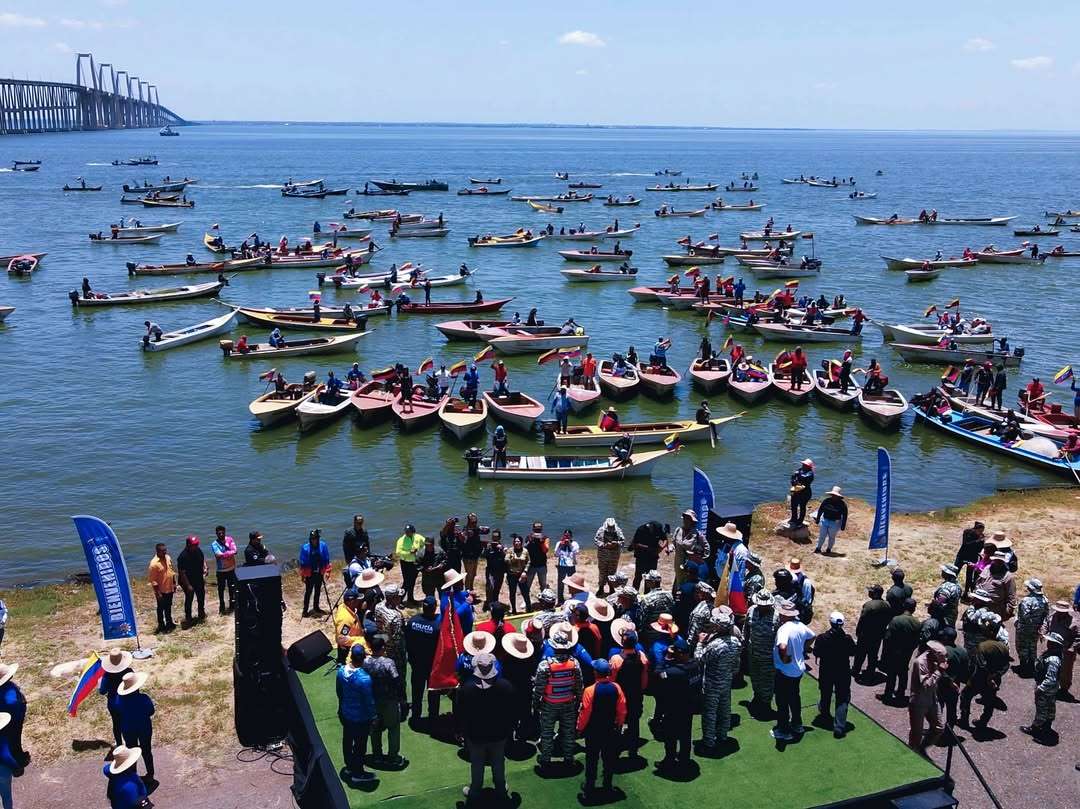
The Venezuelan fishing sector has demonstrated an unwavering will to maintain its work, even in the face of threats from foreign powers. The country’s artisanal fishermen, aware that their daily work at sea is also an act of exercising sovereignty and peace, have made it clear that they are not intimidated by the presence of war fleets or nuclear submarines in the region.
The main spokesperson for the Fishermen’s Councils (Conppas) of the Caraballeda Marina, Luis García, highlighted that life at sea is a tradition that is inherited and learned through practice and that, despite the attacks and difficulties, the union maintains its uninterrupted production.
“It is we, the fishermen of Venezuela and the entire Caribbean Sea, who are affected. We are not criminals, we are workers who go out at 4 in the morning to do our fishing work. Our weapons are nylon and rendal,” he assured ÓN.

For the fishermen of La Guaira, the Caribbean Sea has always been their livelihood and their territory. However, in recent times, their usual fishing waters have become a scene of international tension, forcing them to modify their centuries-old practices to protect themselves from what they perceive as a real threat.
“Evidently, there is a real threat against the fishermen. They have already bombed some boats, but without any type of action protocols, nothing. They are murderers and we have to take care of ourselves, take care of our integrity, take care of our boats, take care of the peace and stability of the Republic,” García said.
For this reason, the routine at docks like Caraballeda has changed, where before they only talked about fish and tides, now they discuss coordinates and possible risks.
“We have done internships, we have taken courses, we have established some communication strategies, now we are trying to go out as a group,” explains García, who does not hesitate to describe the United States’ action against a Venezuelan tuna vessel in national waters as “a flagrant violation of all international law.”
However, the response of the companions stands out: “We are going to re-equip the boat, we are going to put fuel, we are going to put ice and bait and we will go out fishing again. That is the attitude of the fishing people. That is the attitude of the men and women who fish.”
García stated that day by day the organization and commitment of the sector is strengthened to defend the integrity of the nation. He noted that by being part of the Sovereignty and Peace Council of the Fisheries sector, “they are part of the history of the country’s defense” in the face of the imperial siege.

“We are not going to stop. Count on, Venezuelan people, that the fishermen and fisherwomen are going to continue and now much more,” he said.
Some fishermen have taken a step further, joining the Bolivarian militias, men of the sea who now learn how to use weapons.
“We have created a force called the fishing militia, where each and every one of the fishermen from different regions of the country have been joining together for the comprehensive defense of our country and thus guarantee more security for each of our colleagues at the time of any external threat,” said Douglas Díaz, spokesperson for the Conppas of Macuto.
While the fishermen brave the danger on the high seas, another heart beats on dry land, that of the families waiting united by an invisible thread that extends beyond the horizon full of hope and fear.
“Whether they come empty or they come full, but the worry is that they arrive. When you see them here on land, it takes away the anxiety that you have inside. When they leave for work, they don’t sleep outside and you don’t sleep here either because you stay worried. Out there you see so many things and, well, when you see that they set foot on the dock, the fear is over,” the spokesperson for the women Conppas de Caraballeda, Rosmary Castro.
Provision and organization for security. The national government, in coordination with the sector, has promoted strategies to provide greater security to sea workers.
One of the essential tools is the provision of radio beacons, a crucial instrument for the safety of vessels, especially those that carry out tasks of several days and at great distances. These radio beacons, whose value ranges between 700 and 1,200 dollars, have been granted free of charge by the Venezuelan State through the Ministry of Fisheries.
With this mechanism, it is guaranteed that the National Institute of Aquatic Spaces (Inea) can know the exact location of the boats and activate quick, safe and timely rescues in case of emergencies.
In the state of La Guaira, which has 34 fishermen’s councils and approximately 700 boats, it is estimated that around 150 boats have been equipped with these radio beacons, prioritizing those that travel more than 30 nautical miles from the coast.
The sector has also strengthened its internal organization and its coordination with the Peace Quadrants, establishing joint tactics and strategies that will allow it to address any sign of danger in real time, reaffirming that fishing is an activity that contributes to guaranteeing the security and peace of the nation.
Diversified production.
The will to work has not only focused on traditional work, but also on productive diversification. A group of women fishermen, through the Tejiendo Redes program, is processing fresh fish, increasing its value and addition and generating new sources of employment.
This productive chain has resulted in more than 45 processed products that are beginning to reach the shelves of national commerce.
The fishermen, who carry in their peñeros only one “secret weapon: the great love we have for Venezuela,” have assured that they will not stop working and will continue to guarantee sustenance for Venezuelan homes.
“Those who are there, let them stay there. We are still going to go out, we are going to produce because no one is going to stop in Venezuela,” Castro stated.