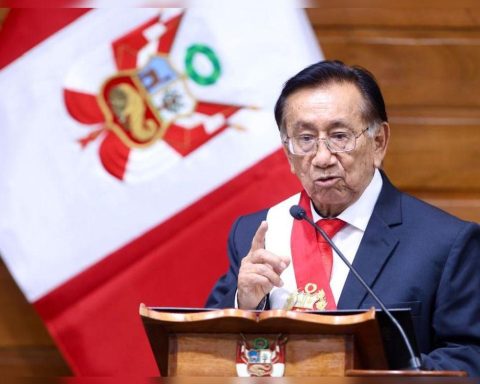
He Fiscal Council (CF) assured that it is “worrying” that, despite the repeated warnings that have been given, the current government of José Jerí has enacted 26 laws without observing the adverse fiscal impact it generates for the country.
Along the same lines, he questioned that no unconstitutionality action has been initiated against those populist norms that have defects, which will continue to put pressure on fiscal accounts in the short and medium term.
“The fiscal vulnerabilities that are being generated will be more evident in the future due to the accumulation of pressures, and even more so, in an eventual context of reversal of the record prices of our main exports,” he said.
Likewise, it warned that in 2025 the rule of total non-financial expenditure, and that of current expenditure excluding maintenance, were not complied with. Regarding the first, he indicated that according to preliminary information, last year said expenditure would have exceeded S/241 billion, exceeding the limit allowed by the rule by approximately S/6,600 million.
“Current spending without maintenance would have registered a real growth of 4.8%, more than double the maximum growth allowed by the corresponding fiscal rule (2.1% real), and would have registered a deviation close to S/ 4,100 million,” he indicated.
Added to this is that in 2023 and 2024 the fiscal deficit goal was not met. In this way, the credibility of Peru is affected and weakens the sustainability of public finances. For this reason, the CF considered that greater control is needed.
“The failure to comply with the rules in 2025 was caused both by the lack of disciplined management of the Executive Branch to control the growth of public spending, as well as by pressure from the Congress of the Republic through laws that increase public spending,” he said.
Likewise, he pointed out that, although extraordinary measures were adopted in the last months of 2025 to contain public spending, in light of the results obtained, these were insufficient to ensure compliance with the goals.
“Preliminarily, it is estimated that the impact of the measure that sought to contain non-critical expenditure items would have generated savings of only 0.05% of GDP (approximately S/ 600 million), especially in the CAS item,” he highlighted.
PUBLIC REMUNERATIONS
On the other hand, the Fiscal Council once again warned that the increase in remuneration spending largely explains the consecutive breaches of the rules. According to him, between 2023 and 2025, the average increase in said item was S/5,900 million, practically doubling the average annual growth of the previous 10 years of S/3,000 million.
In that sense, he warned that this year payroll spending would also exceed what was foreseen in the current Multiannual Macroeconomic Framework (MMM), and that the increase in the budget of said item of S/7.8 billion is considerably greater than the fiscal space foreseen in the MMM of S/2.1 billion.
Peru needs us informed to make decisions. Subscribe for free to the Perú21 newsletter: THE TOP 5 NEWS YOU SHOULD KNOW TODAY. Click on the next link.
RECOMMENDED VIDEO