The governor of Central Bank of the Dominican Republic (BCRD), Hector Valdez Albizuhighlighted that the flow solidity of foreign exchange—coming from tourismexports, remittances and foreign direct investment—has been decisive in maintaining the exchange rate stability and strengthen the international reserves of the country, despite the adverse international environment.
Between January and September 2025, the country received more than $21.4 billion from those three main sources: 8,500 million per tourism8,900 million per remittances and 4,000 million from foreign direct investment, with emphasis on the mining, energy and telecommunications sectors.
Valdez Albizu explained that these incomealong with the exports of goods for 11,600 million dollars —an interannual increase of 11.7%— have made it possible to comfortably supply the demand for foreign currency and maintain the accumulated depreciation of the Dominican peso at just 2.3% until September.
Reserves at historic levels
Thanks to this sustained flow of foreign currency, the Central Bank closed September with international reserves of 13.3 billion dollarsequivalent to 10.4% of GDP and almost five months of imports, levels that exceed the parameters recommended by the International Monetary Fund (IMF).
The governor highlighted that these results consolidate confidence in the Dominican economy and allow the country to have a solid external position to face eventual international financial shocks.
Growth and dynamic sectors
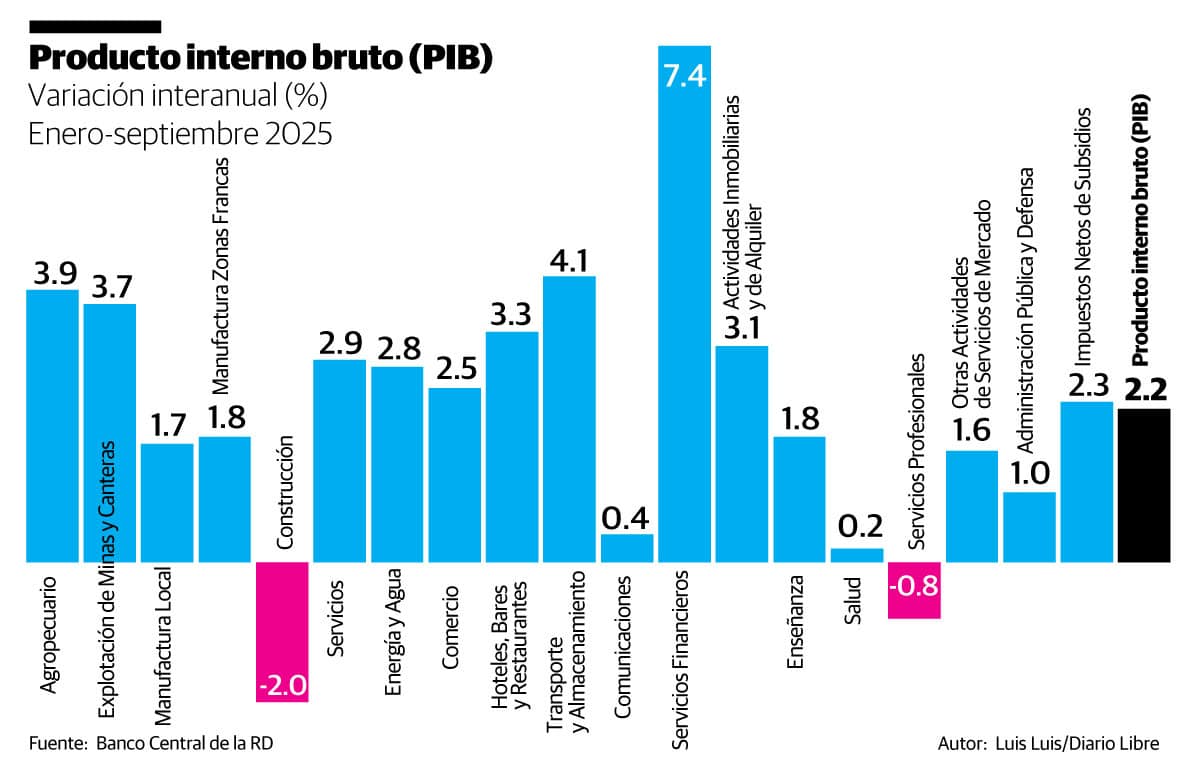
In this context, the real gross domestic product (GDP) registered a 2.2% growth in the January-September period, in line with the regional projection for 2025. Valdez Albizu expressed that a gradual recovery of the potential growth rate is expected in the coming quarters, as global uncertainty dissipates, private investment is reactivated and public capital spending increases.
The sectors with the greatest dynamism were financial services (7.4%), transportation and storage (4.1%), agriculture (3.9%), mining (3.7%) and hotels, bars and restaurants (3.3%). Local manufacturing grew 1.7%, while that of free zones grew 1.8%.
The governor of the BCRD reported that the Dominican economy would reach an amount around 46,000 million dollars, coming mainly from exports for about 14,900 million, income from tourism for 11,200 million and remittances for about 11,700 million dollars. Additionally, foreign direct investment would register more than 4.8 billion dollars.
Tourism and exports: pillars of external income
He tourism maintained its leading role in the generation of foreign exchange: 8.6 million visitors arrived in the country between January and September, including 6.6 million by air and two million cruise passengers, which represented a year-on-year increase of 2.7%.
Meanwhile, the national exports exceeded 5.1 billion dollarsand those of free zones reached 6.5 billion, confirming the weight of the external sector in economic performance.
Perspective
Valdez Albizu stated that the combination of exchange rate stability, robust reserves and constant flow Foreign exchange provides the country with a solid foundation to resume more vigorous growth.
“We are in a position to continue strengthening the macroeconomic resilience of the Dominican Republic against a challenging international environment“the governor stressed during the event for the 78th anniversary of the Central Bank.