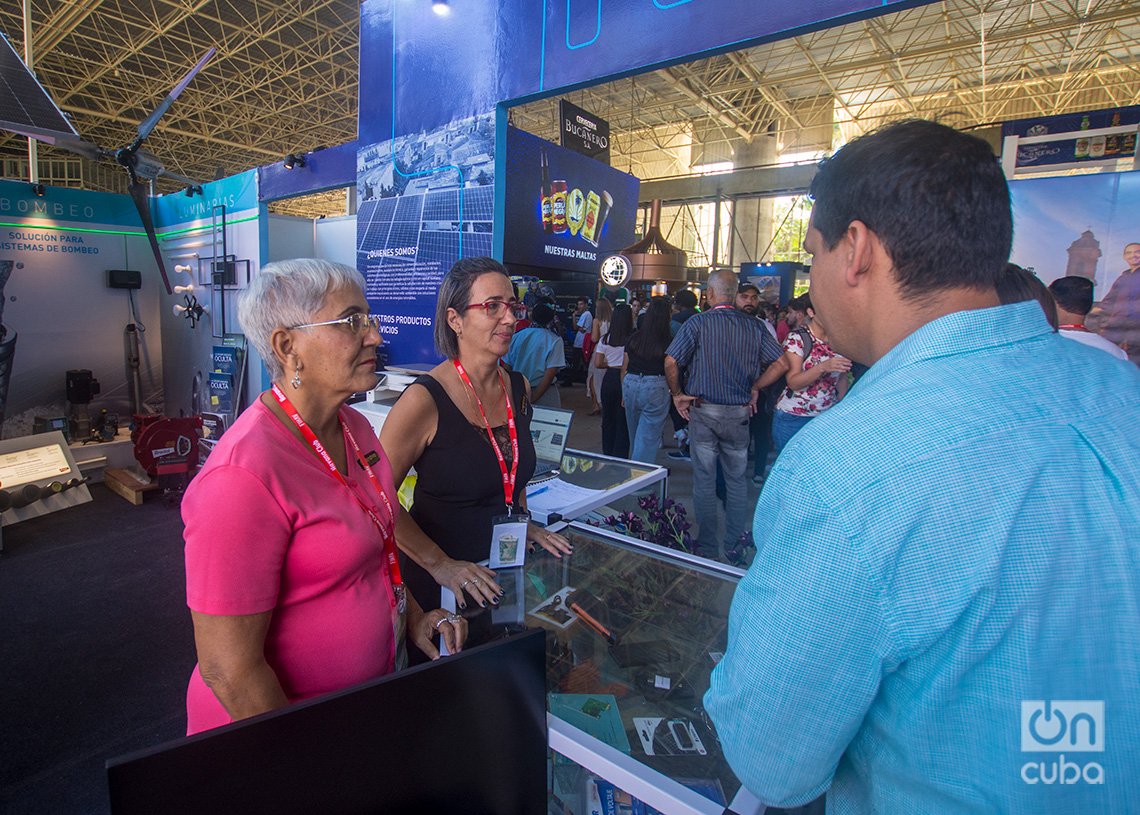
In the middle of a economic scenario “very complex”, as the Cuban Government itself recognized this week, the Havana International Fair (FIHAV) will reach its 41st edition with a novelty that seeks to redefine its scope: for the first time, Artificial Intelligence (AI) will be one of its five central thematic axes.
The bet aims not only modernize the exhibitor and visitor experiencebut also project Cuba as a relevant actor in the digital transformation of the region, according to island authorities.
So explained it to Cubadebate the Deputy Minister of Communications, Aylin Febles, according to which the AI area will be “directly linked to what will be happening at the event.” Meanwhile, in the exhibition area dedicated to this technology, the solutions available for the different sectors represented in the commercial exchange will be grouped.
The strategic shift occurs in an exceptional context. The fair —which will be celebrated from November 24 to 29 at ExpoCuba— changed its usual date to avoid the hurricane season, which last year forced its suspension due to the passage of Hurricane Rafael.
Now, after the recent blow of Hurricane Melissa to the east of the island – which has left significant material losses – the Government hopes it will be “a success”, with the participation of some 700 companies from more than 50 countries, according to the Minister of Foreign Trade, Oscar Pérez-Oliva.
The Government hopes that the Havana Fair will be “a success” just one month after Melissa’s scourge
AI to transform the FIHAV experience
Vice Minister Febles announced that FIHAV 2025 will integrate specific AI solutions into the management and operation of the event.
Among them, a pattern recognition system will allow visitors to be identified through facial recognition; interactive avatars will be introduced; and spaces will be set up to show more than 70 technological solutions developed by universities, research centers and Cuban companies.
Applications will cover sectors such as industry, agribusiness, biotechnology, health, smart cities and education.
“Exhibitors will find in the exhibition area artificial intelligence alliance opportunities to apply AI in their respective fields,” said the vice minister in her statements to Cubadebate.
FIHAV will also incorporate multilingual chatbots and machine translation tools “which will allow us to do without interpreters”, as well as sentiment analysis mechanisms, useful to evaluate public perception in real time and generate information for decision-making during the fair.
A Cuban AI ecosystem that seeks visibility
The area dedicated to AI – installed in pavilion 14, traditional headquarters of the Ministry of Communications – will host institutions such as the University of Havana, CUJAE, the University of Camagüey, UCI and other centers that have been researching in this field for decades.
“Cuba has a solid history in artificial intelligence since the 70s,” highlighted Febles, recalling that Computer Science was one of the first majors to incorporate this topic.
In addition, the edition will present a AI starter book for children and teenagersthe result of joint work between the educational sector and universities, and which is part of the national digital transformation strategy.
They present “Cecilia”, an AI language model trained with specific characteristics of Cuban Spanish
Technology fair in times of scarcity
The technological commitment at the Havana Fair comes at a particularly critical moment for the country.
According to United Nations figures cited by EFE, Cuba currently imports 80% of what it consumeswhile trying to attract foreign investment to reactivate an economy hit by the pandemic, US sanctions and internal economic policy errors.
The lack of foreign currency It limits the country’s ability to finance its own technological development, a point on which the Government, scientists and independent analysts agree.
With this background scenario, the integration of AI in FIHAV is presented as an attempt to reposition the fair—and by extension the country—on a more modern and competitive economic map, according to authorities.
Febles assures that this transformation responds to the national digital transformation policy and to UNESCO’s ethical recommendations on the use of these technologies.
The vice minister considers that AI should be a key element in the purpose of turn FIHAV into a Latin American innovation hub.
“Applying AI techniques to management, promotion, distribution of spaces and analysis of results is an opportunity that we cannot miss,” he stated.