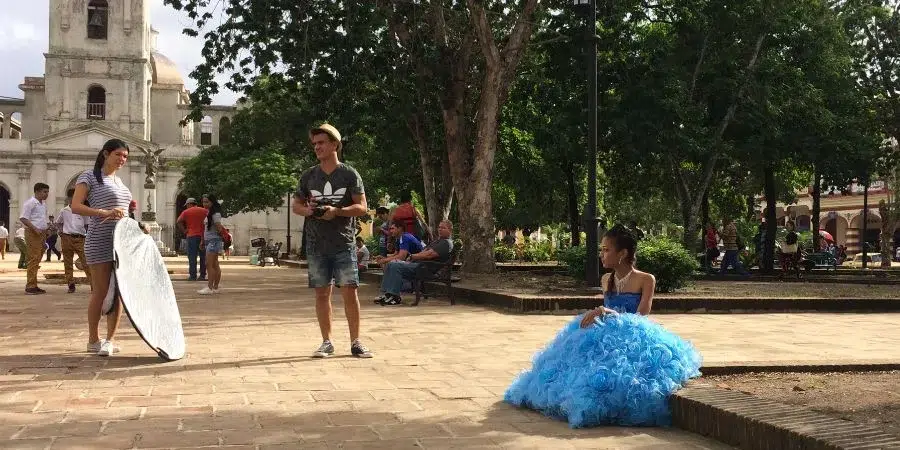
Throughout Cuba, the 15 -year -old tradition has become a contradiction between desire and reality.
Holguin, Cuba. – “The 15 of my granddaughter are next year and does not want a party. She, thank God, understands that we have no good economic situation and wants a celebration as far as the sheet will give us. Until the joy of the quinceañeras has been lost in this country,” says Marta Pérez, neighbor of the Villa Nueva cast, in the city of Holguin.
Not only here, but throughout Cuba, the tradition of 15 years has become a contradiction between desire and reality.
For many parents, the celebration is a commitment assumed from birth. It is confirmed by Lázaro Díaz, for whom the party is a duty: “That’s what my daughter was born on the same day. It is the duty of a father. Seeing her grow and knowing that day you have to take the party so that she feels proud.”
For her part, Mireya González defines him as an opportunity to give her daughter what she did not have: “In my 15 there was no party or photos, they only gave me two dresses and a couple of shoes; my parents did not have more. It was a very big frustration and that is why I promised me that if I was a girl I would sacrifice me so she would enjoy what I could not.”
Cuban psychologist Ivette Vega identifies the origin of this illusion in the family environment itself, where parents are often the creators of sleep. “Parents play a very important role in the manufacture of illusions of the children, because young people often claim what their parents have subliminally conditioned when they tell them: ‘This we are going to keep it for your 15,” the expert told Cubadebate.
However, specifying that dream collides with an adverse economic reality for most Cubans. The specialized site In Cuba It offers prices which seems from another world for the average monthly salary of 6,506 Cuban pesos (16 dollars to change in the informal market): dresses and accessories for up to 500 dollars, photographic packages of 800, and a food budget that can exceed $ 4,000 for $ 100.
Holguinero Noel López confirms it: “For the 15 of my daughter, between the photo album, clothes, shoes and a reservation in a hotel two days, we spend more than $ 5,000.” Yamila González, aunt of a quinceañera, exemplifies it in this way:. “The party of 15 of my niece cost what I did not win in three years of work.”
All that in a country where, according to A study by Food Monitor Programa person needs the equivalent of 10 minimum wages only to “eat” properly.
Given this situation, the question of how a party of thousands of dollars in Cuba is financed is imposed. Ana Luisa Johnson describes what he calls the “Operation 15”, an economic survival strategy based on three supports. “The first is the family who lives abroad. My sister who lives in the United States was the one who paid almost all the expenses of my daughter’s 15.” To this are added informal income: “My husband, who is mechanical, spent months doing jobs ‘on the left'”. Finally, personal sacrifices arrive: “We even sold the flat screen TV we had to be able to complete for the buffet.”
Expenses for the celebration of 15 years are carried out almost completely in foreign currency. Omar Pérez details this inevitable dollarization. “Everything, or almost everything, is in Fulas or in MLC. The photographer charges you in dollars in your hand. The one that rents the place, the same.”
This situation has created a visible social division. Jorge Duany, director of Cuban Research Institute from 2012 to 2024, Point out That it is “logical that the process of social stratification that Cuban society is living is manifested in different aspects of daily life and one of them, is the celebration of the festivities to the quinceañeras.”
A Holguin professional photographer who, for fear of reprisals identified himself only as Ernesto, confirms him in his daily work. “The family with remittances can afford the complete package, while the family that ‘fights’ here, with the salary here, has to cut off everywhere. It is seen in the quality of the final product.”
But money does not solve everything in an environment of chronic shortage. Carlos Enrique Perdomo describes the search for the ingredients for his daughter’s 15 -year -old dinner as an “impossible mission”: “To get the pork stop to roast, I had to talk to a partner who has a little fingering to keep one.
Even electric service is a luxury that must be planned. Dayanara Fuentes had to rent an electric plant. “We found a place, but very expensive. And the owner told us very clearly: ‘Music and lights run for you, and if there is a blackout, it is your problem.”
Behind the one -night event are debts and tensions. Perdomo reflects on the day after: “No one asks you for how you pay the debts of the celebration. The party of 15 in Cuba is an economic and physical wear.”
On the other hand, it contrasts the offer of a state store of Holguín for the 15 -year -old parties: one kilo of cheese, two of sausage and 18 bottles of concentrated soda.A passenger, Ricardo Paneque, cannot avoid commenting on the absurd offer: “Everyone mocks that poster, a 15 -year party has many more expenses and resources. We would be very bad as parents if we celebrate our daughter with that offer.

The honoree are aware of the sacrifice. Yurisleidy Valdés lived it with a mixture of joy and responsibility: “I saw my parents get dead of tiredness of making arrangements. The day of the party every time looked at them and thought ‘All this is for me’.
A new generation of Cubans, formed in the crisis, begins to redefine their priorities. Yenifer Rodríguez, who will turn 15 in a year, summarizes it with a crushing logic that marks, perhaps, the end of an era: “I do not want a party. Does party pa ‘what? With the money I would spend at the party I better buy clothes, shoes and other things that I need and will last several months.”