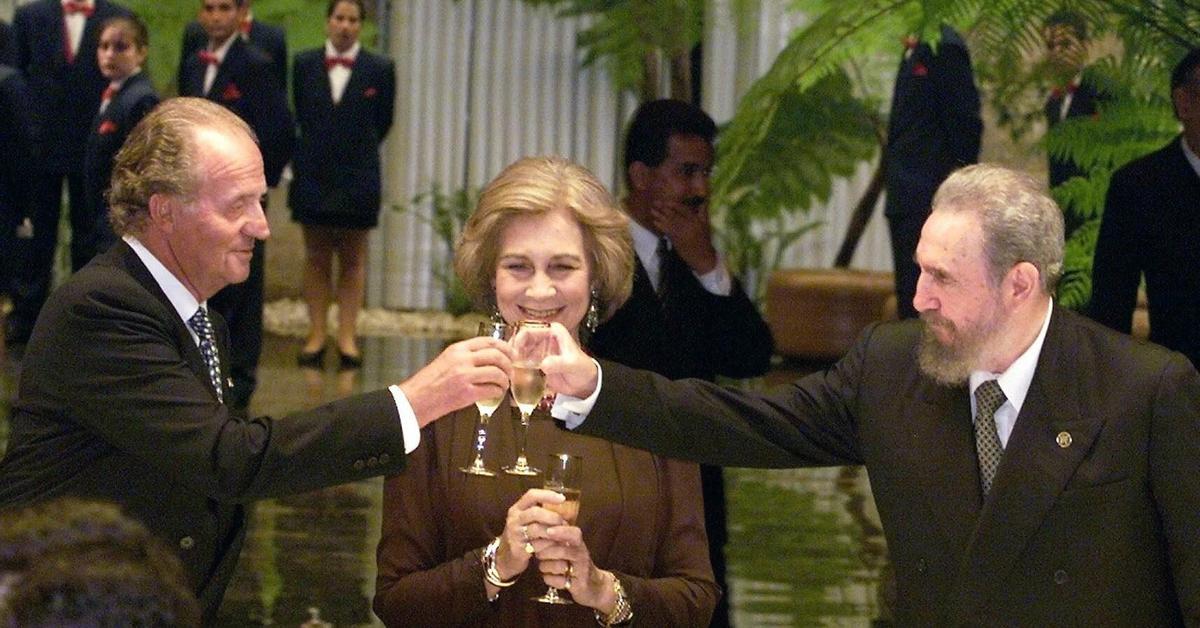
Madrid/The declassification of documents linked to the attempted coup d’état of February 23, 1981 in Spain has brought to light an exchange of letters between Fidel Castro and King Juan Carlos I. More than four decades later, the exchange acquires an unexpected resonance, not so much for what it reveals about 23F – where its weight is more contextual than decisive – but for the moment in which it reappears for Cuba: just when there is talk, as never before in recent years, of the possibility of a transition politics.
The documents included in the file AGA-83-07633 from the Ministry of Foreign Affairs, show Fidel Castro addressing the Spanish monarch with a careful, almost restrained tone, to convey his assessment of the Spanish institutional crisis following the riot of Antonio Tejero, who died coincidentally on the same day that the Government declassified the documents. The Cuban leader expressed his “concern about the events that occurred in Spain” and expressed his desire that “the institutional stability of the country be preserved”, formulas that contrast with the usual incendiary language of the communist leader.
Strictly speaking, the exchange does not modify the central interpretation of 23F nor does it provide evidence of Cuban interference in the Spanish crisis. But it does shed light on something more subtle: the calculated attention with which Havana followed the processes of change in the former metropolis and the regime’s willingness to project an image of a responsible international actor when it observed transition movements in other countries. In fact, Castro is the only Ibero-American leader who appears in the declassified documents.
Today’s Cuba is experiencing a moment of structural exhaustion marked by the economic crisis, institutional deterioration and a public conversation about scenarios of change.
That nuance takes on special relief today. While in the Spain of 1981 the consolidation of democracy was at stake after the death of Franco, today’s Cuba is experiencing a moment of structural exhaustion marked by the economic crisis, institutional deterioration and a public conversation about scenarios of change. The temporal coincidence between the declassification and this new climate on the Island turns the correspondence into something more than an archival curiosity.
Castro’s letter also reveals the pragmatism that the Cuban leader used to display in foreign policy. While maintaining a frontal confrontation with Washington, it guarded channels with key European capitals, and Madrid occupied a special place for historical, cultural and strategic reasons. The message to the King fits into that logic of cold but functional diplomacy, combining ideological distance with institutional courtesy.
At the time that exchange of letters took place, ETA – Euskadi Ta Askatasuna, an armed Basque independence organization responsible for decades of terrorist attacks in Spain – had been in existence for more than two decades and was going through one of its bloodiest phases. Founded in 1959, in the early eighties it carried out an intense violent campaign against objectives of the Spanish State.
The potentially most sensitive files on links between Havana and ETA remain, to a large extent, undeclassified
In this context, Cuban foreign policy had shown rhetorical affinities with various movements that presented themselves as revolutionary or anti-imperialist, which led to contacts and the presence on the Island of some militants of the Basque organization. Unlike the correspondence between Fidel Castro and Juan Carlos I, which has now come to light, the potentially most sensitive files on the links between Havana and ETA remain, to a large extent, undeclassified. And this opacity prevents establishing definitive conclusions about the real scope of Castroism’s movements in the peninsula.
For Transition Spain, the link with Cuba was also useful. The new democratic State sought to assert itself in Latin America and avoid unnecessary tension fronts, even with an ideologically opposed regime. The exchange of letters reflects, therefore, a moment of mutual prudence in the midst of a highly polarized international board.
Spain arrived at 23F with a reform process already underway, legalized political pluralism and a relatively defined institutional roadmap. Today’s Cuba, on the other hand, remains under a single-party system with no visible signs of opening from power. In 1981 it was Havana that cautiously observed an alien transition. It is the Island, now, that appears at the center of speculation about an eventual change to achieve – paraphrasing Castro himself – “the progress” and “the economic and social development” that it so badly needs.