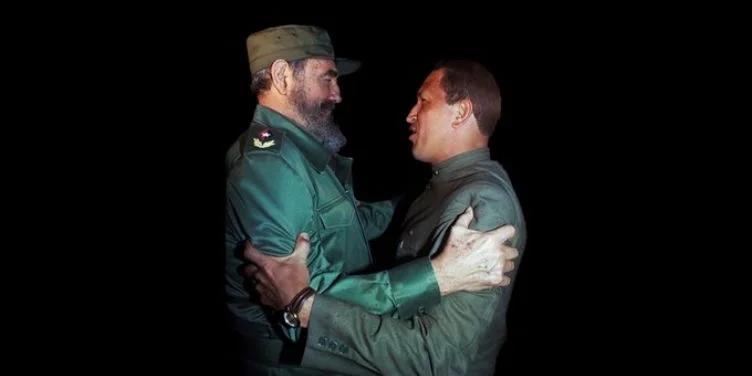
In 1999, forty years after Fidel Castro’s trip to Caracas, the conquest of Venezuela by Castroism would be consummated, with the arrival of Hugo Chávez to the presidency.
On January 23, 1959, just over two weeks after his arrival to power after the overthrow of the regime of Fulgencio BatistaFidel Castro flew to Caracas, Venezuela, on what was his first trip abroad as ruler.
In Venezuela, where exactly one year before, on January 23, 1958, the dictator Marcos Pérez Jiménez had been overthrown, the Cuban revolutionary leader was welcomed as an idol. A fascinated crowd listened to and applauded the seven-hour speech of the bearded commander, who thanked the Venezuelans for their welcome and for the weapons that Admiral Wolfgang Larrazábal, president of the civil-military junta that replaced Pérez Jiménez, had sent to the Sierra Maestra.
The agenda of Fidel Castro In Caracas, during the four days that the visit lasted, it was exhausting, especially for his escorts, who, despite the sympathy shown by the Venezuelans, believed they saw potential murderers at every step.
This tension caused a tragic accident: on January 27, on the runway of the Maiquetía airport, the propeller of the plane that would take Fidel Castro back to Cuba tore off the head of the head of the military in charge of protecting him, Commander Francisco “Paco” Cabrera.
From that trip to Venezuela, successful in terms of strengthening his international image, Fidel Castro would regret not only the loss of the head of his bodyguard, but also for not having been able to convince with his charms and entangle the Venezuelan president-elect Rómulo Betancourt in his web, whom since then he took particular trouble, to the point of getting involved in the destabilization of his government through his support for the guerrilla group Armed Forces of National Liberation (FALN).
Fidel Castro, in that very long speech in a Caracas square, regretted not having been able to give anything to Venezuelans in exchange for the help received. Who could have guessed that what would come back to them would be subversion and violence.
The Cuban soldiers who accompanied Fidel Castro on his trip, and who with their wild appearance and scruffy uniforms turned the Cuban embassy in Caracas into a replica of the guerrilla camps in the Sierra Maestra, would be seen by Venezuelans again in May 1967, but without beards and in the sound of war, when they landed in Machurucuto to try to enter and create a guerrilla focus in the mountains of Falcón, Yaracuy and Lara.
For that failed and scandalous aggression against Venezuela, which caused President Raúl Leoni to break relations with Cuba, Arnaldo Ochoa —who in 1989, already a general, was shot by his bosses—earned the appointment of deputy chief of the General Staff of the Revolutionary Armed Forces.
In 1999, forty years after Fidel Castro’s trip to Caracas, the conquest of Venezuela by Castroism would be consummated, with the arrival to the presidency—thanks to the boredom of Venezuelans with the politicking of Adecos and Copeyanos—of Hugo Chávez.
Sponsored by Fidel Castro, Hugo Chávez would make Venezuela the substitute for the Soviet Union in terms of subsidizing the Castro regime with oil and money at its most critical moment.
After the death of Chávez, which occurred in Havana in March 2013, under his successor, Nicolas Maduroformer student of the “Ñico López” Communist Party Cadre School, the plundering of Venezuela by Castroism would increase.
To ensure that Maduro misgoverned to his heart’s content, hundreds of MININT and FAR troops were roaming around Venezuela, disguised as anything else, as if at home, controlling and monitoring everything, passing on to the Chavista repressors the State Security methods learned from the KGB and the Stasi.
The Castro bosses repeatedly denied that there was a Cuban military presence in Venezuela, but on January 3, when elite North American forces captured Nicolás Maduro and his wife, Cilia Flores, 32 Cuban soldiers who were guarding them were killed.
It will be necessary to see how far the Castros can go to avoid losing Venezuelan oil, if they will continue to support what is left of the Chavista regime.