“Political prisoners need political, spiritual and economic support and accompaniment,” said the UNPACU leader.
MIAMI, United States. – Cuban opposition leader José Daniel Ferrer announced that he will be “sending financial aid to relatives of political prisoners” on the island, in a post on Facebook in which he thanked the support of “patriotic Cubans” such as former political prisoner Pedro Guerra, and called for material and spiritual solidarity with those imprisoned.
“Political prisoners need political, spiritual and economic support and accompaniment. Without real and effective solidarity, there is no cause that will triumph, no matter how just,” he wrote. Furthermore, the opposition leader, recently forced into exile in the United States, added: “Whoever wants to help a political prisoner, contact me (…) and I will put you in touch with the family member who is caring for you.”
The announcement this Tuesday, just eight days after Ferrer arrived in Miami with his family, on Monday, October 13, after accepting the forced exile imposed by the Havana regime as a condition for his release.
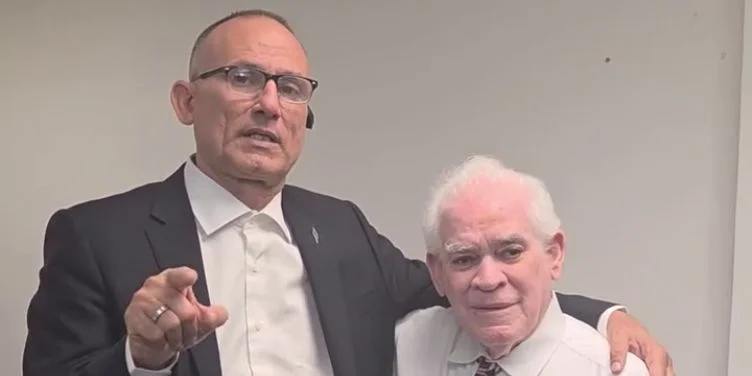
In the video that accompanies his Facebook post, the leader of the Patriotic Union of Cuba (UNAPCU) appears alongside former political prisoner Pedro Guerra, and remembers that he fought “from the early days of tyranny for freedom, for democracy for Cuba.”
“I am very pleased to be able to greet brothers like Pedro who began, began from an early date, the path of the fight for freedom. They began it, others continued it, we continue along that path and I believe that we are increasingly closer to the final goal, the goal that we all want to reach, the freedom of Cuba and the end of the disgraceful tyranny that has caused so much damage to our homeland,” he stated.
At the beginning of the month, members of the State Department traveled to Cuba to coordinate Ferrer’s departure and refused to return without him, according to statements by Cuban-American congressman Carlos Gimémez, who also assured that there were no concessions to the Cuban dictatorship and highlighted the role of the United States Secretary of State, Marco Rubio, in the management that made Ferrer’s departure from Cuba possible.
“We do not accept a can of soda that the American government will give for the release of José Daniel. We made that clear and we spoke about it with the Embassy [de EE.UU. en La Habana]”said Luis Enrique Ferrer, brother of the UNPACU leader, shortly before Ferrer’s arrival in Miami.
He himself described the acceptance of exile as the “hardest” decision of his brother’s life and stated that Ferrer arrived “with a broken soul.” In statements to CubaNetreported that family and friends would prioritize providing him with medical attention to recover from the beatings and torture received in prison. “If communism commits atrocities in the streets, imagine what happens in prisons,” he said.
At the beginning of this month, when Ferrer’s decision to accept exile became known, Díaz-Balart expressed that, after years of imprisonment, beatings and torture for demanding freedom, the opponent deserved “a welcome worthy of a hero.” In mid-September, in a letter written in prison, Ferrer explained that he accepted exile to protect his wife and children and denounced the “humiliating” conditions and cruel treatment suffered during his imprisonment.
The Cuban American National Foundation (CANF) noted that Ferrer’s arrival in the United States marked a new chapter in the fight for Cuban freedom and represented a moral victory for the Cuban democratic movement.
The Ministry of Foreign Affairs of Cuba officially reported about Ferrer’s departure from the national territory, but omitted any reference to arbitrariness, torture and political repression during his detention. Not only did he present his exile as a legal procedure in accordance with due process, but he insinuated that the opponent had been exchanged for a Cuban criminal wanted by Havana, an assumption that It was immediately denied by the United States.