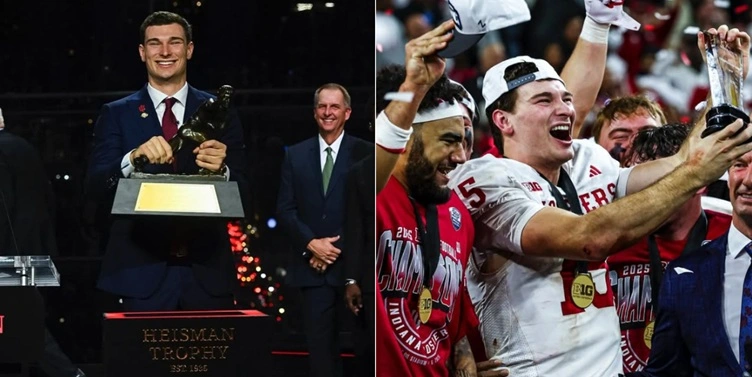
The Indiana University quarterback made history by winning the Heisman Trophy and becoming the first Cuban-American to receive the highest award in college football in the United States.
MADRID, Spain.- Fernando Mendoza has established himself as one of the most relevant figures in university sports in the United States. He recently won the Heisman Trophythe highest individual recognition in college football, awarded to the best player of the season. The Indiana University quarterback not only made history for his sports program, but also marked a milestone by becoming the first Cuban-American player to receive this award.
Mendoza, born in Miami and of Cuban descent, was the leader of a historic season for the Indiana Hoosiers. Under his direction, the team finished with an undefeated record of 13-0, won the conference championship Big Ten and reached a prominent position in the College Football Playoff, unprecedented achievements for the institution. Their performance was key both in the collective results and in their individual projection.
During the season, the quarterback recorded 2,980 yards passing, threw 33 touchdowns and added scores on the ground, numbers that placed him among the most productive and efficient players in college football. Analysts and voters highlighted his leadership capacity, his reading of the game and his consistency in decisive matches.
In the Heisman Trophy voting, Mendoza obtained 2,362 points, including 643 first-place votes, beating other finalists such as Diego Pavia, Vanderbilt quarterback; Notre Dame running back Jeremiyah Love; and Julian Sayin, Ohio State quarterback. The difference reflected a broad consensus on their superiority during the season.
After receiving the Heisman Trophy, Mendoza gave an emotional speech during the ceremony held at Lincoln Center in New York, in which he wanted to highlight the collective nature of the achievement. He expressly thanked his teammates and the coaching staff, and highlighted the group’s determining role in a historic season for Indiana. In his words, he remembered the offensive line, the receivers, running backs and the defense, before stating: “this trophy may have my name on it, but it belongs to all of you, it belongs for the first time to Bloomington (home of Indiana University).”
Mendoza also dedicated a special message to the fans and those closest to him. “Playing in front of the Hoosier Nation is one of the greatest privileges of my life and I will always carry it with me,” he said to the audience. One of the most personal moments came when referring to his mother, to whom he dedicated the award: “Mom, this is your trophy, you have always been my biggest fan, you are my light, you are my reason, my greatest support, your sacrifice is bravery.”
The player extended this gratitude to his family, recognizing the effort and support received throughout his sporting and personal career. “For the love and sacrifice of my parents and grandparents, I love them very much, with all my heart,” he concluded.
In addition to the Heisman, Mendoza was recognized with other prestigious individual awards, including the AP Player of the Year, the Maxwell Award and the Davey O’Brien Award, consolidating a campaign considered one of the most outstanding of the 2024-2025 academic year in college football.
The impact of his victory transcended the sports field and generated reactions in the political field. Florida Governor Ron DeSantis congratulated the player from his X account by saying: “Congratulations to Fernando Mendoza, a former student of Christopher Columbus High School in Miami, for winning the Heisman Trophy.”
Also Congressman Carlos Giménez highlighted the achievement on the same social network, where wrote: “Congratulations to my Christopher Columbus High School classmate, Fernando Mendoza, for becoming the first Cuban-American to win the Heisman Trophy.”
For Indiana University, Mendoza’s victory represents a turning point in the program’s history. For the Cuban-American community, its recognition is a symbol of visibility and representation in a sport where the Latin presence has traditionally been limited.
With his name already inscribed in the history of college American football, Fernando Mendoza closes an exceptional season and is projected as a key figure in the immediate future of the sport in the United States.