Committees that bring together relatives of political prisoners indicated that the amnesty should be an “opportunity” to recognize the effects of repression in the country, and guarantee justice and reparation to the thousands of detainees for political reasons.
The Committee for the Freedom of Political Prisoners and the Committee of Mothers in Defense of the Truth indicated this Saturday that an amnesty law, announced by Delcy Rodríguez, should not undermine the right to justice, reparation and guarantees of non-repetition that victims of human rights violations expect.
“The approval and application of an amnesty does not undermine the right of victims of serious human rights violations to comprehensive reparation, which includes restitution, compensation, rehabilitation and guarantees of non-repetition,” highlighted the mothers’ committee in a statement.
The organization asked to accelerate the releases under precautionary measures while the amnesty is finalized. Specifically, they requested the release of the 37 people who are still in the Tocorón prison, one in the Tocuyito prison, three in the GNB Desur 13 Command in Punto Fijo and one in the PNB Command in Caraballeda.
The organization pointed out that this announcement is “the result of the dignified and brave struggle of all family members,” especially women, while urging the Venezuelan parliament to guarantee “broad and plural participation” of all sectors of civil society in the discussion, implementation and verification of this law.
For his part, Diego Casanova, a member of the Committee for the Freedom of Political Prisoners, believes that the proposed law can be an opportunity to recognize “all the damage that has been done,” as well as the mistreatment that the authorities have committed against the victims.
He indicated that they handle the process “with great caution, because what we have seen so far is that there has not been a correspondence between what is said and what is done.”
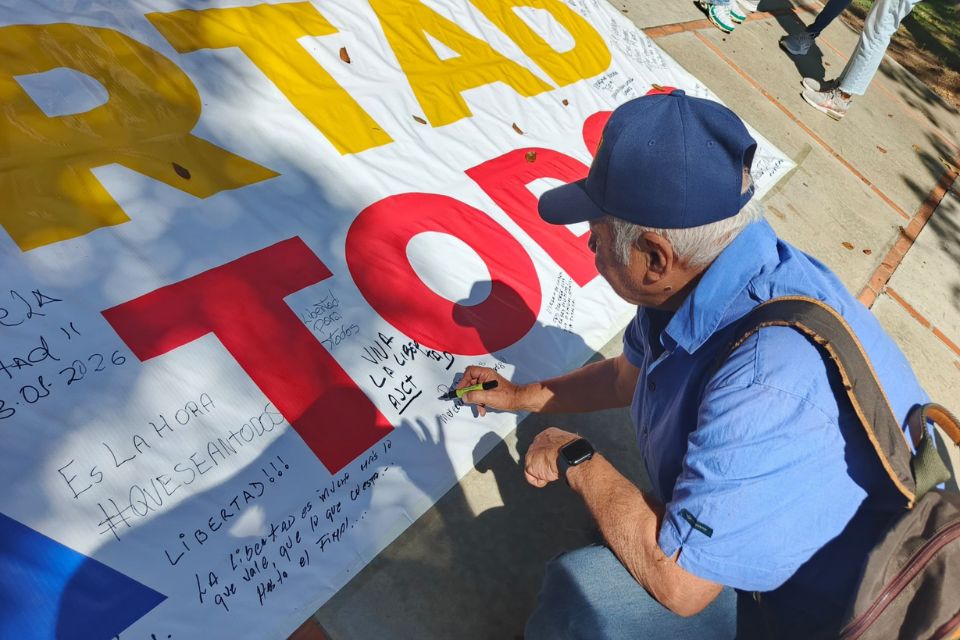
During an activity to collect supplies for relatives of political prisoners at the Central University of Venezuela (UCV), the activist pointed out that the release process “has not materialized” due to its slowness and the constant re-victimization to which they are subjected.
“It has meant that families have high levels of anxiety, they are exposed to uncertainty, fear” due to harassment by police officials, Casanova denounced.
According to the committee, at least 1,200 people are detained for political reasons in the country, some of them forcibly disappeared.
#NowVPItv | Diego Casanova, member of Clippve: “We want to be optimistic, the situation of political prisoners must be resolved (…) we have a list of more than a thousand people arbitrarily detained for crimes they did not commit.”
Connect: https://t.co/XZnDd0rj9k pic.twitter.com/E7zJVDv4VM
— VPITV (@VPITV) January 31, 2026
*Journalism in Venezuela is carried out in a hostile environment for the press with dozens of legal instruments in place to punish the word, especially the laws “against hate”, “against fascism” and “against the blockade.” This content was written taking into consideration the threats and limits that, consequently, have been imposed on the dissemination of information from within the country.
Post Views: 42