
Family and friends gave the last goodbye to the filmmaker and academic Cacá Diegues, at a funeral on Saturday afternoon (15), at the Brazilian Academy of Letters, in downtown Rio de Janeiro.

Cacá Diegues he died This Friday (14) at the age of 84, in the capital of Rio de Janeiro, due to complications caused by surgery. He will be cremated in the cashew cemetery.

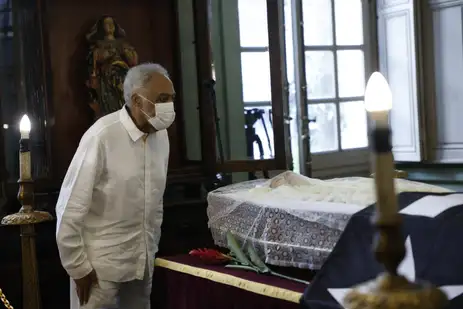
Rio de Janeiro (RJ) 15/02/2025 – Gilberto Gil at the funeral of filmmaker Cacá Diegues, at the Brazilian Academy of Letters. Photo: Fernando Frazão/Agência Brasil
Related News:
- Filmmaker Cacá Diegues dies at 84 in Rio.
- “We invented the image of Brazilian cinema,” Diegues told TV Brasil.
The singer, composer and immortal of ABL Gilberto Gil appeared to the wake and said that Cacá’s work was built with great talent, commitment, interpretation and permanent reinterpretation of the meaning of the country.
“A sweet, quiet man, it also weighs in times today, this is an extraordinary value. He is a person who misses him a lot. I did a lot of jobs with him. I was now ending his last movie, just made the soundtrack God is Brazilian number 2. He couldn’t end and I hope someone will end. The song was ready. We had a lot of collaborations, ”said Gil.
Cacá’s filmmaker and daughter, Isabel Diegues, said that the father is a figure who since the beginning of his life, son of a sociologist researcher of Brazilian folklore, Alagoas, is a lover of Brazil.
“He made his life a great immersion in this universe and at the same time both discoveries for himself and to unravel in the sense of shedding light on aspects of Brazilian culture that we so often, as a society, did not want to see,” said Isabel .

Rio de Janeiro (RJ) 15/02/2025 – Isabel Diegues at the Father’s Felorium, filmmaker Cacá Diegues. Photo: Fernando Frazão/Agência Brasil
She added the importance of Cacá for Brazilian culture is immense.
“He stuck to promote, think, invent a culture for Brazil, an original, mixed culture of joy. He said ‘no use democracy without opportunity’. In addition to a great artist, he is a great thinker of Brazil, of Brazilian culture. He filmed, wrote and edited until the last day of his life. We have a movie of him to release, ”he said.
Cacá Diegues leaves wife, had three children (the youngest Flora Diegues died in 2019) and four grandchildren.
For filmmaker and screenwriter Carla Camurati, Cacá was one of the great filmmakers in the country, not only with everything he filmed, but he was also an extraordinary and companion person.
“He leaves a legacy of a very interesting, deep and magical view of Brazil. Cacá’s gaze on Brazil was a look that could see the mixture, the joy, the madness. He leaves us a very beautiful mirror of what the Brazilian people is, ”said the filmmaker.

Rio de Janeiro (RJ) 15/02/2025 – Actress Claudia Abreu at the funeral of filmmaker Cacá Diegues. Photo: Fernando Frazão/Agência Brasil
Actress Claudia Abreu made her first film with the filmmaker in Tieta. “He is one of the most important people in the sense that he was a key person for cinema. A thinker from Brazil, a lover of Brazil, always tuned to cultural movements. A lighthouse and a supporter of new generations and new talents. ”

Rio de Janeiro (RJ) 15/02/2025 – Actress Mariana Ximenes at the funeral of filmmaker Cacá Diegues. Photo: Fernando Frazão/Agência Brasil
Actress Mariana Ximenes was also paying her honor. She worked with Cacá in the movie The Great Mystic Circus. “He was an Alagoas who loved life and reproduced this love in his cinema. He was in love with Brazil and people. He is a poet of the images. ”
Biography
One of the forerunners of the Cinema Novo artistic movement, Carlos Diegues was born on May 19, 1940, in Maceió, and moved to Rio de Janeiro, with his family, at the age of six.
He started at the cinema while still in the student directory of the Pontifical Catholic University of Rio (PUC-Rio), where he founded a cineclub and started making amateur cinematic productions, along with colleagues such as Arnaldo Jabor.
Cineclub was one of the founding nuclei of Cinema Novo, a movement inspired by Italian neorealism and Nouvelle French vague, and marked by political and social criticism, especially during the military dictatorship.
Among their productions within the movement, they stand out Zumba Ganga (1964), The Great City (1966) and The heirs (1969).
In 1969, he left Brazil and went to live in Europe for participating in the intellectual and political resistance to the dictatorship. Upon returning, in the 70’s, directed When Carnival arrives (1972), French Joanna (1973), XICA DA SILVA (1976), Summer rains (1978) and BYE BYE, Brazil (1980).
In the period of resumption of Brazilian cinema, it launched Tieta do Agreste (1996), Orpheus (1999) and God is Brazilian (2002). THE Great mystical circus (2018) was his last release as director.
Throughout his career, he won awards in numerous national and international festivals. In 2018, he was elected to the Brazilian Academy of Letters in the vacancy of Nelson Pereira dos Santos.













