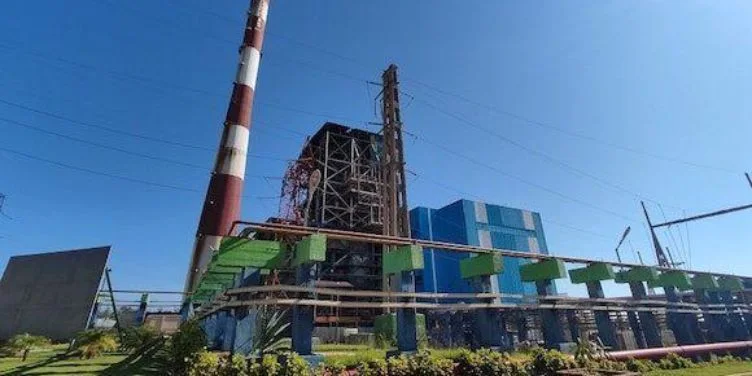
The Cuban electrical system is marked by the age of its thermal plants, the shortage of fuel, the lack of spare parts and prolonged maintenance.
MIAMI.- The Antonio Guiteras Thermoelectric Power Plantlocated in Matanzas and considered the one with the greatest generation capacity in Cuba, left the National Electric System (SEN) unexpectedly this Friday, after a new power reduction that forced its disconnection to carry out “unpostponable work,” according to the Electrical Union (UNE).
The entity initially announced the departure through a brief message on Facebook, which generated discomfort among users due to the lack of details. Subsequently, the UNE specified that the plant had reduced its power to 120 MW and that the technical stoppage would last approximately four days, with plans to synchronize again next Tuesday.
The disconnection occurs at a time of maximum tension for the SEN. According to the official report of November 7, the availability of generation was only 1,529 MW compared to a demand of 2,107 MW, which implied a deficit of 589 MW in the morning alone. During the night peak hours, the estimated impact reached 1,335 MW of deficit. Independent experts have pointed out that the island faces a structural generation deficit, which at times has exceeded 1,100 MW.
The Cuban electrical system is marked by the age of its thermal plants, the shortage of fuel, the lack of spare parts and prolonged maintenance. In the case of Guiteras, serious breakdowns have been reported in its boiler, airtight problems and water leaks that have forced recurrent shutdowns, which reflects the fragility of the plant and, therefore, of the SEN itself.
Likewise, the country has suffered multiple massive blackouts: the departure of Guiteras in September caused one of them, which was described as the fifth collapse of the SEN in less than a year. The regime admitted that the cuts create a burden on the economy, in which activity fell 1.1% in 2024, and that the electricity system crisis is a key factor in the contraction.
The incident aggravates not only the provision of electricity but also other critical services, such as water supply, cooking in homes and the functioning of institutions. In several locations, it has become common to cook with charcoal or firewood due to the recurrence of prolonged blackouts.
Plant maintenance is posed as a major challenge in a system already on the brink of collapse, whose recovery depends on urgent solutions for generation, park modernization and fuel security.