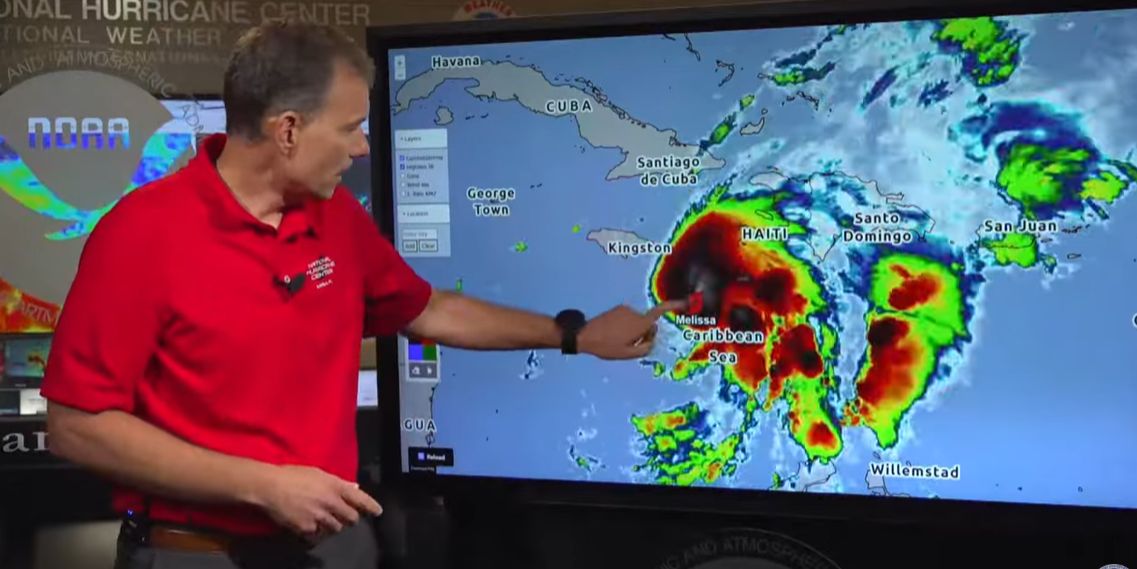
The NHC highlighted accumulated 20 to 30 inches of rain, so much rain that “you could almost measure it in feet instead of inches.”
LIMA, Peru – The National Hurricane Center (NHC) in the United States updated this noon on the evolution of Tropical Storm Melissa, a system that aims to affect the extreme central-eastern part of Cuba during the next few days.
Jamie Rhome, assistant director of the Center, reported that Melissa has been much better organized this morning.
“This is a tropical storm, almost a hurricane, about to become a hurricane, we believe it will become a hurricane later today, so for all intensive reasons, believe it to be a hurricane,” the expert warned.
According to the web portal According to the NHC, the maximum wind speed is currently 121 km per hour (km/h) and the pressure is very low, 982 hectopascal. Likewise, it is still crossing towards the west and northwest at 1.6 km/h.
Rhome explained that slow mobility “unfortunately” will continue for another three or four days, and predicted that the hurricane would be reaching Cuba next Wednesday.
“But really the biggest thing to talk about here is the extremely heavy rains and catastrophic flooding that will come with the storm because it is moving so slowly. This slow movement is going to really cause a problem,” the expert warned prior to Melissa’s passage through Jamaica.
The NHC highlighted 20 to 30 inches of rain accumulation, so much rain that you could almost measure it in feet instead of inches.
“So that type of rain is going to cause catastrophic flooding somewhere over the island of Jamaica and potentially Haiti. Eventually, spreading across southeastern Cuba at some point later in the forecast,” Rhome stresses.
In this regard, the Institute of Meteorology (INSMET) in Cuba issued its ninth tropical cyclone warning. For its part, the Cuban Civil Defense indicated that, together with INSMET and the Institute of Hydraulic Resources, it maintains surveillance over this cyclonic organization, while it governs the Information Phase in the six eastern provinces.
.