Chanting the motto “the death of the forest is the end of our life”, hundreds of extractive leaders, from different Brazilian biomes, marched through the streets of Belémon the afternoon of this Thursday (13), in defense of territorial rights and the role of sustainable use reserves in ecological balance and in the provision of environmental services essential to combating ongoing climate change on the planet.

The event, called Porongaço dos Povos da Floresta, brought together mainly rubber tappers, chestnut growers, riverside dwellers, artisanal fishermen, coconut breakers and other traditional peoples and communities.
The walk lit up the streets of the capital of Pará in the late afternoon due to the flames lit by the porongas, lamps traditionally used by rubber tappers to travel trails in the forest. and which became a symbol of the historic struggle of the National Council of Extractive Populations (CNS), founded in 1985.
Under the leadership of Chico Mendes, in the rubber plantations of Acre, still in the 1970s, the movement gave voice and political articulation to forest extractivists in the face of violence, land grabbing and environmental destruction.
The route was organized as a parallel activity to the negotiations of the 30th United Nations Conference on Climate Change (COP30), which will also take place in Belém throughout this week and next.
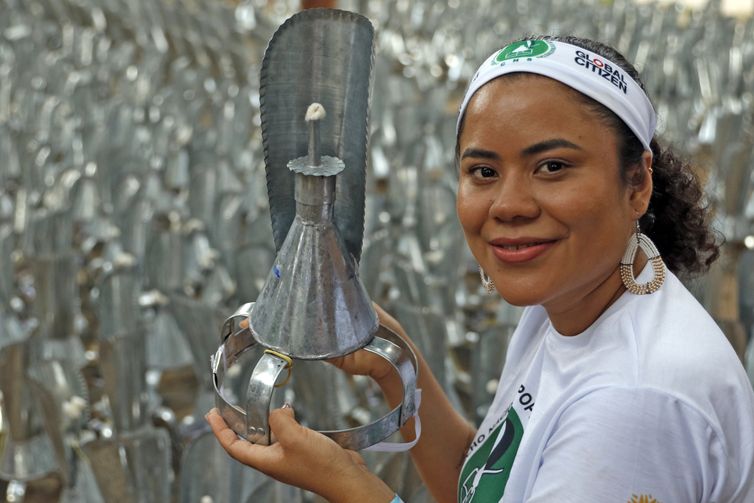
Letícia de Moraes, vice-president of the CNS, participates in the “Porangaço dos Povos da Floresta” march, a parallel event to COP30. Photo: Bruno Peres/Agência Brasil
“We, extractivist populations, understand the territory as an extension of our bodies. So, if the forest is not well, if the rivers are not well, if the tidal wave [área costeira] It’s not okay, we’re not okay”, said Letícia Moraes, vice-president of the CNS.
“It has already been scientifically proven that the only territories that have living forests are territories that are under the responsibility and care of traditional communities. So, our relationship of care is a relationship because we were born in that place. We don’t feel like we own it, we feel part of that place”, added the extractivist born on Marajó Island, where she lives from sustainable agroforestry activities in a different settlement project, known as PAE, Agroextractivist Settlement Project.
According to data from the CNS, reserves and agro-extractive settlement projects protect more than 42 million hectares of forests and rivers through sustainable forest use, which represent 5% of the national territory. It is estimated that these areas store approximately 25.5 billion tons of CO2 equivalent, which corresponds to around 11 years of Brazil’s total emissions. CO2 is the main gas causing global warming, driven by the burning of fossil fuels such as coal and oil.

Extractive leaders and supporters wearing porangas on their heads participate in the “Porangaço dos Povos da Floresta” march, an event parallel to COP30. Photo: Bruno Peres/Agência Brasil
At COP30, Brazilian extractive communities are being represented by a special envoy. Extractive leader Joaquim Belo has been involved in negotiation processes to try to ensure that the ecosystem services provided by these populations are included as climate change mitigation targets.
“We are the solution to several climate change problems, because we take care of the forest and it plays a role in climate balance,” he stated.
At the end of the march, which started at Praça Eneida de Moraes and ended at Aldeia Cabana, in the Pedreira neighborhood, a CNS document was handed over to the Minister of Environment and Climate Change, Marina Silva.
In the letter, the CNS lists a series of demands. One of the focuses is precisely to demand that extractive reserves, sustainable development reserves and other traditional territories be formally recognized in the Brazilian Nationally Determined Contribution (NDC) and in national and international climate treaties, for their effective contribution to reducing deforestation, maintaining native vegetation and conserving carbon stocks.
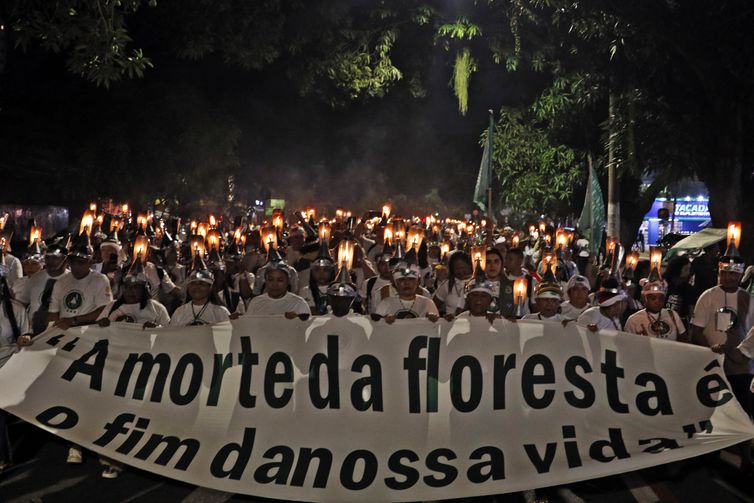
“Porangaço dos Povos da Floresta” march, parallel event to COP30. Photo: Bruno Peres/Agência Brasil
“We demand that these territories be prioritized in adaptation and mitigation policies, with consistent and permanent investments, with public and private resources aimed at territorial protection, support for community management, strengthening territorial surveillance and expanding incentives for sustainable forest use practices”, says an excerpt from the document.
In her speech to extractivists, Marina Silva recalled her career as a rubber tapper in Acre, alongside Chico Mendes, and highlighted the role of these communities as guardians of the forest.
“You have a life that helps solve the problem of climate change. There are people who, to face the problems we are experiencing, have to have technology to be able to do this”, he stated.
“The technology of the indigenous people, the rubber tappers, the riverside dwellers, the babaçueiros, the geraizeiros, the coconut breakers is their own way of life that protects the forest, biodiversity, that sequesters carbon and also functions as the heart of the planet beating with culture, diversity and beauty. But, there is one thing, public policies need to be increasingly expanded”, observed the minister.