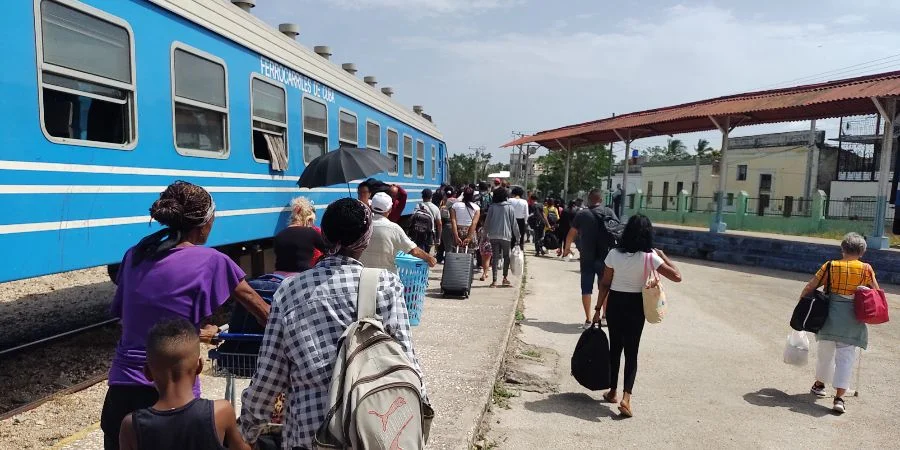
The delays of several hours of passenger trains, although common in Cuba, remain a traumatizing experience for those who use that means of transport.
Holguin, Cuba. -“The Havana-Holguín train has more than seven hours of backward.
The wait for the delay of several hours of the passenger train, although it is normal, remains traumatizing for the Cubans. The country’s rail system, especially on long distances routes, systematically breaches the scheduled schedules.
The experience of traveling by train is a resistance test. What should be a comfortable journey becomes endless travel hours that consume resources, patience and affect health. “The day my daughter traveled the train, she took 24 hours to arrive in Havana. He left Holguín at 3:00 in the afternoon and arrived in Havana 24 hours later. He spent five hours broken in Camagüey,” he says to Cubanet Another holguinero, Miguel Ángel Batista.

The discomfort of the passengers add to the lack of information about the horra of arrival of the trains. This dysfunctionality is “normalized” to the point that even the staff of the railway company presents it as part of the operational routine. “I asked in [la taquilla de] Information and the companion replied that today’s delay of six hours has not been compared to other days when the train has delayed more than 24 hours, ”says, resigned, Charity Velázquez, another holguinera who expects his relatives at the station,
Already in 2019, this problem was officially recognized. Adairis Quevedo Hernández, then head of the National Train Agency in Holguín, admitted the normality of delays“The train has never arrived on time. The delay is for different causes, either due to the problems of the locomotive or by precautions on the road.”
When the trip extends indefinitely, the problems multiply inside the train. The deficit of a basic offer creates a vacuum that covers the informal market. Alexei Pérez, who has traveled by train several times, describes how passengers are at the mercy of the resellers.
“When the train takes more than planned, the gastronomic offer is over and the passengers have to buy what we can, whatever appears, and the one that cannot go hungry and thirst. You cannot do more na ‘.”
The health consequences for food deterioration is latent. This September 18, the Extra number 18 train that covered the Manzanillo-La Habana route was arrested emergency in the town of Jicotea, Villa Clara, due to an acute diarrheal outbreak that caused the hospitalization of 29 people, including five children, according to reported In his Facebook profile the official journalist Henry Omar Pérez
On the possible causes of the episode, the Cuban News Agency (ACN) cited the director of the Provincial Center for Hygiene and Epidemiology of Villa Clara, who revealed that all symptomatic passengers had consumed snacks with sausages and pointed to food poisoning.
Food scarcity adds to breakdowns within the cars themselves. Juan Carlos Méndez tells one of the most painful episodes he has lived during a train trip: “The air conditioning of the car broke and we suffered very hot because the window could not be opened. The technic He served in its entirety and there was also no refund of a part of the passage for the discomfort caused, ”he complains.
Although the bad condition for years of the tracks is a known factor, the passengers perceive failures that begin before the train is launched.
Yoharsis Espinosa insists that operational plans should take into account infrastructure limitations. “When Ferrocarriles de Cuba program that the arrival in Holguin is at 2:00 in the afternoon they must take into account the decrease in train speed in the sections with defects.”
The prudence of the locomotive machinists is justified. A experienced rail worker who preferred to identify as Pepe confirms that fear of an accident is a determining factor in the slowness of the service.
Official figures confirm this critical panorama. Lisvany Fernández Rivero, general director of the administration of rail transport, presented the magnitude of a maintenance crisis that would require an impossible investment in current conditions.

“67% of the railways require some type of maintenance. On the other hand, 40% of the infrastructure works need maintenance. To guarantee the sustainability of the infrastructure mentioned above, 900 million pesos are required annually, of which 25 million are in freely convertible currency for the purchase of materials, supplies and parts. For the maintenance of the railway, between 60,000 and 80,000 concrete annually. The official said.
To the fragility of the tracks is added that of the rolling material. Luis Roberto Rosés Hernández, general director of the Cuba Railway Union, details a critical deficit of locomotives and other essential resources.
Another difficulty is the shortage of fuels and lubricants, as well as technological obsolescence and the aging of the rolling material, the machines, the specialized tools and equipment.
This deterioration not only causes delays, but increases the risk of accidents. The perception of danger among the holguineros is based on a specific history of incidents.
Official media reports confirm a series of serious incidents only this year, attributed directly to the poor condition of infrastructure. Train derailments in Cuba in 2025 have been mainly due to the poor state of the railways and the technical failures of the equipment.
Despite delays, bad technical and comfort conditions and dangers, the train remains the only option for a large majority of Cubans. The reason is economical. “To travel the train option is the cheapest, by bus it is more expensive and by plane the sale of tickets is unstable. I frequently go to Havana for reasons of medical treatment and with my salary I can not pay the 5,000 or 6,000 pesos of the passage of the bus expensive, but I have no choice but. ”
The expectations generated in 2019 with the arrival of the new Chinese rail cars to the island faded rapidly, as A passenger anticipated after that inaugural trip: “After so many years of waiting, we start badly with the arrival of the train to Holguín. If this is the beginning, I do not want to know what it will be from now on.”