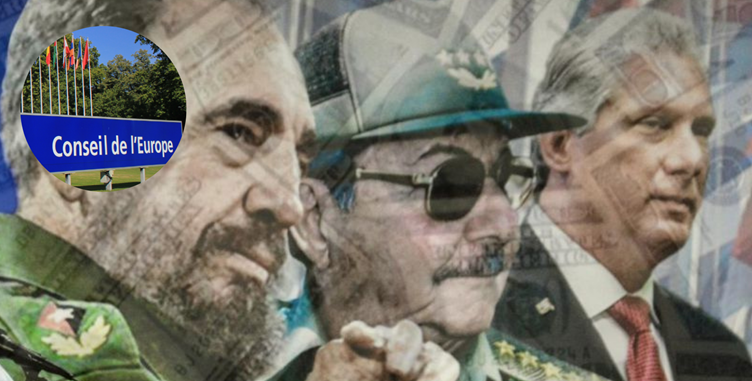
The initiative, supported by 22 signatories, seeks to toughen Europe’s stance towards Havana due to its historical links with terrorist organizations and its alliance with regimes considered a global threat.
MADRID, Spain.- A group of 22 European parliamentarians is promoting an initiative for the Council of Europe to designate the Cuban regime as a State Sponsor of Terrorism. The proposal, formalized in the Declaration Written No. 825 of October 8, 2025, highlights Havana’s “persistent support” for terrorist organizations and individuals and their links with regimes and groups that threaten international security.
The parliamentary initiative cites the Parliamentary Assembly of the Council of Europe and its Resolution 2221 (2018), which condemns state sponsors of terrorism as “a serious threat to global stability.” The text points out that the Cuban regime has maintained for decades a history of collaboration with armed groups and terrorist organizations both in Latin America and Europe, including ETA in Spain and the IRA in Ireland. In addition, he emphasizes that the island has served as a “safe haven” for individuals fugitives from violent activities.

The European Declaration refers to the regime’s close relationship with other countries also designated as sponsors of terrorism, such as Iran and North Korea, and warns that these links “facilitate malign activities” that undermine Europe’s security interests.
“The Cuban regime’s persistent support for terrorist organizations and individuals necessitates its designation as a State sponsor of terrorism, reflecting its destabilizing impact in Latin America and beyond,” the Declaration states.
A call to suspend relations and apply sanctions
The declaration urges member states to “pause the normalization” of their relations with the Havana regime as long as it does not cease its support for terrorists, extradite fugitives and cut its ties with violent groups. It also proposes the imposition of specific sanctions on the officials involved and greater support for Cuban civil society in its efforts to promote democratic reforms.
The document also recalls the “structural integration” of the Cuban regime with the Russian Federation, including its participation in the aggression against Ukraine by sending mercenaries, which – the parliamentarians affirm – constitutes “clear evidence of its contempt for international law.”
The Declaration also links the Cuban Government to the consolidation of the authoritarian regime in Venezuela, creating a “permissive environment” for the actions of organizations such as the ELN. This dynamic has contributed to humanitarian crises and migratory flows that directly affect several European Member States.
“We call on the Assembly to classify Cuba as a State sponsor of terrorism (…); to impose specific sanctions on complicit officials; and to support Cuban civil society that advocates for democratic reforms,” the document concludes.
Coordination with the Cuban opposition
As the Assembly of the Cuban Resistance (ARC) points out, a large group of European parliamentarians has worked in coordination with the opposition organization to document before the Council of Europe the history of the communist regime in terms of subversion and support for violent groups.
The secretary general of the ARC, Orlando Gutiérrez Boronat, described this recent initiative as “a forceful step on the path to ending immoral European financing of the Castro dictatorship.”
For her part, the opposition leader and promoter of Cuba Decide, Rosa María Payá, publicly celebrated the initiative through her account on X.
“22 Parliamentarians are pushing for the Council of Europe to designate the Cuban regime as State Sponsor of Terrorism. Thank you for leading this effort to treat the Cuban dictatorship as what it is: a terrorist organization,” he wrote.
In your publicationPayá directly thanked the promoters of the Declaration, including Markus Wiechel, Pablo Hispán, Belén Hoyo, Oleksii Goncharenko, Emanuelis Zingeris, Jan Kanthak and Gustaf Göthberg, as well as the 22 signatories. The complete list of signatories It is available on the official site of the Parliamentary Assembly of the Council of Europe.
Declaration No. 825 represents a new front of international pressure on the Cuban regime, which currently maintains agreements and dialogues with several European countries under the Political Dialogue and Cooperation Agreement between the European Union and Cuba. If the proposal succeeds, it could imply a drastic change in Europe’s diplomatic and financial relationship with Havana.