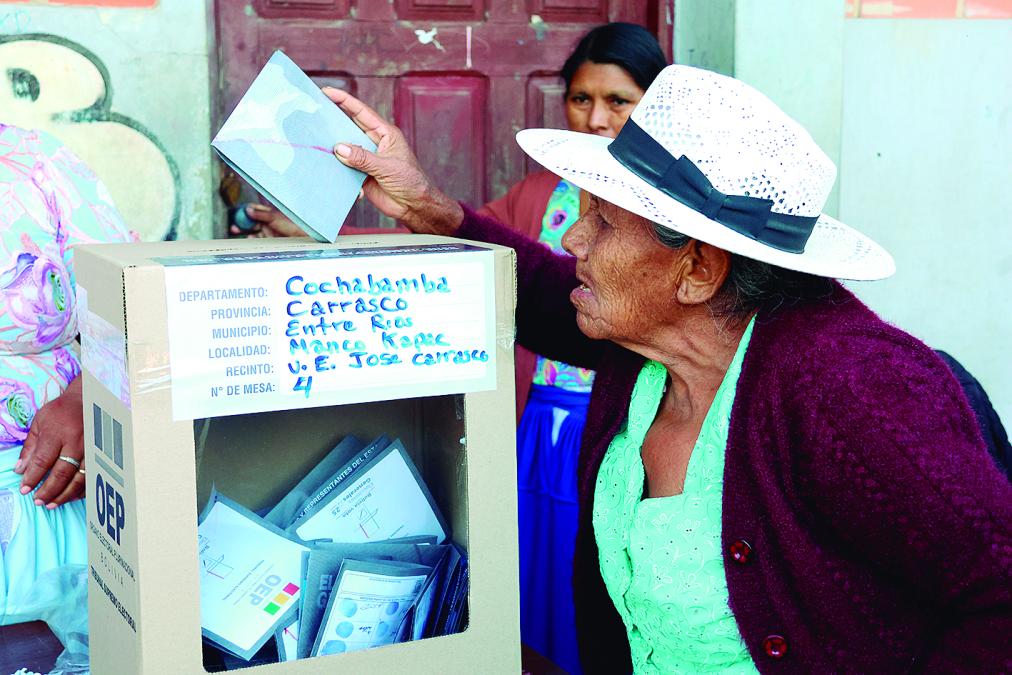
Bolivia beats many identities and, in this unpublished ballot, ethnicity is again a decisive factor. Beyond the candidates, what is at stake are country visions crossed by certain rivalries that democracy must transform into dialogue and unity, instead of division and confrontation.
According to the last 2024 census, at least 38.7 % of the 11.3 million Bolivians self -identified with one of the 36 indigenous nations recognized in the country. This demographic weight does not go unnoticed in the campaigns: both candidates seek to seduce that electorate, aware that identity continues to be a factor that defines adhesions, marks speeches and can tip the balance in the second electoral round.
The important thing is that the polls are a place where these historical divisions and fractures are settled and that the parties that go to the ballot see these differences as an opportunity to create something in common and that it is not to deepen the division, says the sociologist and professor of the Universidad Mayor de San Simón, Gabriela Canedo.
The sociologist adds that the three main political forces in the Legislative Assembly are opponent of the Socialism Movement (MAS) and the ideal is that dialogue paths are opened to achieve consensus among all and seek “strengths in diversity.”
Identity in politics
Canedo explains that the division between “indigenous and k’aras or white” “has done a lot of damage” and that has caused a polarization around indigenous identity, which has also been partially “instrumentalized” in a political way by the movement to socialism (more) in previous years.
This polarization shows, for example, in publications and comments on social networks in which certain ethnic features and the indigenous association with the official party in tone of insult predominate. A situation that can open wounds between Bolivians and delve deeper into the division than to bring dialogue and unity.
Now that the Free Alliance of Jorge ‘Tuto’ Quiroga and Juan Pablo Velasco, and the Christian Democratic Party (PDC) of Rodrigo Paz and Edman Lara continue in the electoral contest must take into account the “political empowerment” of the indigenous people for this next vote, says Canedo.
Changes in the indigenous vote
For his part, the sociologist and expert in racism and ethnicity issues, Rafael Loayza, argues that there is a “positive correlation between ethnic identity and the vote towards currents of the popular movement” and that according to a tabulation between the intention of the vote and the ethnic self -identification of the voters in the first electoral round, at least 88% of people who voted for PDC. 80% of free voters were ascribed as “non -indigenous.”
Loayza adds that electoral behavior has changed in these elections. Before the indigenous vote was “proactive”, that is, a candidate was supported by who was really believed. In these elections, on the other hand, the “reactive” vote predominates, aimed at blocking the “K’aras and those of the right.”
The Lara Factor
In the first election round, the PDC reached 32.06% of the valid votes, the Free Alliance obtained 26.07%, while the MAS, which ruled the country for two decades, obtained 3.17% of the vote, the lowest percentage in 20 years. An important fact in these elections was the null vote promoted by former President Evo Morales, who reached 19.78%. Cochabamba was one of the departments where he obtained most of the null votes, places where he used to earn the most and has an indigenous and popular demographic characteristic.
This voting percentage in this second electoral round can be captured by the candidates. A study by Ciudatos Lab shows the face of face -to -face campaign, not counting the digital space, which each candidate used in the first round. The free campaign was marked by posters and flags. On the other hand, PDC was the one who made the least campaign through those media. In Cochabamba, for example, Tuto Quiroga focused on capturing more vows from neighborhoods in the northern zone, where the middle class lives, and visiting some markets, while Rodrigo Paz and Edman Lara went to more popular places and neighborhoods.
Canedo points out that this indigenous vote finds a “strong self -identification” with Lara, the candidate for vice president for PDC for the “ant work” that he made to visit different populations, provinces of the country, for his speech against corruption and for the proximity to popular class people.
In addition, it states that support for Lara has to do with that people can be reflected in it and this indigenous self -identification and popular class weighs more than government proposals themselves when people have to choose who to vote for.
Identity as a democratic challenge
This ballot will test if Bolivian policy can overcome the logic of “indigenous versus k’aras” that marked previous stages, to open a space in which diversity is recognized as a shared democratic value. The challenge is that the polls become a space where differences can be overcome and that it is the beginning to weave agreements in the midst of plurality.
The true strength of the country lies in recognizing and respecting its diversity, transforming identities into bridges that allow working together towards an inclusive future. Converting cultural plurality into a democratic motor should not be an exclusive task of electoral times: it is a path that demands constant dialogue, mutual respect and willingness to encounter.
The ballot will not only decide who will rule Bolivia, will also put into play if society is willing to transcend the walls of ethnic confrontation to embrace the possibility of a broader democracy, where all voices count and no identity is relegated.
To analyze
According to the 2024 census. At least 38.7 % of the 11.3 million Bolivians are self -identified with one of the 36 indigenous nations.
Voting trend. 88% of people who voted for PDC were self -identified ethnically.
To be defined. This ballot will test if Bolivian politics can overcome the logic of “indigenous versus k’aras.”