“If at the federal level the organization of the judicial election must have made improvisation due to lack of resources and compatibility between the way in which the Judicial Power and the organization of the electoral system are structured, in the entities the reforms were still worse and we will have improvious elections,” considers Javier Martín Reyes, of the Institute of Legal Research of the UNAM.
The vast majority of states what he did was to trace, copy and paste the federal reform and now the result is that we will have federal and local elections with multiple improvisations ”
Javier Martín Reyes, investigator at UNAM.
Although they had the opportunity to carry out their processes in 2027, 19 entities approved their local judicial reforms in less than two months, from November 13 to January 27, and their electoral processes began almost immediately.
On the march they have been adjusting the logistics, but for the number of positions to choose, each citizen will have between nine and 13 tickets (six at the federal level plus the corresponding premises). In some entities, voters will select more than 40 judges.
“What can obviously be predicted is that there are many errors in the type of vote,” warns the political scientist Ernesto Guerra Mota.
While the electoral counselors Alfredo Alcalá Montaño, of the State Electoral Institute of Hidalgo (IEEH), and Karina Vaquera Montoya, of the State of Mexico (IEEM), who are in charge of the responsibility of organizing local judicial processes admit that they will face logistics and resources challenges.
According to the most recent report on the budgetary situation of local electoral public bodies (OPLE), of the 19 entities with local judicial election, in nine of them some risk for lack of resources persists.
In “High Risk level” is Colima, San Luis Potosí and Zacatecas due to insufficiency of resources and cuts of 69%, 68%and 67%, respectively, to what is requested to organize the processes, while in “medium risk” are the OPLES of Nuevo León, Tamaulipas, Yucatán, Guerrero, Quintana Roo and Mexico City.
The race for the “informed vote”
The absence of sufficient resources is not the only problem, the most serious – the Electoral Specialist Mota’s War – will be the misinformation about so many candidates and the complexity of the tickets.
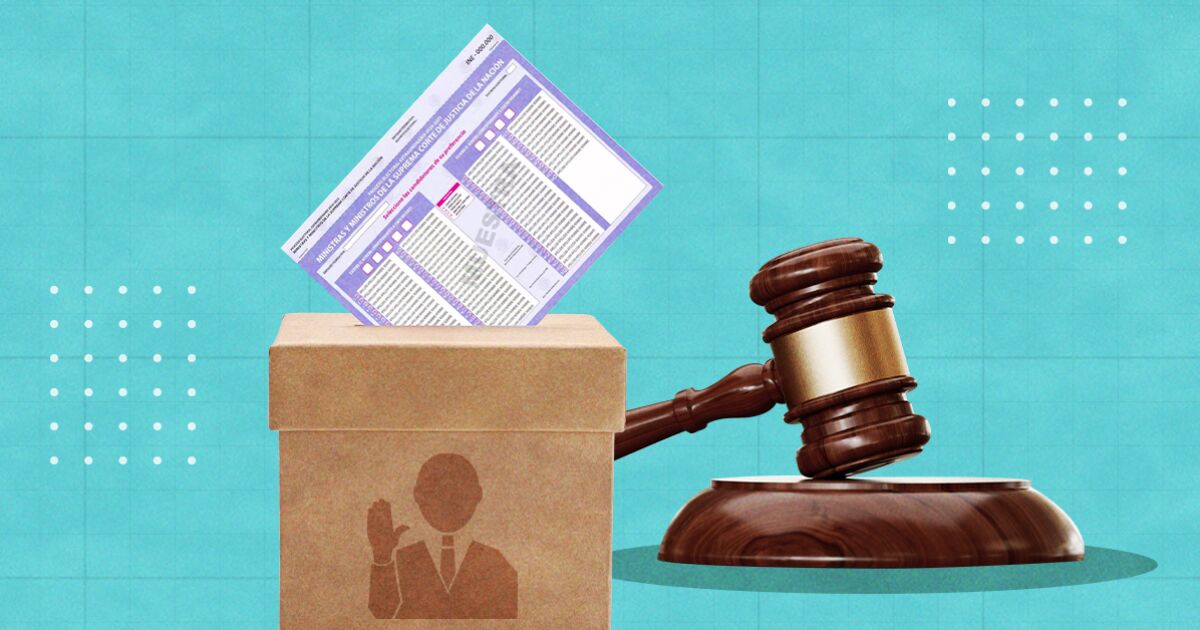
“The ballots are not easy, they are not like before marking with a tache about an emblem or name and already, as we are used to. Here you have to write a number, get close to the specialty, remember the name the number or carry a paper. You have to check each ballot and you have to mark not only a ball option, that is complex on the day of the choice,” he says.
The counselor Alfredo Alcalá coincides with the complexity of the voting system for these positions, because unlike the traditional elections, where a vote is issued by ballot, this time citizens must choose for open lists, which implies choosing for the number of each candidate and not by name, as is done.
“This is an important issue, since the ballots will be different, and the candidacies will appear in an alphabetical list. Instead of marking a box with a name, the citizens must now write down the number corresponding to the candidacy of their election,” said the counselor.
For example, he explains, on the ballot for the Supreme Court, more than 80 names will appear, and people must write five numbers corresponding to women and four candidates for men.
This complexity implies the need for an intense information campaign to guarantee a free and informed vote ”
Alfredo Alcalá Montaño, electoral advisor of the State Electoral Institute of Hidalgo (IEEH).
While the Voquera Montoya counselor considers that another of the complexities is Inform and motivate citizens to participate In an election that breaks with traditional schemes, because unlike other elections, there will be no pre -campaign, or public financing, or propaganda such as blankets or souvenirs.
Given this, he insists, the information will be key for citizens to issue an informed vote. “The elections cost, they are paid with citizens’ taxes and we have the right to participate,” he says.
The electoral advisor of Hidalgo argues that they must “get citizens to understand the importance of the positions they will be choosing”, since they will not only try to choose ministers and magistrates, but also judges from different areas.
“It is important that citizens not only know what is going to choose, but also the role and importance of these positions, each one has different functions, and that is why we must encourage the informed and reasoned vote,” he says.