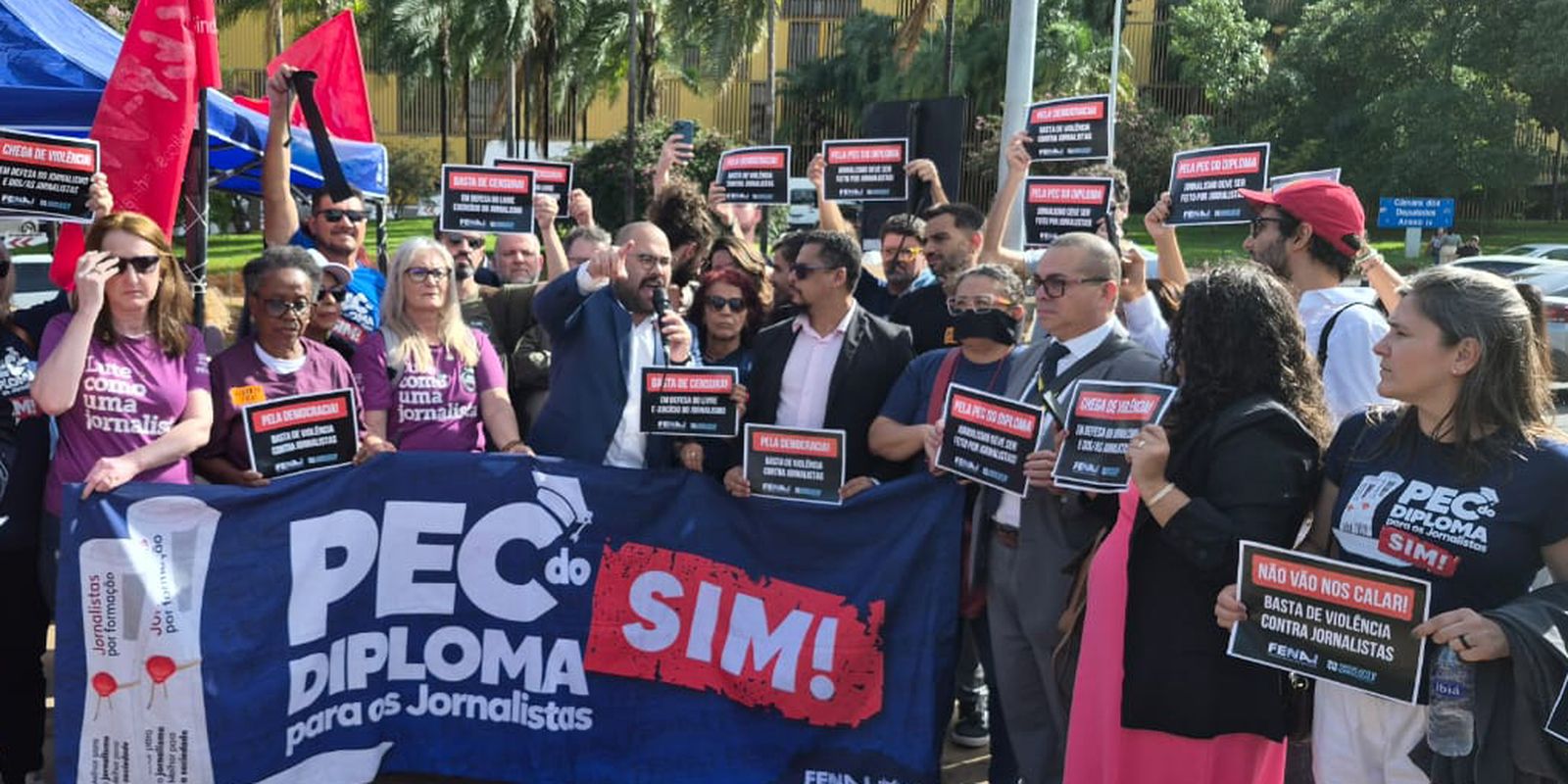
The violent action of legislative police against journalists and the episode of censorship with the interruption of the television signal TV Camera and the removal of press professionals from the plenary of the Chamber of Deputies led to a public hearing in the Senate, this Thursday (11). Representative entities lamented the restriction of the right to information that occurred on Tuesday (9).
The episode occurred after deputy Glauber Braga (PSOL-RJ) occupied the presidency of the House in protest against the president of the Chamber of Deputies, Hugo Motta (Republicanos-PB). While Braga was forcibly removed from the scene, journalists, photographers, cameramen and press officers were also suffered aggression.
When opening the public hearing, at the Human Rights Commission, senator Paulo Paim (PT-RS), author of the request, declared that he followed the case initially on television and then through videos recorded on cell phones and released.
“We were all shocked by the violence suffered by journalists on Tuesday night in the Chamber of Deputies. My solidarity with all press professionals”, declared the senator, the only parliamentarian to speak at the session.
The president of the Brazilian Press Association (ABI), Octávio Costa, announced that the institution filed a representation with the Attorney General’s Office (PGR) requesting action against deputy Hugo Motta for a crime of responsibility, for the act of censorship that violates the Federal Constitution.
“This cannot go unpunished. We don’t just want an explanation, we want punishment for this president of the Chamber. What he did is regrettable and affects us all”, he defended.
Costa said that the entity will also file other complaints with the Human Rights Committee of the House, the Organization of American States (OAS) and the Ethics Committee of the Chamber of Deputies.
“When a president of the Chamber of Deputies sets the example that Mr. Hugo Motta did, on the eve of an election, it is highly worrying, which is why I say that it is important that there is a judicial response against what happened”, he reinforces.
In the assessment of the Incidence Coordinator for Latin America at Reporters Without Borders (RSF), Bia Barbosa, the episode of violence and censorship is the result of a trivialization and naturalization of the restriction of journalistic and communication activities in the country.
“This was brutally intensified during the government [Jair] Bolsonaro and spread and spread throughout our society in such a way that even after a change of government and this change in institutionality in relation to the press, it did not stop episodes like this from happening”, he assessed.
Violence
The president of the Brazilian Association of Investigative Journalism (Abraji), Kátia Brembatti, states that the attitude of politicians, security agents and even ordinary citizens has suffered an escalation of a violet approach that manifests itself in different ways, whether in physical, verbal violence or judicial violence, which occurs with intimidation following the opening of a Judicial process that questions the content conveyed.
“The press is not under a dome that could not be criticized, it can be criticized, but there are ways of doing that. It is not by attacking, attacking people. Violence is not legitimate in any way”, he states.
According to Kátia, there are currently 654 cases in Brazil that are characterized as judicial harassment based on a classification already judicially recognized by the Federal Supreme Court.
“These processes intimidate journalists. They financially suffocate companies and create self-policing. Society stops being informed when a journalist thinks five times before approaching a subject because that subject will cause a headache”, he warns.
Samira Cunha, president of the National Federation of Journalists (Fenaj), recalled that the Annual Report on Violence against Journalists and Press Freedom points out that, in 2024 alone, there were 144 cases in Brazil.
“It is still a shocking number and one that we cannot naturalize,” he highlights.
In the opinion of the president of Fenaj, restricting the work of the press results in the loss of citizens’ right to information.
“In a country that claims to be democratic, preventing the press from doing its job under any form of violence, from threats on social media to verbal aggression, which very quickly escalates to other types of violence, such as judicial harassment, results in censorship, self-censorship, and is absolutely unjustifiable.”