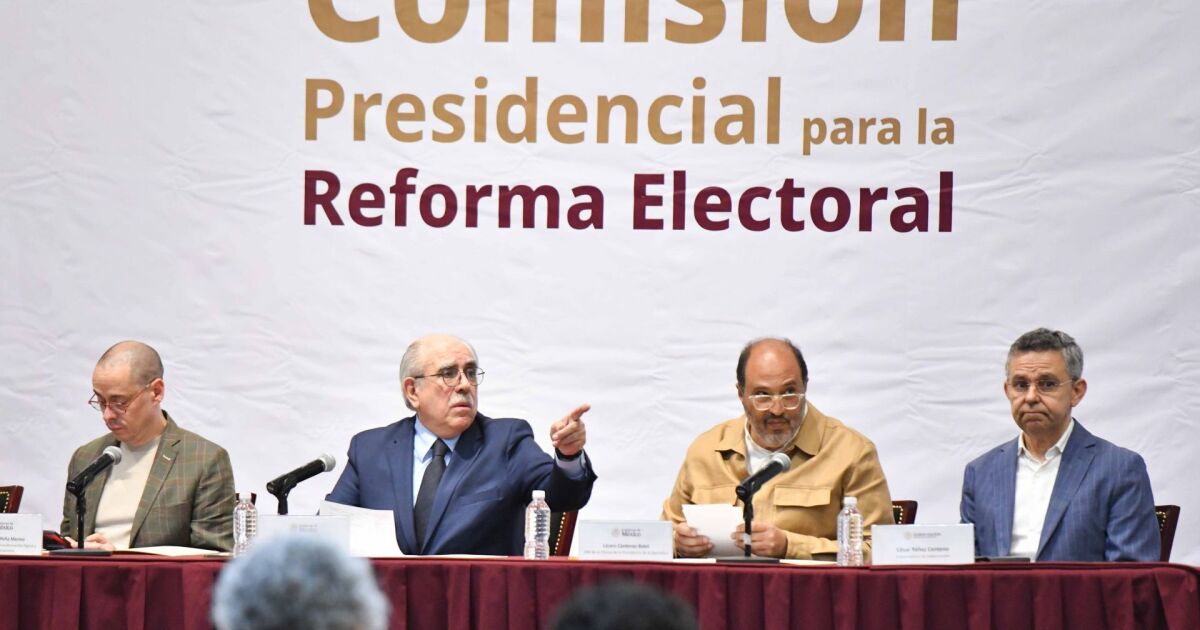
The head of this Commission already has experience in this matter, because he was the author of the electoral initiatives of former President Andrés Manuel López Obrador, known as Plan A and B, but which did not prosper in the Congress of the Union due to the lack of Morenoist legislators and allies.
(Photo: Moisés Pablo Nava/Cuartoscuro)
Although the proposal will be presented in the coming days, among the changes that have been mentioned are the elimination of Public Local Electoral Organizations (OPLE) and legislators by proportional representation, better known as “pluris”, as well as the reduction of the public budget for political parties and for elections.
Xochitl Pimienta, professor at Tecnológico de Monterrey, considered that this electoral reform “is very political,” so it will redefine the composition of political power in the country, and could favor existing majorities, such as Morena, as well as raise the costs of competition for the opposition.
The reform is not neutral, it will redefine who will control the rules of access to power. “Any adjustment made to the INE or legislative representation will impact the balance between political forces.”
Xóchitl Pimienta, professor at the Tecnológico de Monterrey.
Also, he said, this reform could strengthen the Executive Branch as an actor in the political system; meanwhile, the OPLES could lose independence, which will alter the institutional design that has been inherited from the democratic transition.
Although Morena has a majority in Congress, recent ‘clashes’ with its allies from the PT and PVEM put its acceptance at risk.
The necessary vote will depend on whether they are constitutional or secondary reforms. If it is the first case, two-thirds of the votes in favor of the legislators present will be necessary.
The above means that if all 128 senators attend, 86 votes will be essential, and the three parties gather 87, and if all 500 deputies attend, 334 votes will be necessary, they have 364. That is, in this case Morena needs its allies.
If they are secondary reforms, they only need half plus one of the attendees. This is 65 senators and 251 deputies, and in both cases Morena can go alone.
For political scientist Patricio Morelos, the electoral reform could bring greater divisions between Morena and its allies, since some of the points that this reform is expected to affect the PT and the PVEM, such as the elimination of legislators through proportional representation.
It will be necessary to see if Morena would obtain the votes in the Legislative Branch, since the main victims of this would be its allies, which are the Green Party and the Labor Party.”
Patrio Morelos, director of the polling firm Poligrama.
For this reason, he commented that there are three options for Morena and the president: carry out the reform with the elimination of proportional representation legislators, putting the alliance at risk; The second option is to carry out a “lighter reform” without touching the elimination of the “pluris”, and the third, not to carry out any electoral political reform.
“Morena would have two risks. If it carries out this reform with all the points that have been discussed. An electoral risk that would be reaching 2027 without the alliance with the PT and the Green Party and breaking the legislative alliance, which would take away Morena’s possibility of making constitutional reforms and needing the votes of the PRI, the PAN and the Citizen Movement,” the expert mentioned.
The changes to come
Although the initiative has not been presented, President Claudia Sheinbaum has already outlined the “fundamental” points that the proposal must contain, which are the same as those raised in López Obrador’s initiatives.
“What, from my perspective, is fundamental in the reform is (delete) multi-member listswhich are actually chosen by the party leaders, although in Morena they are by raffle, but they are chosen without the participation of the people,” he said on December 16.
Meanwhile, Pablo Gómez pointed out that among the changes that will be proposed are the transformation of the National Electoral Institute (INE) so that it is in charge not only of the electoral processes at the federal level, as it currently does, but also of the local ones.
Another point that the head of the Presidential Commission for Electoral Reform pointed out is the rreduction of the number of electoral councilors to go from 11 to 7 and that these be elected by direct vote as is done with the election of District judges, Circuit magistrates and ministers.
“The system for appointing counselors (of the INE) has never worked. The last one (in 2023) was the one that worked best, it was carried out until insaculation,” defended Pablo Gómez in a interview with El País last August.
Although some experts and officials have defended the work of the Public Local Electoral Organizations (OPLES) – such as the current president of the INE, Guadalupe Taddei –, the Moreno government insists on disappearing them under the argument of saving public resources.
“We cannot leave aside their experience and operational capacity (of the OPLE),” commented the president of the INE on October 8 in front of the Secretary of the Interior, Rosa Icela Rodríguez.
The electoral reform initiative will be presented in “mid” January, President Sheinbaum stated last December 15 at a conference, so legislators are already preparing to receive it.
“We are going to meet in the Commission that was founded for the electoral reform in these days, because the forums have already ended, and well we would be making it public early next year, maybe mid-Januarysomething like that, we would be making the proposal public,” said the federal president.