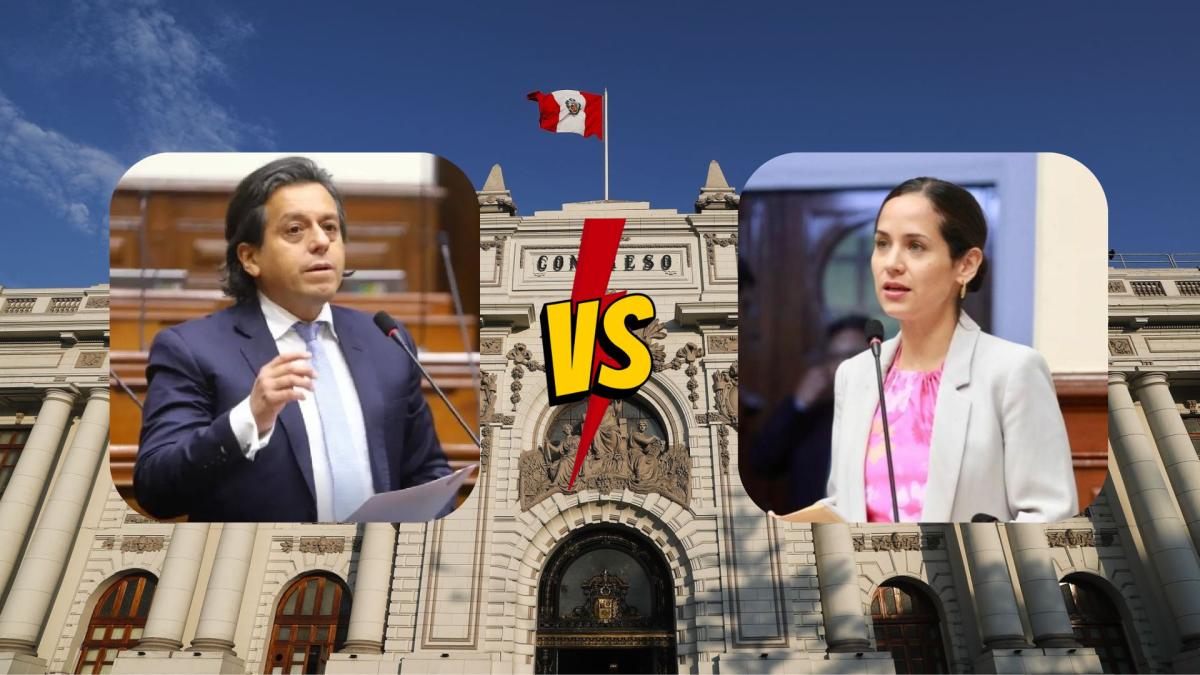
Political interests or promotion of science and innovation? In the last hours, the congresswoman Sigrid Bazán He hardly questioned in his X account the advance of a bill that, he says, is promoted by Fujimorism and, if approved, would affect the small farmers. However, the legislator Edward Málagapromoter of the initiative, responded by inviting her to a debate to show him that, rather, the norm will increase the productivity of Peru through technological development.
“Congress once again seeks to open the door to transgenics in our country.” Thus Bazán began his speech in a video published on Saturday afternoon, February 15, in which he questions the progress of the 9475 bill, which is ventilated in the Agrarian Commission of the Congress, and that, in his opinion, “It would put our food biodiversity, our food and nutritional security at risk”.
“A few days ago, the Agrarian Commission, directed by Fujimorismo since 2021, has put in debate the bill 9475 that seeks to repeal the law that prevents the entry of transgenics into Peru,” Bazán is heard to say in the recording .
The only beneficiaries, he continued, “would be the great transnationals that produce these seeds modified at the expense of our little farmers. “He said that, therefore, the Ministry of Agriculture, by Ángel Manero, and the aforementioned parliamentary commission,” walk hand in hand, legislating in favor of a few. “
As Bazán mentions, on February 12, Conveagro (National Convention of the Peruvian Agro) published a pronouncement against the project and argue that Minister Manero “instead of supporting this harmful nonsense for the country, should worry about the difficulties that happens The small and mediated agriculture in general and, especially, the producers of the mango, corn, potatoes, onion and others. “
However, on the other hand Congressman Edward Malaga (Avanza País), one of the main authors of the law along with his bench colleagues Alejandro Cavero and Adriana Tudela, replied and even invited it to a “public debate” to confront arguments .
“Put time and place,” he urged him in his X account.
As he explained, “here they have nothing to do with the transnationals or the great agro -exporters or Fujimorismo. It is not the initiative of Congress and the Agrarian Commission.”
Malaga mentioned that the moratorium on OVMs (modified living organisms), also called transgenics, “It has a lot to do with science, innovation, competitiveness and productivity; with food security and strategies to deal with water stress, climate change and pests.”
“Nothing to do with the loss of biodiversity and damage to ‘small farmers’. Much less with class struggle or antifujimorism narratives”he concluded.
The project
The initiative was presented on November 7, 2024 and was referred to two commissions, the Agrarian, which is chaired by Eduardo Castillo de Force Popular; and that of Andean, Amazonian and Afro -Peruvian, environment and ecology, directed by Guillermo Bermejomember of the previous bench of Sigrid Bazán, together for the people of the people.
It raises the modification of 11 articles of Law 27104 Risk Prevention Law derived to the use of biotechnology. In article 2, it proposes to promote the security in the research and development of biotechnology in its applications for productive innovation and the provision of services, as well as its safe use in the national territory.
It also indicates that the Ministry of Environment will be the competent national authority in the field of conservation and sustainable use of biological diversity. The initiative includes this portfolio in instances such as the National Commission on Biological Diversity (CONADIB), which can create sectoral technical groups, some of them are Senasa, Sanipes, Digesa and Oefa.
These competent organizations are those that may, among other things, develop training and implement the necessary infrastructure for the evaluation, introduction and use of transgenics in Peru, as well as ensure compliance with the authorizations arranged in the law.
If the norm is approved, the introduction and liberation of OVMs in the national territory will be carried out “in a controlled and gradual way, starting with pilot projects in the territories of less biodiversity, under strict protocols of biosafety.”
Sectorial opinions
On February 6, the Minister of Health, César Vásquez sent a trade to the Agrarian Commission concluding that, in accordance with the technical opinions issued by the General Directorate of Environmental Health and Food Safety, the National Institute of Health and the Directorate General of strategic interventions in public health, The bill “is viable”.
Meanwhile, on the 11th of this month, the foreign trade society of Peru (Comex Peru)he pointed out before the aforementioned commission and before the working group of Andean peoples that “the Moratory for the import and production of OVM has slowed the competitiveness of Peru in the agroindustrial and textile sector.”
“We reiterate that it is not only about having a greater amount of crops, but that these are of a better quality and that they can introduce greater benefits for the health of citizenship. In that sense, we support the project “they pointed out in a trade.
Both the Agrarian Commission and that of Andean peoples must approve or dismiss the bill. If approved, the Plenary of the Congress will go to the vote, where it will finally be known if the Executive is referred for publication. In Government Palace they can also decide whether to promulgate or observe it. If the latter occurs, the Parliament will decide whether it approves it by insistence or if it files it.
Take advantage of the new experience, receive by WhatsApp our enriched digital newspaper. Peru21 Epaper.
Now available in Yape! Find us in Yape Promos.
Recommended video: