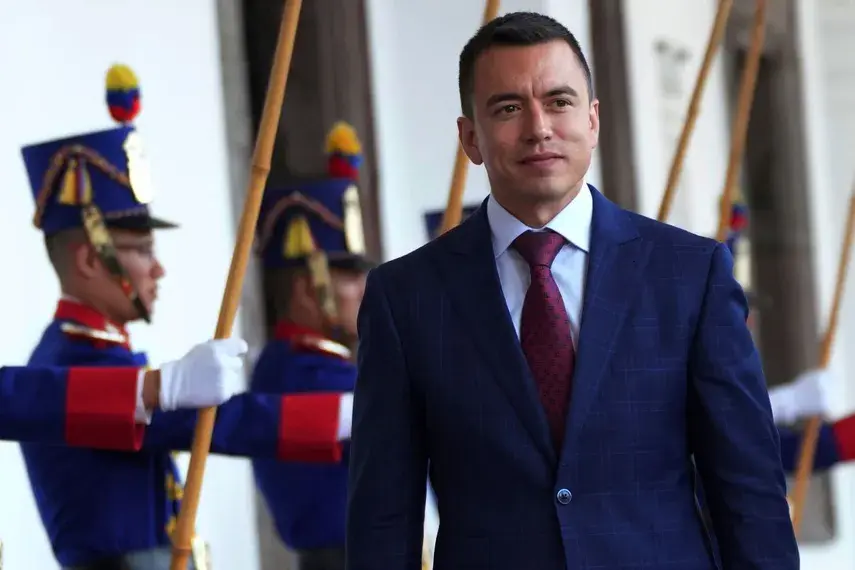
He was barely preparing to receive the heavy inheritance of a financial crisis that had brought Ecuador to the threshold of default, along with the political storm that forced the former president Guillermo Lasso to decree the “crusading death”, when, a few months after assuming command, Daniel Noboa He began to take uncertain steps that we observe from this table with caution: he promised tax cuts that the country’s fragile fiscal back could hardly sustain.
Over time, however, it corrected course and adopted decisions that restored some confidence to the markets, among them the increase in the VAT of the 12% to 15%. It was not enough, of course, to restore the balance of public accounts, and Noboa himself understood it: by decree, he ordered the reduction of the diesel subsidy.
You can read: Importance of keeping pace in the economic march
The response was immediate. Indigenous communities called a strike that soon led to violent episodes, with attacks on the presidential motorcade. They had done it before and had managed to defeat Noboa’s predecessors.
But this time, the president did not respond with surrender. He did not give in to demands that, although they appealed to social justice—improving health and education—implied emptying an already exhausted treasury. The protesters demanded to repeal the decree that reduced the subsidy and return the VAT to 12%. Had he given in, Noboa would have buried the credibility that was just beginning to germinate under his mandate.
Nor did he choose the inactivity of someone who waits for the ripe fruit to fall by itself. He traveled to the troubled cities, explained his strategy to the population and offered economic support and technical assistance to lower-income homes and businesses. And when, after thirty days of strike, he judged that he had done what was necessary to protect public finances, he announced that law enforcement would clear the blocked roads and remove the debris. Perhaps convinced that their support base had weakened, the strikers—moved by just but misguided reasons—decided to end the protest.
The outcome left an encouraging balance: credibility, although still fragile, was strengthened. The country risk, which was at 1,925 points when Noboa took power, first fell to 968 after the fiscal measures; then to 812 on October 21 and, finally, to 738 points this November 3, its lowest level since mid-September.
Because when the suffocation eases, the country breathes deeply again, and the future, light and luminous, touches the horizon with fingers of hope.