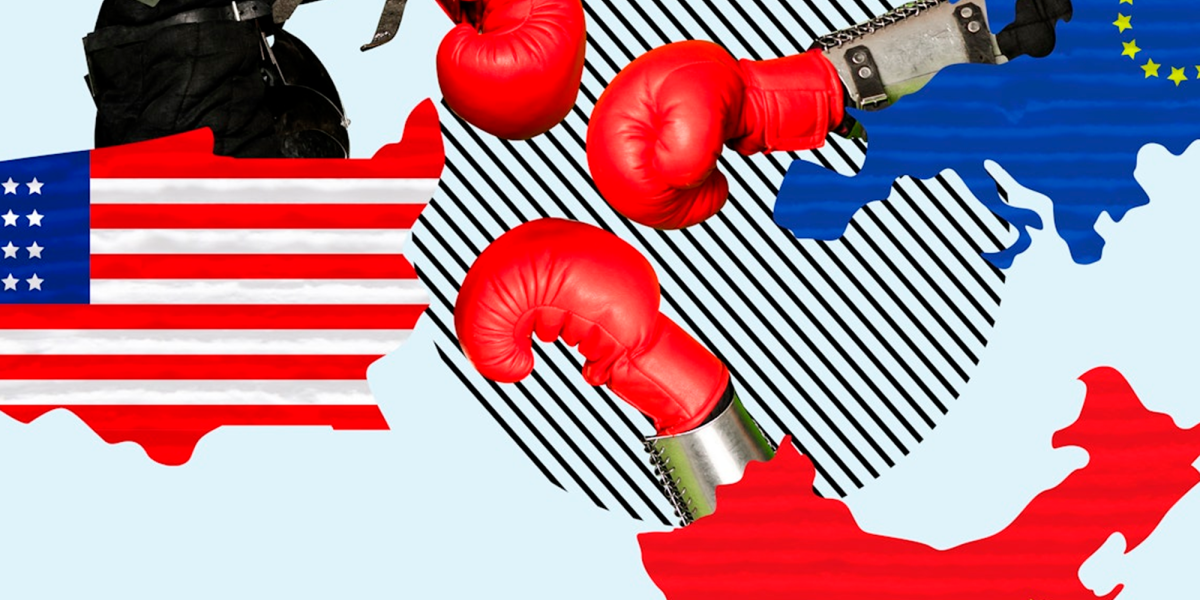
The Fundéu has just chosen the word of the year in Spanish: tariffs. Which, coincidentally, is also US President Donald Trump’s favorite word. And so much! In fact, it was he who put her in the debate after decades of free trade.
For our annual summary of global economic content, we may prefer to start, rather than from a word, from a name: that of the aforementioned Trump, the 47th president of the United States who, during the first year of his second term, has altered the world economic order with the imposition of universal tariffs.
When Trump was re-elected president, in November 2024, the issue of tariffs was already in the air. It was known that I would use them to attack China and Mexico, its southern neighbor and trading partner with Canada in the United States-Mexico-Canada Treaty (USMCA), I expected more taxes, controls and interventionism.
On April 2, the “Liberation Day”: Trump presented tariffs to be applied to “all disloyal partners” who, in his words, for decades caused the gigantic US trade deficit and “stole countless American jobs.”
With this measure, the American president put end to free trade policy which since the end of World War II had been the flag of American leadership.
A historical review of the effects of protectionism and the imposition of tariffs shows that their application causes an increase in prices for consumers, the destruction of jobs and the reduction of global economic growth due to the fall in international trade.
Iberian blackout: the economic event of the year in Spain
On Monday, April 28, around 12:30 there was a general blackout in Spanish territory. This energy drop kept citizens and institutions in suspense and made us interested in the design of the country’s electrical system.
The chain begins with the energy generating companies, from there it goes to the transporters, which take it through high voltage networks to the distributors, which transmit it from the electrical substations to the point of consumption, and, finally, the marketing companies participate, which sell and bill the final consumer for the electricity purchased on the wholesale market.
Electricity converges in this market generated from different energy sources and with different technologies and production costs: nuclear, renewables, fossil fuels.
From this event the lesson was learned that maintaining balance in all phases of the electrical system It is a complex and delicate matter.and that the digitalization and technologization of society continues to generate greater demand for energy and requires the security of the electricity supply to be guaranteed.
This need can again put the use of nuclear energy on the tablewhich is stable and continuous. Although, let us not forget, it also implies long-term contamination risks.
Technological society: AI, chips and bubbles
At the beginning of 2025, China won an important battle against the US in its particular technological war: without access to Nvidia chips, the Chinese company DeepSeek was able to develop fast and powerful AI with fewer resources than its competitors.
Beyond the technological euphoria, it is worth remembering that major disruptions have two major phases: installation and deployment. The first, fast and frenetic, usually generates a bubble (like that of the “dotcom” companies in the early 2000s) that ends up bursting. At the beginning of this year, analysts were already wondering if microchips It would be a possible new technological bubble.
The truth is that the market has maintained its unstoppable path throughout 2025: Nvidia shares have multiplied their value by 13 since the beginning of 2023 (and on Wall Street they believe that it can still continue to rise). This growth has been due to factors such as the growth of new technologies and low interest rates, which make investors look for more profitable options than the markets.
The point is that, after excessive market growth, there usually comes a price correction (which can be mild or violent) when enough investors realize that many assets are overvalued.
Of fashion, labubus and luxury
A process similar to that of microchips has been experienced in the fashion, luxury and trends sector with labubus dolls that, from products for geeks, have become objects of desire for fashionistas. Born as a rarity in 2015, in 2025 they exploded as a fashion. The big winner of this move is Wang Ning, owner of Pop Mart, the company that created these sharp-toothed dolls, who has seen his assets grow by 20 billion dollars.
In the luxury sector, the year began with some concern: there was some wear after the dazzling climbs in recent years. On the one hand, there was talk of the weakening of the Asian economies, major drivers of the sector. But also from the TikTok effect in the face of the proliferation of videos in which the relationship between quality and price in the luxury sector was called into question.
Comes into play here, both when talking about luxury and quirky dolls, the importance of intangible value, which is not seen but is felt, and in which issues such as the brand, its history, its origin, its values or its aesthetics come into play. This value can make a product desirable although its tangible attributes (aesthetics or quality, for example) are not extraordinary.
Nobel 2025: economic development and creativity
On October 13, the Bank of Sweden announced the award of the Nobel Prize in Economics to Joel Mokyr and Philippe Aghion and Peter Howitt by explain economic growth driven by innovation.
On the one hand, Mokyr is a professor of economic history who for years has studied the circumstances that made the Industrial Revolution possible: what happened, why in England and why at that time. He maintains that the true driving force of development was not machines but curiosity, ideas and confidence in progress.
On the other hand, Aghion and Howitt have described in their works how innovation opens space for progress. Both are disciples of JA Schumpeter (promoter of the idea of creative destruction, in which it is not about destroying but letting die what is no longer useful so that something new and better can emerge). Aghion argues that economies that reward innovation and its risks are the most dynamic, while Howitt has shown how this support for innovation is transformed into long-term well-being.
This Nobel reinforces the idea that entrepreneurship should be supported and promoted.
To undertake, you need creativity, experience and risk.
The entrepreneurship needs an optimal balance (which is sometimes marked by age) between creativity (to generate innovative ideas), considerable experience (to make informed decisions) and risk tolerance (to take on the challenges of entrepreneurship).
Also social stereotypes and gender play a role: in most societies, entrepreneurship is associated with the expression of characteristics typified as masculine (competitiveness, aggressiveness, risk). This influences the initial predisposition to start a business but then, beyond the initial interest, men are significantly more likely than women to act to create the company.
Entrepreneurs’ business ideas usually need external financing. And an essential factor to achieve it is knowing how to sell your ideas to potential investors. The emotions shown by entrepreneurs when communicating their projects influence investors’ decisions.
When it comes to crowdfunding, there are two factors that come into play: in addition to what the entrepreneur says about his project (and how he tells it), microinvestors are attentive to the signals of more experienced investors and they copy your investment behavior.
Let’s hope that in the new year the news about tariffs and trade wars will be more reassuring than it has been in 2025. And that creativity and innovation will prevail as factors driving the economic development of countries.
Happy 2026!