The Colombian economy is preparing for an electoral year with signs of apparent stability, but with fragile foundations and growing fiscal and political tensions; according to the most recent report from Colombia Risk Analysis, which describes a panorama where uncertainty economic and electoral polarization combine to increase the country’s vulnerability in 2026.
These analysts began by pointing out that although the Government has managed to maintain moderate growth in gross domestic product (GDP), a sustained reduction in inflation and the lowest unemployment in more than two decades; These achievements are accompanied by a structural deterioration in public finances and an increasingly fractured political context.
Check here: The serious technical mistakes of the study that ‘justifies’ Ecopetrol’s departure from the Permian
“The Government shows macroeconomic resilience, but with a critical deficit and a margin increasingly limited maneuverability. During the first half of 2025, GDP grew 2.4%, driven by private consumption, the strength of the labor market and the improvement in real incomes,” the report states.
Control Risks also recognized that inflation, which had reached 13.3% in May 2023, dropped to 5.18% in September 2025, and explained that although this is a relief for people’s pockets, it should not be overlooked that it is still above the long-term goal of the Bank of the Republic.
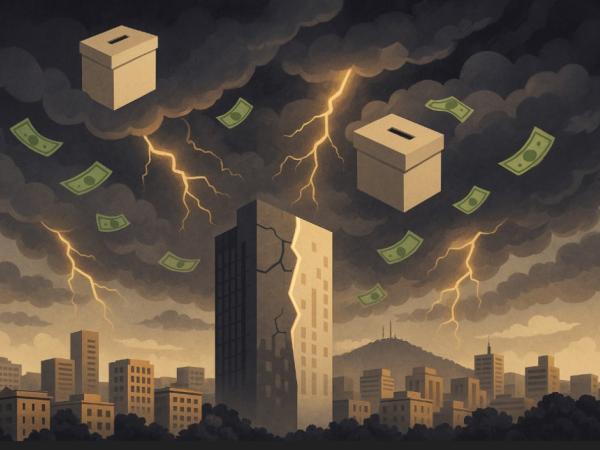
The growth of the economy and fiscal pressures will mark the 2026 electoral agenda.
Image from ChatGPT
Likewise, despite this and other advances, the report warns that the economy remains on a weak foundation due to excessive public spending, growing debt and the suspension of the fiscal rule. In short, the country spends much more than it earns, and leither does so in a context where investor confidence has been significantly reduced.
Growing deficit and fiscal pressure
The fiscal outlook is the most worrying point of the analysis, since according to the document, the Government’s deficit went from 4.3% of GDP in 2023 to 6.7% in 2024, and official projections raise it to 7.1% in the Medium Term Fiscal Framework (MFMP) of 2025. All this, due to a tax system that collects little and unequally, high informality, persistent evasion and a rigid public spending burden dominated by mandatory transfers, subsidies and debt interest payments.
Also read: EITHEREight out of every ten Venezuelan migrants in Colombia plan to stay
Due to this, the report estimates that by 2026 the relationship between interest and amortization will reach a record of 256%, which means that a growing part of the budget is allocated only to paying the State’s financial commitments and remember that in light of this scenario, the Government decided to invoke the escape clause of the fiscal rule, temporarily suspending its limits to allow greater spending.
“The measure was criticized by the Autonomous Committee of the Fiscal Rule (CARF), which considered it legally questionable and insufficient to correct the course of the deficit. The response of the markets was immediate and Moody’s and Standard & Poor’s lowered Colombia’s credit ratings, which increased the cost of debt and caused massive sales of TES bonds by foreign investors,” they explained.

The growth of the economy and fiscal pressures will mark the 2026 electoral agenda.
Image from ChatGPT
In another section, the document examines the accounts of the General Budget of the Nation 2026, presented by the Ministry of Finance, initially for $556.9 billion, along with a tax reform for $26.3 billion; Although the projections are not encouraging, Congress has already agreed to cut nearly $10 billion and the probability that the reform will be approved is low.
“A roadmap was presented with a tax reform in 2025, structural adjustments to spending and improvements in debt management, seeking to resume the fiscal rule in 2027. However, it is unlikely that, in its current state, the tax reform will be approved,” the report states.
You may be interested in: Health system expenses reached $121 billion in 2024
Pressures and reforms
Control Risks also referred to the Bank of the Republic, which, from its perspective, remains one of the institutional pillars of the country, highlighting that its Board of Directors has maintained the interest rate at 9.25%, privileging the control of inflation over fiscal risks.
For them, this independence has contributed to preserving a certain exchange rate stability, Although the Colombian peso, which has appreciated against the dollar, has done so mainly due to the interest rate differential, and not due to solid economic fundamentals.

The growth of the economy and fiscal pressures will mark the 2026 electoral agenda.
Image from ChatGPT
Added to this analysis is the decertification of the United States as an ally in the fight against drugs, announced in September, which is emerging as another risk factor for the economy. Although the country received a partial exception, the measure allows Washington to suspend up to 50% of assistance and vote against loans in multilateral organizations such as the IMF and the IDB.
On the other hand, the report highlights that external tensions are compounded by internal factors that will put pressure on the economy; such as the reform of the General Participation System (SGP), known as the Competencies Law, which will increase transfers to departments up to 39.5% of income nationals in 2038, which reinforces regional autonomy but also perpetuates the fiscal deficit.
More information: Tesla will debut in Colombia at the Auto Show: who is its country manager?
Likewise, they indicated that the increase in the minimum wage, described by the report as “significant”, could increase labor costs, increase informality and put pressure on inflation in the short term; while the Electoral Guarantees Law, which restricts public procurement and inter-administrative agreements, could slow down investment in infrastructure and services during the campaign.
Political scenarios
Regarding the elections, Control Risks proposed two scenarios that, from its perspective, must be followed carefully. First, in the event that the left wins, they indicated that “a large victory will probably provoke protests and smears from the opposition, which will also pressure the US and Europe to cut aid, impose sanctions and, although less likely, not recognize the Government.”

The growth of the economy and fiscal pressures will mark the 2026 electoral agenda.
Image from ChatGPT
Now, as far as the right is concerned, they stated that if they win, “President Petro is likely to question the results if his candidate loses by a narrow margin, given his history of discrediting the CNE and other electoral authorities. Petro will probably call for public protests and social uprisings, while the Historical Pact will oppose the legislative initiatives of the incoming Government.”
In this environment, they closed by saying that the 2026 presidential campaign will be highly polarized and that the elections are shaping up to be a referendum on the management of the current Government, with a Congress divided and a debate dominated by security, the deficit and the relationship with the United States.
Other news: More buyers, fewer bricks: this is what the housing market looks like in 2025
With all of the above, the report concludes that the combination of fiscal imbalance, political tensions and deterioration in external confidence will make 2026 a particularly volatile year, in which economic vulnerability will be amplified by polarization and electoral uncertainty, in an environment of low growth and inflexible spending.
DANIEL HERNÁNDEZ NARANJO
Portfolio Journalist