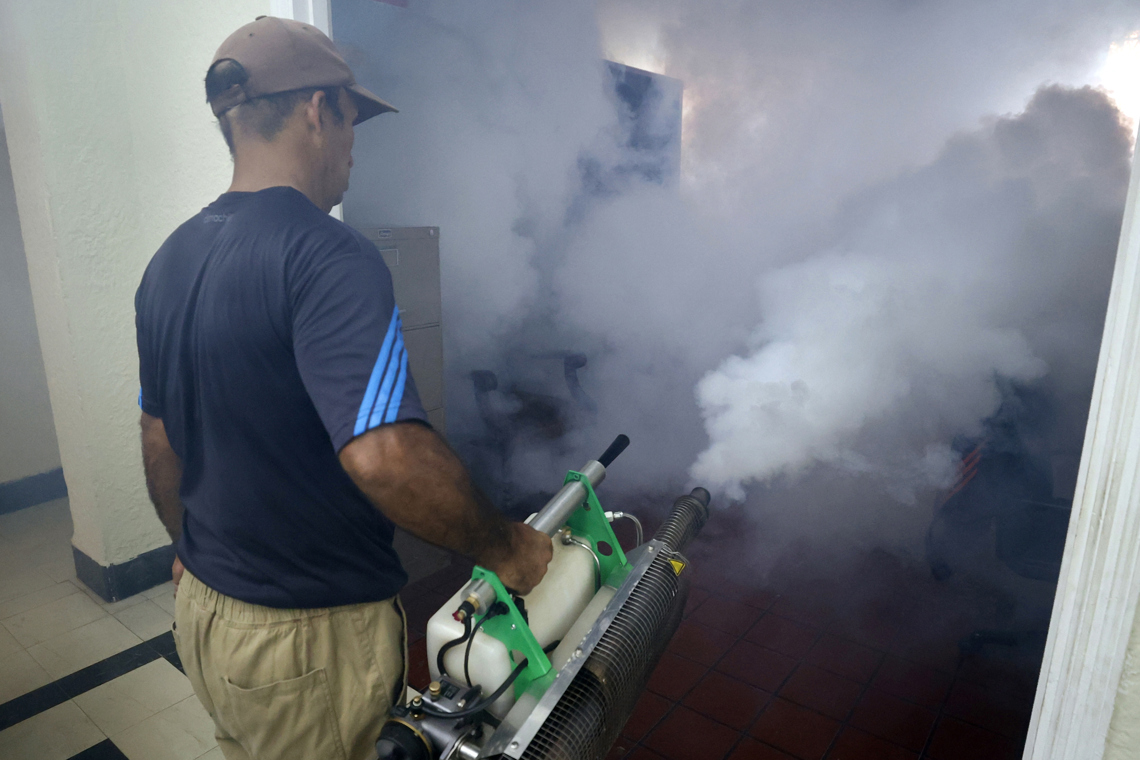
The “shortage of resources” resulting from the economic crisis limits Cuba’s ability to combat its “double epidemic” of chikungunya and dengue, he warns in an interview with EFE Mario Cruz, representative on the island of the Pan American Health Organization (PAHO).
Cruz explains that the response to the epidemic – both the fight against the mosquitoes that transmit both arboviruses and the treatment of the sick – is “resource-intensive” and prolonged over time, which is a “challenge” given the “complex economic situation” of the country.
“The epidemic is clearly developing,” says Cruz. Cuban health authorities have already registered more than 42,000 cases of chikungunya and about 26,000 of dengue, in addition to at least 44 deaths (two out of every three were minors).
The PAHO representative considers that, “to a large extent,” Cuba has the “scientific,” “technical and human” capabilities to confront the epidemic, but not with sufficient means.
“The measures necessary to contain, with the coverage and intensity required in the conditions of availability of resources in Cuba, are not a question of inability, lack of knowledge, lack of political interest… (but) of real scarcity of resources,” he points out.
He emphasizes that “all countries” have difficulties due to “economic limitations” to “sustain integrated vector management over time.”
The “challenge” is the “scale” of vector control and “the intensity of the resources required,” explains Cruz, who adds to this the cost of “medicines and supplies for care” and the hospitalization of seriously ill patients.
“Not infrequently, arbovirus epidemics challenge the capacities and resources that countries have available at those times and that is where a call for cooperation and support may be necessary,” he indicates.
International cooperation
The PAHO representative in Cuba points out that multilateral support is precisely the “reason for being” of his organization, something “essential.” However, he regrets that it is not working in this case.
He assures that Cuba circulated “a list of needs for supplies and medicines,” a table that PAHO later used as a basis to request help, but so far only three projects have been able to advance, for $950,000, still in the negotiation phase.
“The request for support has been made and the response has not been so effective. Regardless of assessing the moment in which it was made, the request was made. And the response has not been seen. We have offers from some partners, which we hope will materialize soon; but everyone is worried. They have the information of what may be necessary and the Government is open to receiving cooperation,” he states.
He considers that the “significant decrease in official development aid”, the coincidence of “several complex global emergencies that compete for resources” and “important changes in the policy of actors that have been very relevant in the context of official aid” may be related to this situation.
Cruz also explains that PAHO does not need a country to formally declare an emergency situation to offer its support. Cuba has not done so: on November 12, about five months after the first case, it simply spoke of an epidemic for the first time.
Cuba registers more than a thousand new cases of dengue and chikungunya in one day
The PAHO representative also emphasizes that “it is important not to let our guard down” even though cases may decrease in the coming weeks because next year “there could be a new outbreak” of chikungunya.
“In reality, an intensification of vector control measures and increased surveillance is required to, in the new season next year, also have a greater possibility of detecting outbreaks earlier and carrying out containment,” he explains.
EFE/Juan Palop.