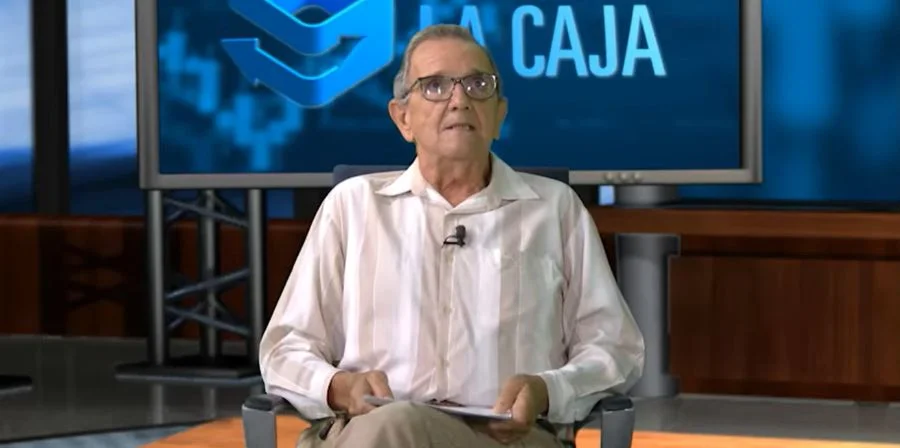
Doctor of Science Roberto Caballero Grande, member of the National Executive Committee of the Cuban Association of Agricultural and Forestry Technicians, suggested Cubans stop consuming rice and potatoes.
MIAMI, United States. – The statements issued in the program Squaring the boxbroadcast by Cuban Television (state), have caused a strong controversy by questioning the place of central foods in the Cuban diet, such as potatoes and rice, in the midst of a prolonged production and supply crisis.
During an edition dedicated to food production in Cuba, officials and invited experts recognized that the country is unable to cover domestic demand and attributed this situation to structural, energy, financial and management factors, while defending a shift towards so-called “sustainable agriculture” and food sovereignty.
The debate was led by presenter Marxlennin Pérez, who introduced the space as “a television proposal to debate, question and reach consensus from Cuban socialism” and proposed as a starting point a diagnosis of the current state of food production.
Among the guests were the engineer José Carlos Cordovés Urquiza, general director of industrial policy of the Ministry of the Food Industry, and the doctor of Sciences Roberto Caballero Grande, member of the National Executive Committee of the Cuban Association of Agricultural and Forestry Technicians.
“We are not Asians”
The most controversial moment of the program came when addressing the Food Sovereignty and Nutrition Education Law and the consumption habits of the population. Caballero maintained that one of the problems is that in Cuba “we get used to eating things that are not typical of our country.” In that context he stated categorically: “The potato is not a product of Cuba.”
As he explained, it is a crop native to the Andes that requires high levels of inputs and imported seeds, which made producing it on the Island more expensive than its real cost. “More than half of what was stored in the refrigerator could not reach the consumer,” he said, alluding to losses due to lack of adequate infrastructure.
The specialist even related an anecdote to reinforce his argument: “An Italian once told me this, quite rightly. He told me, why do you spend so much money on potatoes if you have sweet potatoes, cassava, yams, taro?” he noted, adding that with the money invested in potatoes the country could be “flooded” with these traditional crops.
The criticism also extended to rice, another pillar of the Cuban diet. Caballero described the levels of consumption as “disproportionate” and stated: “We are not Asians. That is not a Cuban habit.” Although the presenter recalled that rice is part of current traditions, the guest responded that “that changes” and suggested that scarcity makes it easier to adapt to other foods.
Despite the official’s statements, millions of Cubans consider potatoes and rice not only as basic foods, but as symbols of food security in a context of chronic shortages, inflation and deterioration of purchasing power.
What else did they say?
From the beginning, Caballero described a critical panorama: “Food production is logically in a situation similar to that of other sectors of the Cuban economy,” he stated, and listed as causes the energy crisis, the damage caused by meteorological events, the dependence on external inputs and the administrative and financial problems faced by farmers. According to him, “productive levels are totally insufficient” and production costs have skyrocketed, making it unfeasible to produce when price ceilings are imposed. “The farmer cannot sell at a price lower than what it costs him to do so,” he stressed.
Cordovés agreed with the diagnosis and explicitly recognized that “food production in Cuba today does not satisfy the demand of the population,” a statement that he also attributed to previous statements by the Cuban ruler, Miguel Díaz-Canel.
The official explained that the food industry depends on both national production and imports that today cannot be carried out in the usual volumes due to the lack of financial resources. However, he defended that the country has an industrial infrastructure created over decades that, with better financial flows and greater coordination with agriculture, could respond to internal needs without large additional investments.
One of the axes of the program was the defense of the concept of “sustainable agriculture” as a strategic horizon. Caballero defined it as an agriculture that is “efficient in the use of resources,” productive, stable throughout the year, resilient in the face of extreme climate phenomena, environmentally responsible and “socially fair.” At that point he warned against models that, under the label of organic, end up excluding those who cannot pay higher prices. “That doesn’t fit in our system,” he said.
Squaring the box It has been consolidated in recent years as a space on state television destined to debate sensitive economic and social issues, under the discourse of “constructive criticism” within Cuban socialism. In previous broadcasts, the program has addressed problems such as inflation, the foreign exchange market and price distortions, generally with the participation of officials and experts aligned with official policies.
The debate on food sovereignty and import substitution is not new in Cuba. Since the beginning of the so-called “Special Period” in the 90s, the State has promoted speeches and policies aimed at reducing external dependence and modifying consumption patterns.