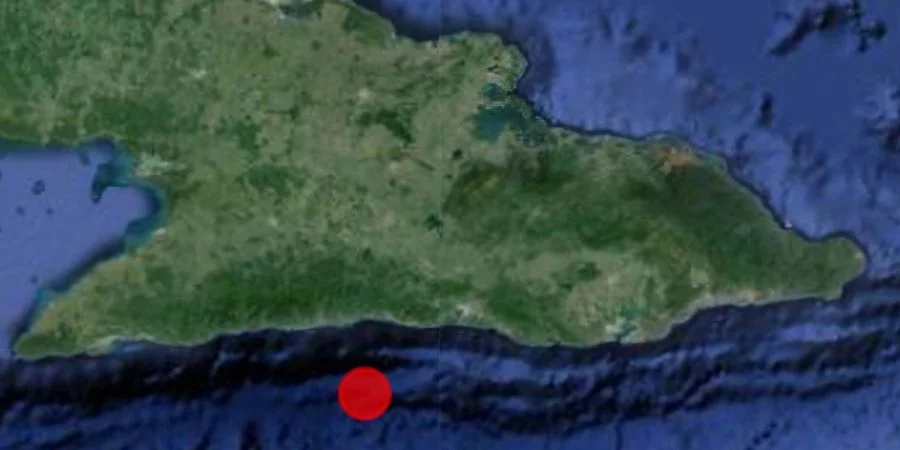
The epicenter of the earthquake was located about 17 kilometers southwest of the city of Santiago de Cuba.
MIAMI, United States. – A low magnitude earthquake was noticeable this Monday night in towns in eastern Cuba, with citizen reports from points in Santiago de Cuba and Granma, with no material damage or victims reported. The National Center for Seismological Research (CENAIS) placed the event at 9:41 pm and set its final magnitude at 2.9, after adjusting a higher preliminary estimate.
According to the information disclosed by the National Seismological Servicethe epicenter was located about 17 kilometers southwest of the city of Santiago de Cuba, on the coast of the Guamá municipality, with a depth of 5 kilometers, at the coordinates 19.70 degrees north latitude and -76.26 degrees west longitude.
Before the technical note, CENAIS specialist Enrique Diego Arango Arias advanced on Facebook a preliminary report on the perceptibility of the tremor in both provinces: “Preliminary data of perceptible earthquake recorded at 9:41 pm today, December 29, with epicenter south of the municipality of Guamá, province of Santiago de Cuba. It is reported perceptible in several locations in the provinces of Santiago de Cuba and Granma. The information note from the Central Station will be shortly.”
NOTE OF THE PERCEPTABLE EARTHQUAKE OF 12/29/2025 pic.twitter.com/mNbxFthybE
— National Seismological Research Center🇨🇺 (@CenaisCuba) December 30, 2025
The combination of a low depth and the relative proximity to inhabited areas can explain why an event of reduced magnitude is perceived by the population. The literature on seismology itself underlines that, at greater distance from the source, the intensity of the shaking decreases, so a more superficial earthquake can be felt more clearly on the surface than a deep one of equal magnitude.
The earthquake took place in a region considered the most active in the country in seismic terms. investigations and specialized reports They locate in the south of eastern Cuba a key area associated with the plate boundary and the Oriente fault, where a good part of the seismic activity recorded on the Island is concentrated.
Is a high intensity earthquake possible in eastern Cuba?
In November 2024, after the earthquakes that shook the province of GranmaGeology engineer and seismologist Eberto Hernández Suró, with more than 30 years of experience, told the newspaper The Demajagua that “in Cuba it is estimated that a significant earthquake usually occurs every 80 to 90 years.”
“They have given us two more years of grace, given that 92 years have passed since the last major event in Cabo Cruz, therefore the concern is increasing that the energy accumulated in the subsoil is reaching a critical point,” said the expert.
On the other hand, he stressed that the tremors in the region “are due to natural geological factors that have been occurring for millennia and are not related to human activities.” Furthermore, he indicated that these telluric movements originate at considerable depths, around 10 kilometers, and are the result of internal tectonic processes of the Earth.
The seismologist pointed out that the Chivirico and Pilón area is known for its high seismic activity due to the instability caused by rock breaking. “The scientific community agrees that the movements of the tectonic plates are the main cause of these tremors,” he stated.
When comparing the earthquakes of November 2024 with others that occurred in the territory, the expert classified them as “moderate magnitude.” He also recalled past events such as the 7.1 magnitude earthquake of January 28, 2021 near the Cayman Islands and the 5.8 magnitude earthquake known as the “Providencia earthquake”, which mainly affected the municipality of Bartolomé Masó. “The Bartlett-Cayman fault zone can generate earthquakes of even greater magnitude,” he warned.
Regarding the apparent increase in seismic activity in recent years, Hernández Suró clarified: “The increase in records does not necessarily indicate more earthquakes, but rather that we now have more advanced technology that allows us to detect smaller magnitude events.”
The specialist also specified that Cuba currently has 24 broadband seismological stations with “top-level technology,” which facilitates more precise monitoring.