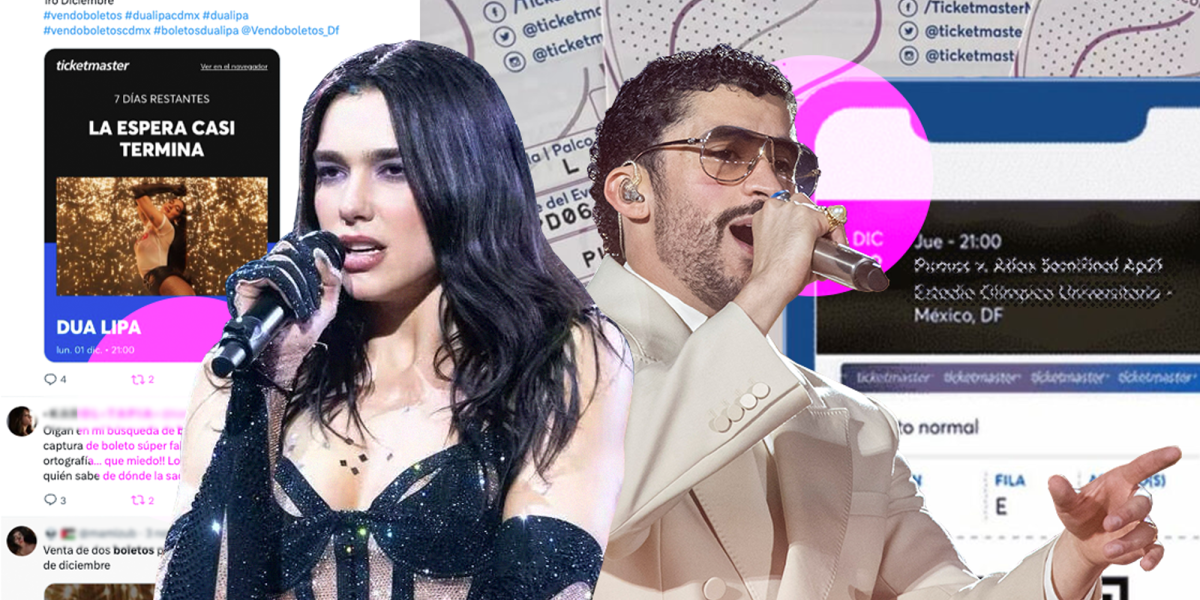
Mexico City prepares to receive the British singer Dua Lipa and to the Puerto Rican Bad Bunnywho will offer a series of concerts during December at the GNP Stadium.
The Training Season performer will perform on December 1, 2 and 5, with prices ranging from 829 to 3,880 pesos. For its part, the “Bad Rabbit” will give eight concerts on December 10, 11, 12, 15, 16, 19, 20 and 21, with tickets ranging between 1,093 and 12,183 pesos.
The sale for both artists began between April and May, and sold out quickly. Now that the dates are approaching, many fans are looking for tickets on unofficial channels, mainly on social networks, where supposed last minute access is offered.
According to data from Kaspersky11% of Mexicans have made payments to sellers who operate on social networks and 39% have already fallen into a scam on platforms such as Facebook, where resale groups abound for all types of events. The risk not only involves losing money, but also compromising the digital security of fans.
FOMO: main ally of cybercriminals
According to the cybersecurity firm, scammers take advantage of the FOMO (acronym for Fear of Missing Outthe fear of missing out on rewarding experiences) that is generated on social networks to create clickbait that directs to malicious sites designed to steal credentials or install malware.
Among their tactics are offering fake tickets that exploit fans’ urgency, posting fraudulent links on resale platforms, and even spoofing these sites to obtain personal and financial information.
“Today, cybercriminals operate with such sophistication that they can clone legitimate resale pages, create fake profiles and misleading posts on social networks. Therefore, it is essential that fans make sure to only buy from official channels, be wary of offers that are too good to be true and protect their personal and financial data, especially when the purchase is made on social networks or resale groups, where a large number of scams are concentrated,” he explains. María Isabel Manjarrez, Security Researcher in Kaspersky’s Global Research and Analysis Team in a statement.
Facebook groups have become one of the main meeting points for fans looking for last-minute tickets, as well as for users trying to resell them. In these spaces, offers are published, seller references are requested, and screenshots of conversations are shared to validate whether a profile is trustworthy. At the same time, there are many testimonies from victims who denounce alleged scammers, tell how they were deceived and warn other users about suspicious profiles that remain active despite the alerts.
“Ticket resale scams not only imply immediate economic losses, but also put fans’ personal and banking information at risk,” says Manjarrez.
In Facebook groups you can find testimonies from victims that expose profiles of alleged scammers. Facebook screenshot.
5 Recommendations to avoid fraud when buying tickets
1. Don’t get carried away by the first offer. There are many publications on social networks with attractive prices and urgent messages. Check the source and be wary of offers that seem too good to be true.
2. Buy only from official channels. Avoid links sent by direct message or posted in reselling groups. Make sure the URL is legitimate and starts with “https”.
3. Do not share information or make advance payments. If a seller asks for your email or cell phone number to “transfer” tickets, check its reliability first. Avoid providing personal or banking information to strangers.
4. Use secure payment methods. Opt for virtual cards or platforms with anti-fraud protection and avoid storing your data in unknown places.
5. Protect your devices. Use security solutions that block suspicious sites and protect your online payments.