While Cuba fights against chronic food shortages and agricultural production that fails to satisfy the basic needs of the population, Pinar del Río has stood out for some years as a laboratory of innovation.
In this province, where tobacco is the economic pillar par excellence, representing 70% of the country’s total, the use of drones has proven to be a valuable tool to optimize resources and reduce losses. However, technological advance contrasts with a national reality: the Cuban countryside is still far from guaranteeing food security, which is also codified in a law that does not comply.
From damage mapping to agricultural precision
The Geocuba Pinar del Río Company, in alliance with the powerful company Tabacuba, has integrated drones into tasks that go beyond traditional mapping.
After Hurricane Ian hit in September 2022, these devices made it possible to quickly assess the damage in thousands of tobacco curing houses, accelerating the recovery process, but their true potential has been revealed in agriculture.
Josiel Cue Regalado, director of Geocuba Pinar del Río, explained that the drones have exposed significant discrepancies in the figures reported by the cooperatives. “We found fields where 50 thousand planted positions were declared, but the drone revealed only 40 thousand,” details the newspaper Granma.
This precision prevents the waste of state resources, a recurring problem in an agricultural system plagued by inefficiencies.
Fighting pests and fertilizing quickly
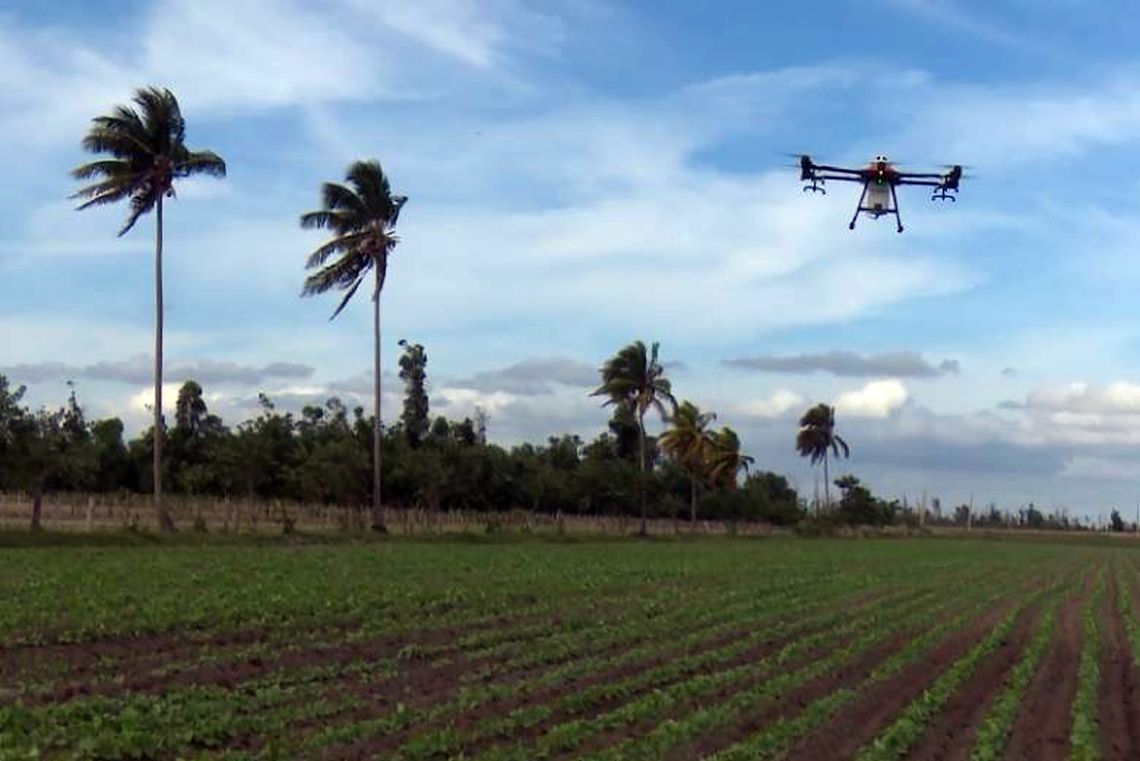
The technology has also proven effective in crop management. At the Hermanos Barcón production hub, a bean field besieged by pests was treated with drones in a matter of hours, saving part of the harvest.
Something similar happened in Guanajay, Artemisa, where a yucca plantation, planted in difficult terrain, was sprayed with insecticides without the need for heavy machinery.
These successes have motivated the import of ten new drones, intended to reinforce tobacco areas (70% of national production) and extend their use to vegetables, vegetables and grains.
However, the scope of this technology remains limited in the face of structural problems: lack of fuel, agricultural inputs and an aging workforce.
Fertilizing from the air: drones over beans in Pinar del Río
Innovation in a system in crisis
Cuban agriculture faces a dilemma: while Pinar del Río modernizes, the country depends on imports for 80% of the food it consumes.
Technology improves efficiency, but it does not solve failures such as the lack of motivation of producers, prices monopolized by the State or the obsolescence of infrastructure.
The implementation of drones, although encouraging, collides with a broader reality: without profound reforms that incentivize private production and eliminate bureaucratic obstacles, even the most advanced tools will have a marginal impact.
It is considered that in the particular case of drones, the extension of their use is still very expensive since in a practical way only the GEOCUBA Company has all the infrastructure and trained personnel for their most complete use, so the different companies, institutions and farmers who wish to use them must make large outlays, estimated a study published in 2024 by the Agrarian University of Havana and the Ministry of Agriculture.
Although they were initially used mainly for military purposes, drones can be used in agriculture, with the Japanese being the first to successfully employ them in the 1980s for fumigation.
These equipment are used for aerial surveying, including crop monitoring, field mapping, pesticide spraying, imaging, and crop health assessment, among other features.