The Federal Public Defender’s Office (DPU) concluded, in a technical note, that free, prior and informed consultation does not apply to traditional communities and isolated indigenous peoples. In the defender’s opinion, isolation would already be a negative for any type of enterprise. This is the summary of a note recently published by the defender’s office on prior consultation, an instrument provided for in Convention No. 169 of the International Labor Organization (ILO) that deals with indigenous peoples. 
Convention 169 stipulates that indigenous peoples and traditional communities have the right to be consulted before measures are taken that could impact territories, assets and ways of life. Since 2002, Brazil has been a signatory to the convention and, therefore, is committed to the practice of consulting communities.
Public defender Renan Sotto Mayor recognizes the importance of the instrument, but says it is inapplicable in the case of isolated peoples.
“The consultation [prévia] is always fundamental. Now, when you talk about isolated indigenous peoples, the consultation has already been done. And the answer is no.”
The technical note is the first measure of the recently created Office of Isolated and Recently Contacted Peoples, formalized in October, and of which Sotto Mayor is the first holder.
The defender realized the urgency of working in the area in 2019, when indigenous man Bruno Pereira contacted the DPU to denounce the context of human rights violations in the Vale do Javari Indigenous Land. Three years later, Bruno and British journalist Dom Phillips were murdered in the region.
Framework
The DPU’s position is not unprecedented in the field of law and norms. The regulations of the National Foundation of Indigenous Peoples (Funai) and the Ministry of Indigenous Peoples have already established the principle of non-contact and, in 2020, the National Human Rights Council (CNDH) approved a resolution recognizing the impossibility of carrying out consultations with isolated peoples. Two years later, it was the turn of the National Council of Justice (CNJ) to adopt the same position. Even so, the technical note was well received by those who work in the area.
“These are documents that can influence the actions of the Federal Court in cases involving these groups. It is a strengthening of this legal framework of protection”, argues Fábio Ribeiro, executive coordinator of the Observatory of Isolated Indigenous Peoples (OPI).
“Each document in which these bodies deal with this topic, for us, is a very big victory. Because it means that the Brazilian State is beginning, after 525 years, to be sensitive to this situation”, he adds.
The general coordinator of Isolated and Recently Contacted Peoples at Funai, Marco Aurélio Milken Tosta, has a similar opinion. “Although regulations already exist, it is very important that we reinforce these understandings from time to time, especially in different instances. This instance of the DPU represents a relevant strengthening for our actions and for the defense of the rights and promotion of the rights of isolated indigenous peoples.”
The inadequacy of prior consultation for isolated peoples is based on another principle of international law, the self-determination of peoples. Sotto Mayor reminds us that isolation is a choice. “These people are not isolated in the idyllic world. They are usually on the run. They have a history of extermination.”
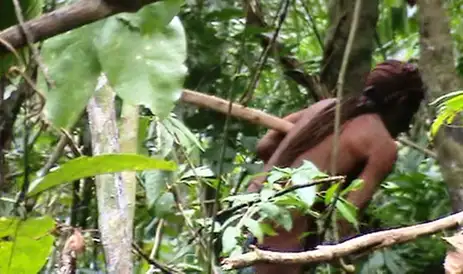
Indigenous man who became known as the hole man lived in isolation for 26 years – Photo: Collection/Funai
This is the case of the Tanaru people, an ethnic group that ceased to exist after the death of the man who became known as the Hole Indian, in 2022. He chose to live alone, isolated, for 26 years, on an 8,000-hectare Amazon Rainforest island, in the state of Rondônia. He was the only survivor of a series of massacres that occurred on a farm, Fazenda Modelo, in the first half of the 1990s.
The extermination of the Tanaru is considered one of the most emblematic cases of genocide. A survey by the non-governmental organization Survival International estimates that more than 90% of the world’s isolated peoples live under threat from legal and illegal extractive sectors.
The NGO points out that across the globe there are 196 isolated indigenous peoples. Brazil records, according to Funai, 115 of these people.
“Brazil, as the country that has the largest number of isolated indigenous peoples in the world, also has to have enormous protection for these people. A mistake can lead to genocide. A wrong decision by Funai, or a poorly made contact, or a contact with a gold miner can kill an entire ethnic group”, warns Sotto Mayor.