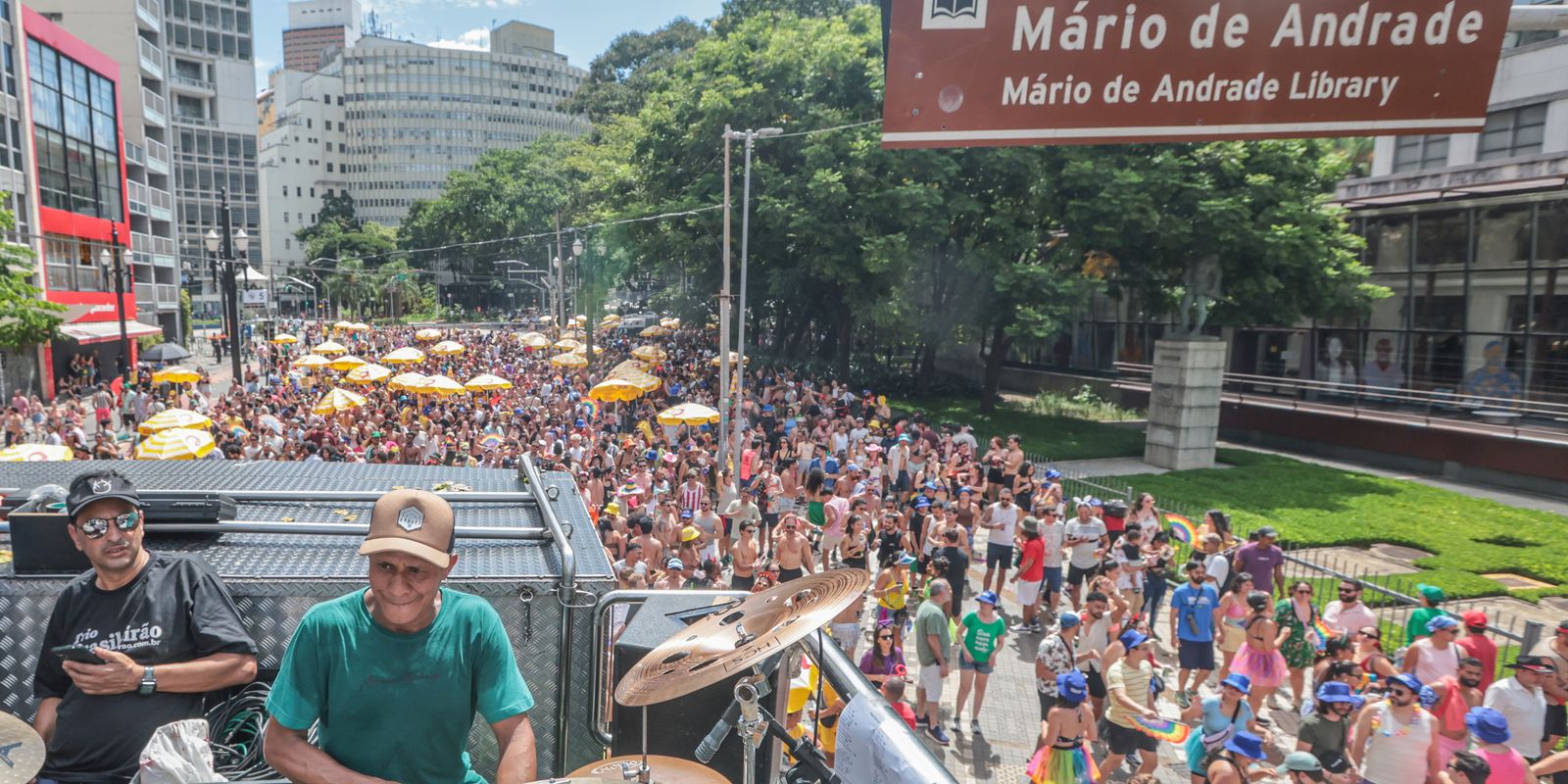
In the capital of São Paulo, the República block circuit had an afternoon of calm parades, accompanied by northeastern rhythms such as Axé and Forró. 
The Domingo Ela Não Vai and Explode Coração blocks were the main attractions of the circuit which, although full, had good mobility and easy access for revelers.

Luma Gregório at Bloco Afro na Rua, on Avenida São Luiz – Paulo Pinto/Agência Brasil
“It’s nice, to play with family and friends. Happy, peaceful and with more space than in other circuits”, said Luma Gregória, journalism student. At Carnival since childhood, when he was in the Tom Maior children’s wing, Luma was with relatives and friends.
Leaving Domingo Ela Não Vai, the group still had plans to continue with Explode Coração and party with Axé – a rhythm that, for Luma, is the face of Carnival.
The student said that, on Monday, she intends to go with friends to the Charanga do França marchinhas and, on Tuesday, although she still doesn’t know where, she is sure that she will look for other street bands.
Another certainty of Luma’s is to avoid the megablocks, as pre-carnival he didn’t have a good experience in Consolação: “there were a lot of people and some of them were trapped there. We went to the cemetery side, where we could follow better, but those who stayed on the other side had difficulties”, he recalled.
The circuit accompanied the electric trio bands, such as Bloco Afro Tô na Rua, with two drums, a percussionist on atabaque, guitar, bass and keyboard, all accompanying the axé in the voices of Lia, Paula and Marcos, facing the 2pm sun with great energy, on Rua São Luiz and Consolação. In this place, the rhythm slowed down and people danced, moving between the blocks and beginning to disperse, taking advantage of bars and restaurants, normally closed on Sundays.

Sisters Josy and Estela Madeira were catching their breath near the Mario de Andrade Library – Paulo Pinto/Agência Brasil
Next to the Mário de Andrade Library, the report from Brazil Agency spoke with the sisters Estela and Josy Madeira. Librarian Estela, who previously worked at Mário de Andrade, said she was in the third block of the weekend, and that it wouldn’t be the last.
“It’s a little more empty, you know. It must be because of the megablocks, which are emptying the more traditional ones a little, here in the Center. Of course, they are still much bigger, today, than when the carnival was in Tiradentes”, says Estela.
The sisters have been following the party since before block parades became more popular in the city, about a decade ago. Certainly well before the parades for tens of thousands, like some of the Consolação blocks and the Ibirapuera circuit.
“There are some really cool ones. Yesterday we went to Bollywood, with Indians, and Perdi Tudo at Augusta. Tomorrow we haven’t decided yet, but I think we’ll go to Bixiga. It’s a shame we missed Esfarrapado”, said Josy.
If you go to Bixiga on Monday, you will be in for a good surprise as the group, which has been parading since 1947, celebrates from 10am, with Vai-Vai sambas.
Those who returned to the Republic in the middle of the afternoon, around 3 pm, in addition to the sea of vendors, in some places even discouraged by the crowd of yellow umbrellas and weak movement, still found the small and lively crowd of Bloco SP Forró, which was beginning its parade.

Bloco Afro parade on the street, on Avenida São Luiz – Paulo Pinto/Agência Brasil
Dressed as Lampião and Maria Bonita, Juarez and Ana led the block, organized by their friend and cultural producer Zé da Lua, with whom they perform during the year in the Trio da Lua outfit.
“We play whenever we can, we perform all year round. I love it”, says Ana Freire, who is from Paraíba and lives in São Paulo, where in addition to performing, she teaches music, especially guitar.
Lampião’s partner is art educator and sculptor Juarez Martins dos Anjos, a Bahian who has been in São Paulo since 1973, resident of São Miguel, in the east zone. The group has already performed at Carnival for six years, and was still lively in the middle of the afternoon.