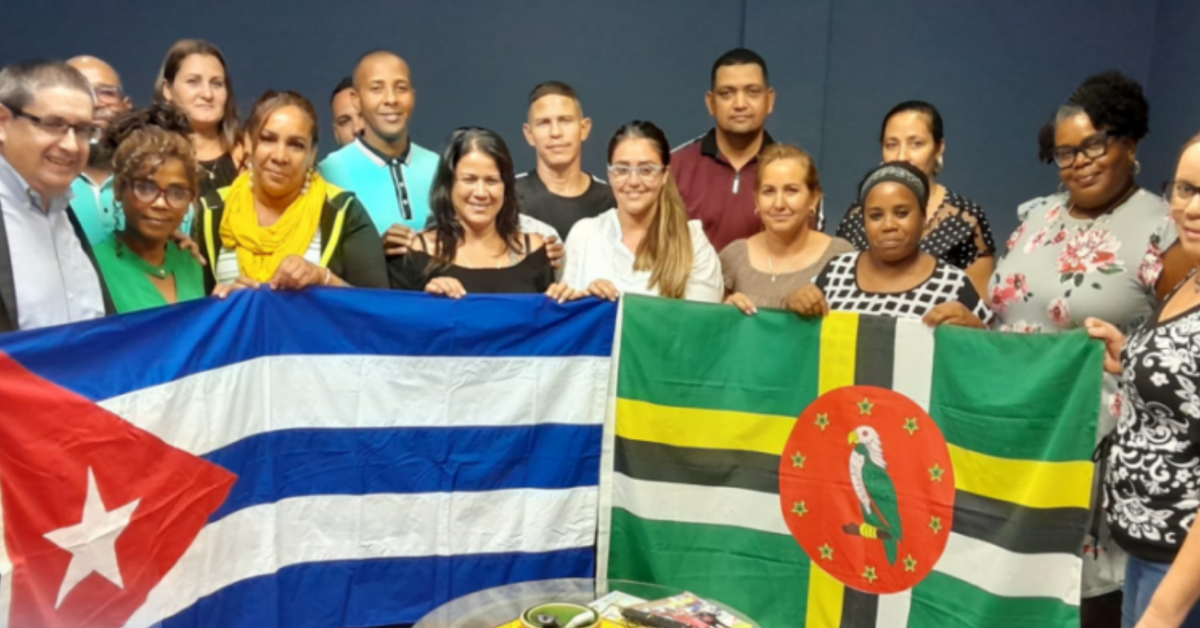
Madrid/Dominica confirmed this Monday that it is joining the list of countries that modify the conditions of its agreement with Cuba for the hiring of doctors from the Island, although the regime may have found a way to circumvent Washington’s main argument against these programs.
“We recognize that we have to make some changes to the medical worker program and we appreciate that the Government of Cuba has kindly agreed to collaborate with us in our attempt to meet the new requirements for Cuban health workers,” said Vince Henderson, Foreign Minister of the Caribbean island, on Monday.
Currently, Henderson said, 65 Cuban doctors provide services in the country – including doctors, specialists, nurses and technicians – but the collaboration has lasted decades. “I want to take this opportunity to thank Cuba for more than 30 years of support to the Government and people of the Commonwealth of Dominica by sending medical workers,” added the chancellor.
“We will always be grateful to Cuba. They have been true friends in good times and bad,” he continued, while praising the Island’s role in the training of Dominican health workers who graduated in the Greater Antilles, as well as the help of Havana in the creation of the first intensive care unit and diagnostic center in the country.
“We will always be grateful to Cuba. They have been true friends through thick and thin”
The information makes official what Henderson himself had advanced at the Caricom summit on February 24when he first mentioned the matter to say that his Government planned to “make changes to the Cuban health worker program” and that if there had to be a way out, it would be as gradual as possible to avoid affecting the population. This Monday’s words do not suggest, however, a withdrawal but a reform of the agreements, a path that several countries have chosen, without the new method having been revealed.
The key, which the Bahamas and Jamaica had already pointed out, seems to be in direct payment to healthcare workers, something that has been done in Calabria for a long time. as revealed this Tuesday The Country. The Spanish newspaper has traveled to the John Paul II hospital in Lamezia Terme, in the southern region of Italy, and has spoken with members of the Cuban team, as well as with the Calabrian president, Roberto Occhiuto, a few days after his meeting with the head of US business in Cuba, Mike Hammer.
“I explained to him frankly that the Cuban doctors present today are essential to keep hospitals and emergencies operational,” says Occhiuto. “I clarified that our health system is open to professionals of all nationalities.” According to the politician, from the conservative group Forza Italia, “the US State Department has expressed its willingness to provide concrete assistance in the process of hiring doctors,” although it has not said how. However, those that exist will not leave until at least 2027. “They would have to close all the hospitals,” he confesses.
The Calabrian authorities insist, as they had already anticipated after his meeting with Hammer, in which in 2026 a thousand Cubans were to be reached, although now they have opened the option to those of any nationality. “It is inappropriate to talk about US pressure on Calabria to end its collaboration with Cuban doctors. The US Administration, even during Joe Biden’s presidency, has never hidden its lack of enthusiasm for this initiative, but it cannot be considered interference or imposition,” softens Occhiuto.
General Antonio Battistini, former head of Health of the Italian army, works as a commissioner at the Lamezia hospital, who speaks of the Cubans as a relief. “In a region that does not yet have a specialization school in emergency medicine, having trained doctors represents a resource that is difficult to replace,” he says. He has 20 doctors under his command, from a province in which there have been 48, although three deserted –five in the entire region–.
“I was skeptical at first because the system is very complex. However, after a period of physiological adaptation, its contribution has been noticed not only from a quantitative point of view, but also qualitatively”
“Initially, the agreement provided that of the salary of 4,700 gross euros, about 1,200 would go directly to the doctors and the rest to the agency dependent on the Cuban Government. But it was changed two months later and the amount was transferred in a single payment to the doctors, who then sent a part to the Island,” the report indicates. Until now, the only known version of the payment was the one given by the Italian press when the agreement was signed, but the new information reveals a method that would allow us to avoid the accusation that the regime keeps up to 90% of the salary. Archivo Cuba had already denounced last year that this could be a way out for Havana, by being able to disguise the delivery of the salary as a voluntary contribution.
The Italians, it is clear from the report, are more than satisfied with the work of their Cuban counterparts. “I was skeptical at first because the system is very complex. However, after a period of physiological adaptation, its contribution has been noted not only from a quantitative point of view, but also qualitatively,” says the head of Internal Medicine at the center, Gerardo Mancuso, who highlights that the island’s doctors never miss days or ask for days off.
Battistini, who points out the similarities between the Italian and Cuban Health systems, also highlights the “clinical competence” of Cubans. “Without them we couldn’t keep the Emergency Department open. It couldn’t continue to exist,” adds a doctor from the same hospital. In the contingent, whose members have learned the local language, there are those who have been to other countries before, such as Venezuela or Panama, and also say they feel satisfied with their work: “I think that we have contributed to lightening the work in the Emergency Department, since the admissions are thousands. The Calabrians are very similar to the Latins. With the Italian colleagues we have been able to get involved in a job that is not easy.”