The previous corporation, part of the GAESA military conglomerate, received more than $ 1,000 million from Angola between 2013 and 2017.
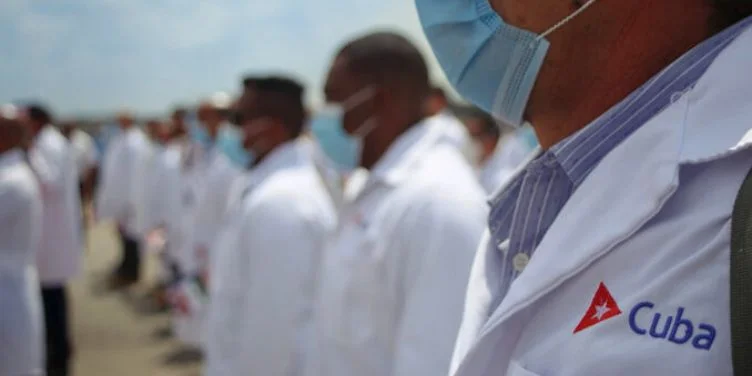
Lima, Peru – Several Cuban doctors exported by the Castro regime to Angola plan to sue an above (Corporation Antillana Exportadora SA), part of the GAESA military conglomerate, so they denounce as the theft of their salaries in dollars within the island.
According to a coverage made by the Independent Portal 14ymedioThe issue motivates the catharsis of the doctors since this Friday in Launda, the day they began meetings with officers to address their disagreements.
Although the contract signed with Antex indicates that they can extract dollars in cash once in Cuba, the current trigger for the discomfort of doctors has been the decision of the regime to transfer part of their savings on the island to a classic card, without the possibility of having liquid money.
Given the discontent, the justification of the coordinator of the meeting was to appoint the scapegoat of Castroism, the American embargo, as well as other difficulties in transferring the money to Cuba.
“Well, why do you send my money for Cuba? If in Cuba the money you can not give it to me, why do you send it, why don’t you 14ymedio under anonymity.
The doctor warned that he was going to look for a jurist and was going to take legal actions against the corporation due to breach of the contract.
“That classic card is why it is not real money in hand,” said the doctor. The demand motion was subsequently seconded by other colleagues, who see in classical a strategy to force them to spend on New stores in dollars imposed by the Cuban government on the island.
The individual would force the professionals returned from Angola to spend their currencies on food, appliances and the scarce inventory of the dollarized stores of the regime, denying them the possibility of using it for the purchase of real estate or other investments that they deem appropriate.
The Cuban doctors have expressed their disagreement through several channels, even sent a direct letter to the ruler Miguel Díaz-Canel. Frustration has been exacerbated to the extent that they have not obtained a response from the letter, or from any other way.
“We have lost relatives, births of children, diseases. These are moments that we are not going to recover,” said a doctor about the emotional cost of the so -called “medical missions.” Others also highlighted the risk to contracting dangerous diseases such as malaria or work in remote areas of Angola, exposed to crime and even died.
According to information revealed by The touchthe Anterx Corporation received more than 1,000 million dollars from Angola. The GAESA entity has already been sanctioned by the United States Foreign Assets Control Office (OFAC).
“This of giving us a classic is the worst scenario. Who is thinking about us? It is what I wonder. Who thinks of us? Who takes those measures and really thinks about the collaborator? (…) raped, stolen, disappointed, so I feel,” said a Havanera doctor who has been in Angola for more than four years.
On the Cuban part the control is iron about doctors
In conversation with Cubanet, The director of the Cubalex Legal Information Center, Laritza Diversent, said that what Cuban doctors face in international missions – including Angola – fits fully into the definition of modern slavery according to the agreements of the International Labor Organization (ILO) and international law.
“Forced labor and modern slavery are defined, among other things, by Extreme vulnerability of the person, “Diversent explained.” And every person who lives in Cuba today is in a vulnerability situation, thus being graduated from the university. “
The lawyer emphasizes: “When you threaten someone with her salary, to return it to a place where she has worse conditions, there you are abusing and using your power.” And he adds: “You implement a whole system where the threat is to return it to a place where there are 72 hours of blackout, where people have no food, where they have no money to access food or medicines … that is to take advantage of you.”
Diversent, who has interviewed numerous doctors who have participated in missions in different regions of the world, points out that control over workers is systematic: “After 6:00 in the afternoon, [en algunos de los países donde cumplen misión] They have as a kind of curfew. That curfew is not written, but from the Medical Mission Operations Center they call the houses where they are staying and make a list pass. ”
The sanctions, he states, include from “a public warning in front of their peers” to the deduction of 10% of the salary. In addition, the doctors must report their movements and, in some cases, they are forced to betray colleagues who have defected. “If that is not control and Lack of freedomI don’t know what the lawyer said.
For Diversent, it is particularly serious that doctors be forced to carry out activities outside their profession, such as “talking about the work that does the medical mission” or participating in propaganda acts. This, he warns, has a political impact: “Medical missions influence the electorate (…). If they are taking them to rural regions where other doctors do not want to go, that already influences the vote. Therefore, it is a political benefit for those who are in power.”
Diversent concludes: “They do not share their salary voluntarily, they do it because they are in a condition of poverty. That is the basis of slavery. It is a form of modern slavery. You have to read the ILO agreements on forced labor to understand that what the Cuban doctor lives in these missions is not cooperation, it is exploitation.”
“They [los médicos cubanos] They are the last link in the chain, “says the lawyer.” The only solution is for them to go out and talk [denuncien]. Unfortunately they are under the threat that they return them to Cuba and process them – their reality is cross -border repression – but all they can do is keep talking to the independent press. ”