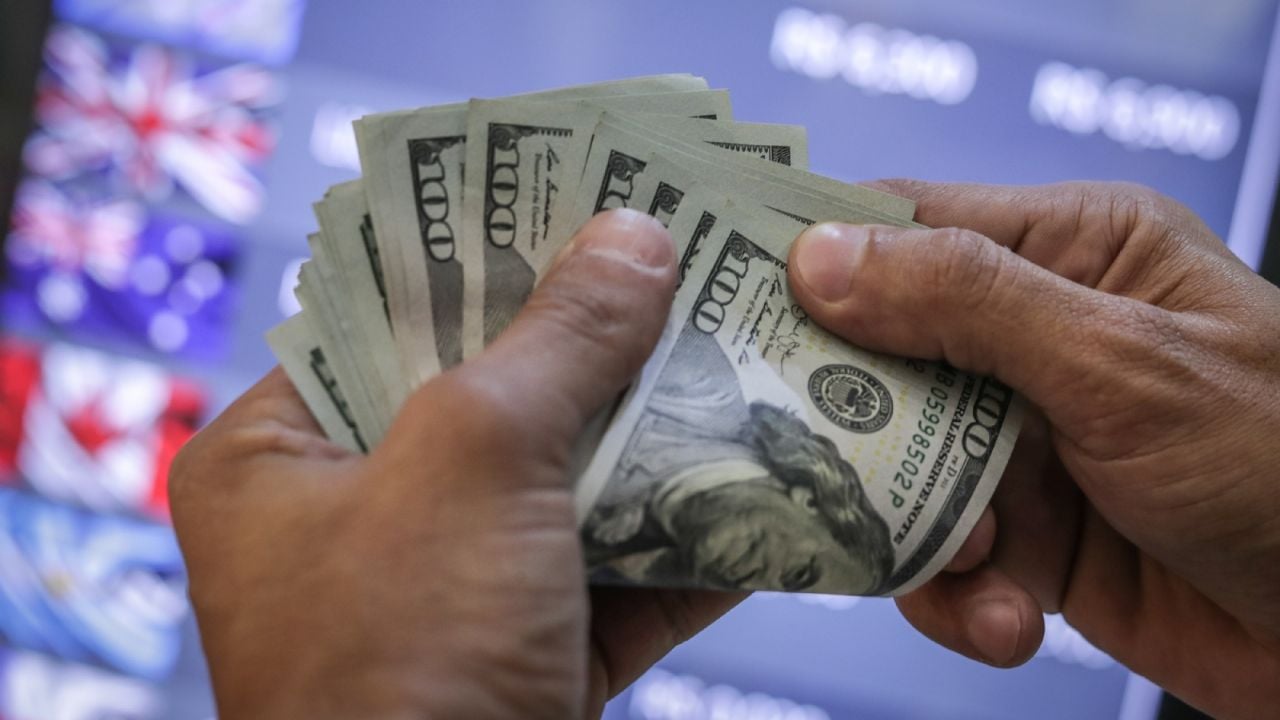
The exchange day was developed in a context of relative stability, although with latent tension signs in the Argentine financial market. The price of dollarboth in its official version and in the parallel market (dollar Blue), it was again the protagonist of the economic agenda, reflecting the expectations, fears and strategies of the different actors of the system.
According to the data relieved by different financial sources and specialized media, the dollar Official operated at the Banco Nación at $ 1270 for purchase and $ 1310 for sale, while in the average financial entities published by the Central Bank, it was $ 1271.81 (purchase) and $ 1312.80 (sale).
For its part, the dollar Blue, which is negotiated in the informal market, quoted at $ 1320 for purchase and $ 1340 for sale, staying stable with respect to the previous day. In some surveys, such as the financial field, slightly lower values were recorded: $ 1315 (purchase) and $ 1335 (sale).
The gap between the official dollar and the Blue remained around 3.7%, a relatively low level if compared to periods of greater exchange volatility. This difference, although moderate, remains an indicator of distrust that persists in certain sectors with respect to the official exchange rate.

Fountain: Dollar today
In addition to the official dollar and the Blue, the market offers other variants that reflect different financial operations: Dollar MEP (stock market): $ 1297.02 (purchase) / $ 1299.90 (sale). CCL dollar (counted with liquidation): $ 1300.90 (purchase) / $ 1302.40 (sale)
Dollar or tourist: $ 1703 (sale), result of applying the tax surcharge to the official dollar. Crypto dollar: $ 1305.65, according to platforms such as Bitso. These quotes show a price dispersion that responds to the different restrictions, taxes and mechanisms for access to the exchange market.

Economic context
The relative stability of dollar Blue in August contrasts with the previous months, where the exchange pressure had been more evident. So far this month, the Blue rose 2% compared to July, but accumulates a decrease of 1.12% so far this year, if compared to the January values.
Analysts warn that current calm could be transient. The evolution of inflation, political definitions in capital control and negotiations with international organizations such as IMF are factors that could alter balance.
Followers in Google News And in our channel of Instagramto continue enjoying the latest news and our best content.