Johanne Sacreblu began as an idea on Tiktok and quickly evolved to became a Viral phenomenon on YouTube. Since its launch on January 25, the short film has exceeded 3 million visualizations, consolidating itself as one of the most resonant expressions of the newly coined protest cinema. Now, with its premiere in movie theaters by the hand of the chain CINDOTJohanne Sacreblu achieved what Emilia Pérez, the French film that caused this movement, did not get: fill the movie theaters.
In an interview for The economist, Camila D. Aurora, trans activist and director of Johanne Sacrebluhe shared his emotion for the impact of the short. For her, it is not only an exercise of satire, but a political statement and a resistance tool.
“I feel grateful, loved and motivated. From the beginning, This project was conceived as a form of protest rather than entertainment. While it has been incredible to see how the public has received it with such enthusiasm, the most important thing for me is that the message arrives strong and clear: the film Emilia Pérez It is directly an act of discrimination against Mexicans. ”
The film Emilia Pérez is directly an act of discrimination against Mexicans “: Camila D. Aurora
Camila D. Aurora directed this media (as was finally classified) and promoted a collective financing campaign that allowed its realization. Through GOFUNDMEhe managed to raise 174,706 pesosan amount that although it is modest compared to the large cinematographic budgets, became the basis for a project that quickly captured the attention of the public. According to the filmmaker, the funds raised by the exhibition will be allocated to associations of seeking mothers and other organizations.
In the short, the protagonist is an heiress of the bread industry in France who decides to challenge the systemic racism of her country with “The strongest weapon you have: love”. With a burlesque tone and direct references to the clichés of French cinema, the film plays with the same elements as Emilia Pérez He used, but with a turn that puts the cultural appropriation and trivialization of the suffering of others in the center of the discussion.
It is expected that before the end of February, a Extended version With scenes that were left out of the first version, including a scene with hundreds of pampering that will seek to break a Guinness record.
Regarding this second stage of production, Camila said: “I had the opportunity to have a broader talent range, because we gave the opportunity to cosplayers, makeup artists, choreographers, really what I love about the opportunity is that, that we have more talent to Our disposition, and I feel that is wonderful because the more they join, the better. ”
Photo EE: Rocio Melgoza
CINDOT opens the doors to alternative projects
One of the most important achievements in the history of Johanne Sacreblu was Cinedot’s decision to project it in his rooms. This cinemas was key in the distribution of short film.
Ramón Estévez Fajardo, CEO of Cinedothe explained to El Economista, the motivation behind this decision: “We seek to have a closer link with the public. We saw that there was a genuine interest in seeing this content in cinemas and we seemed important to give it a space. It is not the first time that We do it; We have always tried to open our rooms to alternative projects“
The programming of Johanne Sacreblu began on February 14 in several cities in Mexico, including Mexico City, Tijuana, Querétaro and Cuernavaca. The permanence of the short billboard will depend on the support of the public, but the initial reception was more than positive in its premiere on Thursday, February 13.
Photo EE: Rocio Melgoza
The public’s voice: is this the birth of protest cinema?
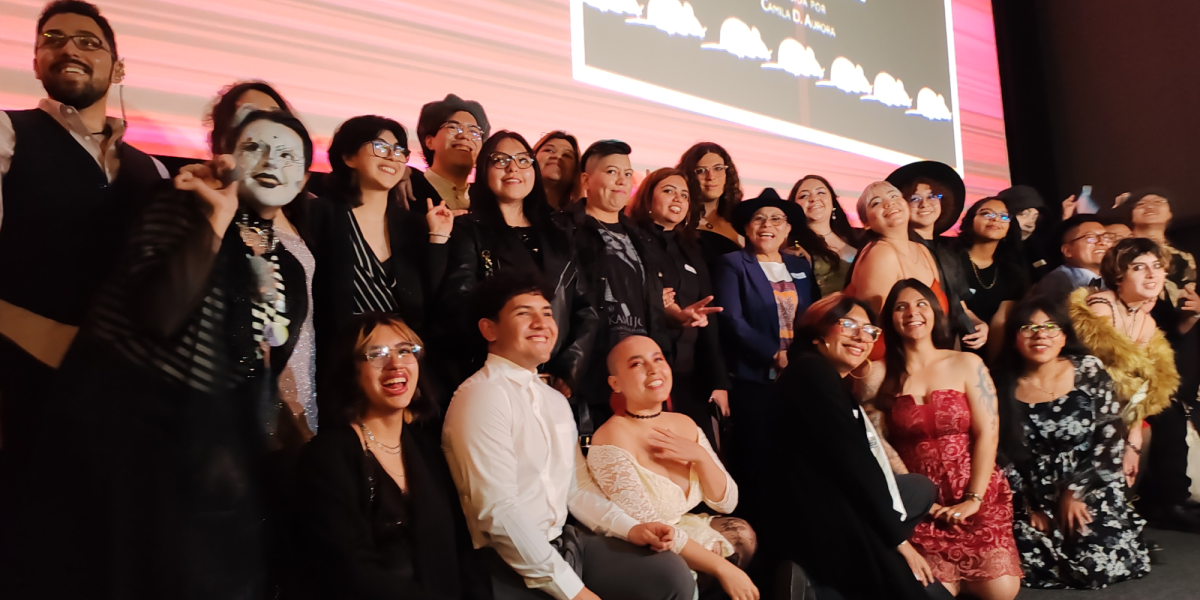
The Johanne Sacreblu Premier brought together a diverse audience, from activists to curious cinephiles.
Cristian Valdez, a spectator who attended the first function, commented: “It seemed like a fun project, but with a very important background message. I didn’t see Emilia Pérez Because the reviews were terriblebut when I knew that this short was a form of protest, I decided to support it. “
Gabriel Ángeles, another assistant, highlighted the relevance that this type of productions reach theaters: “This short is a way of saying that We will not allow us to represent us wrong. It is also a lesson on how cinema can join as Mexicans. “
For its part, Mala, who follows the project since its inception in Tiktok, highlighted the impact of activism within the cinema: “Art and activism are not fought. I am inspired to see that we can move forward our own projects. It is clear that the project is activism, and I love how it gives visibility and opportunities to the trans community, especially because many of the cast and Camila are part of it. ”
Photo EE: Rocio Melgoza
Johanne Sacreblu’s phenomenon aroused a broader debate. Film influencers such as Javier Ibarreche mentioned that this short could open the door to new forms of expression within Mexican cinema.
Ramón Estévez Fajardo said about this: “I think There is immense creativity And to protest there are many ways and if this serves precisely to encourage that, so that people want to see it, then hope and be the beginning of that trend. I think many people have said that they want to see it in the cinema, because we already got it. Now let’s see if it is true that people are going to overflow and go to the cinema to see it.
The question that remains in the air is whether this trend will continue. Will we see more filmmakers opting for this approach to respond to internal or external narratives? Can independent cinema consolidate as a cultural resistance platform?
“Do not get into Mexico”
The French film Emilia Pérezdirected by Jacques Audiardwas initially received with praise at international festivals, obtaining multiple awards and accumulating 13 Oscar nominations. However, his arrival in Mexico was not received with the same enthusiasm. The work, which tells the story of a drug trafficker who changes identity and becomes a woman, was pointed out by critics, activists and journalists as a frivolous and decontextualized representation of the humanitarian crisis in Mexico.
The criticisms did not wait. Photography director Rodrigo Prieto, known for his work in Barbie and Killers of the Flower Moon, expressed his dissatisfaction with the film for his lack of authenticity. The journalist Cecilia González was even more forceful in her social networks, describing her as “offensive” and “frivolous” for profiting with the tragedy of the disappeared in Mexico.
Before this panorama, Johanne Sacreblu was born, a satirical musical who, far from trying to replicate the drama of Emilia Pérezhe chose to use humor and irony as protest tools. The final message of its director, Camila D. Aurora resonates: “They don’t get into Mexico.”