He Dominican state delivers 5.6 million gallons of water each month to 21 public transportation federations dieselexempt from paying 272 million pesos in taxes, as part of a subsidy whose purpose is, according to the official discourse, to avoid increases in fares.
The 67.5 million gallons of diesel delivered each year are allocated in items defined by the Government without clear legal parameters, they are distributed among the routes according to a list prepared by the large driver groups and are sold to drivers under a insufficient supervision.
This subsidized fuel the productive activities of the urban transportinterurban, tourist, cargo and student School Transportation Program (BRING).
18,478
It was the subsidy to generators, miners, free zones, construction companies and diplomats in 2024. (In millions of pesos)
3,887
It is the annual expense of subsidies for diesel, Bonogás and Motoben. (In millions of pesos)
74%
The subsidized diesel is distributed between Conatra, Fenatrado, Fenatrano and Fenacho.
He President Luis Abinader reestablished this plan on September 7, 2021 (Danilo Medina had suspended it), increased the Bonogás from 428.9 million to 633.8 million pesos and created a new subsidy called Motoben, with which 1,500 pesos are delivered monthly to motorists with an annual cost of 72.8 million.
They all add up to a annual expenditure of 3,887 million pesos, of which 3,265 million correspond to diesel.
The most benefited
The largest beneficiaries are the National Confederation of Transport Organizations (Conatra) and the National Federation of Dominican Transportation (Fenatrated), directed by the senators Antonio Marte and Ricardo de los Santos, respectively.
They are followed by the National Federation of Transportation New Option (Fenatrane) and the National Federation of Drivers (fenacho). These four concentrate 74% of the subsidy.
The fuel is deposited in the tanks on the routes according to the amount assigned by the federations and, from that moment on, it is their responsibility to ensure that it is only sold to public transport units at a discounted price in 48.37 pesos.
The National Institute of Traffic and Land Transportation (Intrant), coordinator of the program, maintains that Milton Morrison’s management began to apply audit and oversight mechanisms as of January 2025, three years after its creation.
They carried out audits of 417 associations or unions and began to monitor the distribution and receipt of fuel, review invoices issued by distributors and inspect tanks and carrier operation terminals.
From Fenatrane, Juan Hubieres denies that such supervision exists. “If you receive a million gallons and you share that with some official, are you interested in having that supervised? Yes, there was supervision when Leonel Fernández, but only for us; not for the big ones,” explains Hubieres.
For years, the transport leader has maintained the complaint that the subsidized diesel is distributed according to political connections and that 40% of the other subsidy granted to generators, miners, free zones, construction companies and diplomats “is sold in the black market”.
He Treasury registered a tax sacrifice of 18,478 million pesos for the refund of the selective consumption tax (ISC) on fuels to the five aforementioned sectors.
“Many friends of politicians receive subsidies to distribute the earnings. What is the profit? Forty pesos for a million gallons: that’s 40 million pesos,” he accuses.
On the contrary, Antonio Martepresident of Conatraand Mario Diazfrom the National Federation of Christian Social Transportation Workers (Fenattransc), they affirm that the authorities are strict with surveillance and guarantee that transporters handle the issue with transparency.
Fenattransc It has regulations for the use of fuel that prevents, among other things, pouring it into jugs or into private vehicles.
The 30 thousand gallons monthly they receive supply their 426 trucks charging agricultural products from the field.
The distribution
He Intrant directs the program under the “Agreement on cooperation in the public transportation sector of the Dominican Republic”, signed with the Ministry of IndustryCommerce and MSMEs (MICM) in 2021, where the funds come from.
The transport businessmen deliver the list of beneficiaries that the Intrant refers to the Dominican Oil Refinery (Refidomsa) so that it dispatches to each route.
Hubieres maintains that Fenatrane is discriminated against because it is not related to the Government, since it transports close to 70% of the capital’s passengers, but more than 80% of its drivers do not have Bonogás, while Antonio Marte He assures that about 40% of his people do receive it.
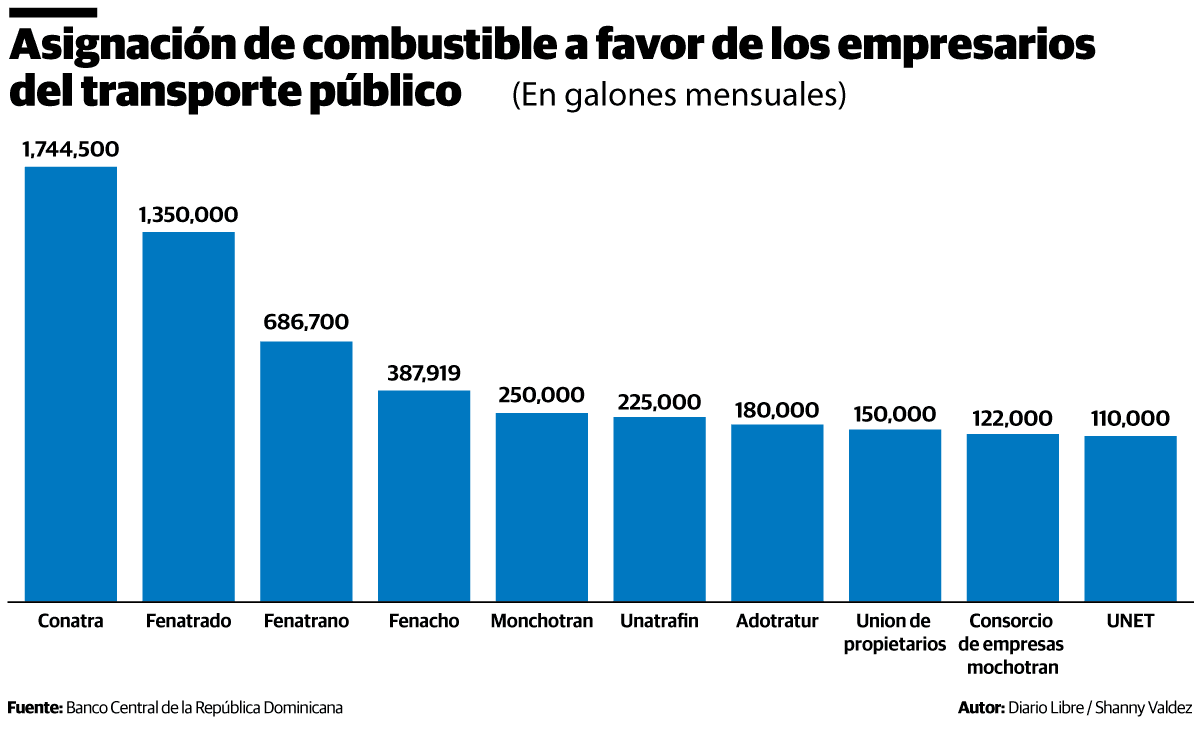
TO Fenatrane correspond 686,700 gallons per month, for an exempt value of 33.2 million pesos, while at Conatra They assigned 1.7 million gallons, for a subsidy of 84.4 million pesos.
That amount represents 53.35% of the 3.27 million gallons that, according to Mars, its vehicles consume each day.
TO Fenatratedresponsible for the transportation of goods in heavy vehicles, is responsible for an allocation of 1.4 million gallons and an exempt value of 65.3 million pesos each month.
fenachochaired by Alexis Dislareceive 387,919 gallons. They are followed by the Transportation Driver Movement (Mochotran) with 250,000 gallons; National Union of Transporters and Related Workers (Unatrafin) with 225,000 gallons; the Owners Union with 180,000; the Dominican Association of Tourist Transportation (Adotratur) with 150,000 gallons and the Join with 110,000 gallons.
The Specialized Body for Control of Fuels and Trade of Goods (Ceccom) is in charge of monitoring and intervening when it detects the external sale of diesel for public transport. The institution reported to Diario Libre that it had carried out, in the last 10 years, some 230 raids on the so-called unions.
There, 344,832 gallons were seized and those responsible for the crime were referred to the Public Ministry. Although the offenders are not brought to justice, they are punished with the loss of the retained fuel, of which the State takes possession.
“When there is a failure, they (Ceccom) are there, I don’t know how, it seems like they are witches. But they are watching. That doesn’t lend itself to much distortion because we are serious people who are in that supply circle,” says leader Mario Díaz.