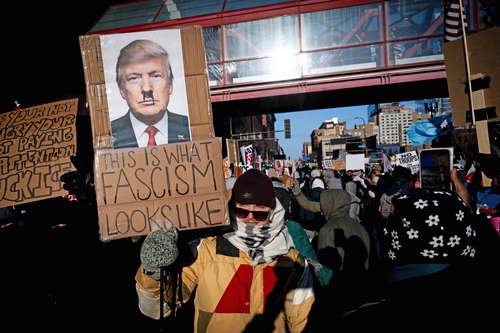
▲ A person holds a sign that says, “This is what fascism looks like,” with a photo of Donald Trump with a Hitler-style mustache, during the ICE protest outside Minnesota: Day of Truth and Freedom, in Minneapolis.Photo Afp
Alonso Urrutia
La Jornada Newspaper
Monday, January 26, 2026, p. 4
The return of Donald Trump to the White House for a second presidential term has brought with it a chain of tensions and shocks in the relationship with Mexico. The bilateral agenda has been conditioned by the magnate’s threats to impose tariffs on Mexican exports; the threats to end the trade agreement; the tightening of measures in agricultural matters – especially against tomatoes, avocados, livestock and, more recently, Mexican strawberries – as well as the pressure to comply with the water quotas established in an old agreement.
Obsessed with correcting the trade deficit in the balance with Mexico, as part of a broader strategy to reconfigure United States trade relations, Trump has used, since his return to the presidency, economic retaliation as the spearhead of this recomposition. With its strident discursiveness and intimidating rhetoric, Mexico has not been the exception.
Since his first day in office, January 20, 2025 – a date that inaugurated a new era characterized by greater vehemence in threats – tariffs became the main negotiating instrument of the White House, loaded with a high intimidating component towards his interlocutors.
In North America, Trump’s discursive game has turned the trade agreement into a kind of hostage, with the aim of subduing its partners under the argument that said agreement has endorsed abuses against the US economy.
As the United States’ main trading partner, Mexico has particularly resented this new stage in the bilateral relationship, which has motivated intense negotiations at the highest level. One year into this new era, Trump and Claudia Sheinbaum have already held 15 telephone conversations and a trilateral meeting in Washington – which included the Prime Minister of Canada – through which Mexico has managed to greatly clarify the impact of the tariffs.
January 20, 2025, marked on the calendar of American politics as Trump’s return to the White House, meant a dizzying return to power. Proclaimed by the magnate as the beginning of a new “golden era,” it was accompanied by a cascade of executive orders and announcements that, for Mexico and Canada, represented the first warning: the imposition of 25 percent tariffs starting February 1.
In the case of Mexico, the threat was accompanied by the announcement of the militarization of the border and implied conditions for both our country and Canada: despite the current trade agreement, tariffs would be applied if both countries did not make greater efforts to contain fentanyl trafficking and migratory flows to the United States.
It was the dawn of the new Trump era, full of turbulence. From then on, without opening space for confrontation and opting for a dialogue without fanfare, President Claudia Sheinbaum deployed a strategy that privileged diplomacy and caution. This position has earned it international recognition and has allowed it to negotiate on good terms the deadlines, percentages and even the products that would be impacted by the tariffs.
Stop the flow of fentanyl
Howard Lutnick, then in the ratification process as United States Secretary of Commerce, confirmed Trump’s intentions, beyond the commercial relationship: it was a measure aimed at putting pressure on both countries to stop the flow of fentanyl. Once the first deadline had passed, Trump extended the entry into force of the tariffs for the first time and reduced them to 10 percent, with application scheduled for February 4.
“There is no longer room for Mexico or Canada. The tariffs will come into effect at midnight,” he warned the day before.
In exchange for reinforcing the border with 10,000 National Guard troops to stop the migratory flow, among other agreements, Mexico obtained a new one-month extension in the application of tariffs.
On March 4, a few hours before a new deadline and with a call from Sheinbaum for a massive rally in defense of sovereignty, diplomatic efforts once again postponed the entry into force of the tariffs, although a 10 percent tax was set for Mexico. However, the imposition of tariffs on automobile exports – the most dynamic sector of the Mexican economy – as well as on steel and aluminum was maintained.
Since then, the dynamics of the bilateral relationship have been marked by ultimatums, diplomatic negotiations and extensions. The Ministries of Economy and Foreign Affairs have been the main instruments used by Sheinbaum to deactivate, time and again, the imposition of tariffs, through continuous negotiating tables aimed at mitigating American disagreements. To the point that, in July, Secretary Marcelo Ebrard proclaimed a new 90-day extension as a “strategic triumph.”
With the world in suspense over the change in US tariff policy, Mexico’s diplomatic strategy has allowed it to better navigate it and keep the negotiation of the Treaty between Mexico, the United States and Canada in force. Beyond Trump’s disqualifications of this agreement, the renegotiation deadlines scheduled for 2026 remain.
Since then, tariffs have become the main negotiating tool with Mexico in areas such as security, migration, water and the countryside. In September, a new US attack was detonated by the Secretary of State, Marco Rubio, who warned of the need to eliminate 57 barriers that, according to the Departments of State and Commerce, affected the commercial relationship between both countries.
“Unfair” practices
In agricultural matters, Trump returned to the offensive in January 2025 by threatening with tariffs on avocados on the eve of the Super Bowl. In July, the United States reported that it would apply a 17.09 percent tariff to tomatoes imported from Mexico, upon withdrawing from the agreement to suspend the investigation. antidumping on fresh tomatoes for 2019, after failing to reach an agreement with the Mexican government.
“Mexico remains one of our greatest allies, but for too long our farmers have been oppressed by unfair trade practices that reduce the prices of products such as tomatoes,” was the argument put forward. Associated with the screwworm plague, the Trump administration also closed the border to Mexican livestock and, more recently, has threatened to take measures against Mexican strawberries due to alleged practices of dumping.
The imposition of tariffs has not been the only side of pressure towards Mexico. Beyond Trump’s public praise for Sheinbaum – “she is an elegant and fantastic woman” – there has been a hardening in other areas, particularly in security and immigration.
On December 8, Trump issued a new warning: the imposition of a 5 percent tariff on Mexico if it did not comply with the quota of 200 thousand cubic meters of water owed to Texas during the last five years, derived from an unusual drought in the region. New rounds of negotiations dissuaded the United States from applying the measure, and Mexico committed to liquidating the debt gradually.
July 1st marks the deadline for renegotiating the treaty. A few months before the midterm elections in the United States and in the midst of a public rupture between Trump and the Prime Minister of Canada, Mark Carney, the context for the negotiations appears especially complex.