The bullet attack during the Agua Marina concert in Chorrillos ignited protests, recriminations and demands for responsibilities towards the government. Political groups took it as a breaking point to demand that the president Dina Boluarte respond in a concrete way to the insecurity crisis that has identified your government.
In this context, almost all the benches have joined the vacancy motion due to “permanent moral incapacity”, arguing that the government’s management is incapable of protecting citizens.
According to Congressman Elías Varas, one of the motions would have already exceeded the required 33 signatures and would be ready to be formally entered. In that first list, banks such as Together for Peru, the Socialist Bank, Podemos Peru, Avanza País and the Democratic Bloc are mentioned. In total they comment that there would be about 36 rubrics.
Initially, Fuerza Popular had refused to join the request, but then announced a change of position and declared that “it will support any vacancy motion,” this being a breaking point as it is the bench with the largest number of congressmen.
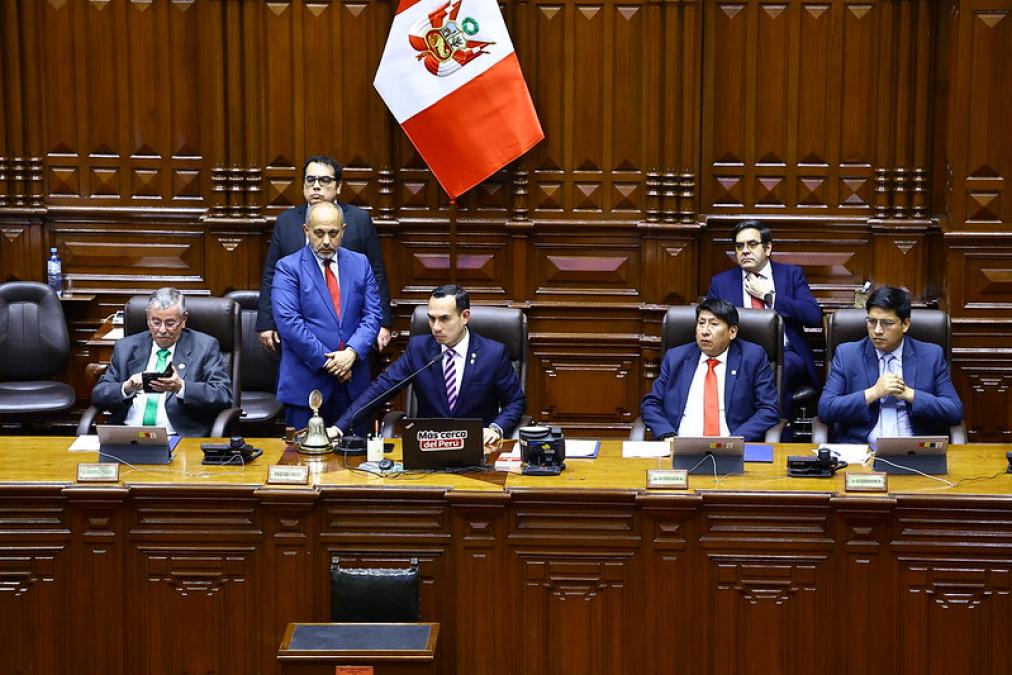
#CongresoInforma | With the corresponding signatures, two vacancy motions were presented against the President of the Republic, Dina Boluarte Zagarra, due to permanent moral incapacity.
It will continue its process in accordance with the provisions of the Congress Regulations.
Motion 19769… pic.twitter.com/yR0r33W6OM
— Congress of Peru 🇵🇪 (@congresoperu) October 9, 2025
How does the vacancy procedure work in Congress?
To understand the seriousness of the political movement, it is worth reviewing the constitutional and regulatory mechanism that empowers Congress to vacate a president:
Presentation of the vacancy motion
- A congressman proposes an agenda motion that aims to declare a presidential vacancy due to moral or physical incapacity.
- It must be accompanied by at least 20% signatures of the Plenary (that is, 26 of the 130 congressmen).
- The motion states the facts that support the accusation.
Acceptance of the order
- The Plenary of Congress votes to admit the motion to debate.
- A minimum majority of 40% (52 votes) is required for it to be admitted.
- If it is admitted, the date and time of the debate is set, which must take place – according to the Regulations – between the 3rd and 10th day after (unless the period is reduced with a qualified majority).
Right of defense of the president
- The president or her legal representative may appear before the Plenary Session to defend herself, with a maximum time of 60 minutes.
- If they do not attend, the debate continues without their intervention.
Debate and final vote
- The arguments for and against are discussed.
- So that the vacancy prospers, The vote in favor of two-thirds of the legal number of congressmen is required, that is, 87 out of 130.
- If that quorum is reached, the vacancy is declared immediately.
Presidential succession
- In the event of a vacancy, the first vice president (if there is one) assumes the presidency.
- If there are no vice presidents, the president of Congress does so, and must call elections within a maximum period of five days, so that they are held within the next 120 days.
- Then a Legislative Resolution is issued that formalizes the vacancy, published in El Peruano and communicated to the National Elections Jury.
- This procedure, as Congress has applied in previous cases, is designed to ensure that the debate passes through admissibility filters and strict voting margins.
DINA ON THE EDGE OF VACATION
In the case at hand, the promoters of the request already claim to have met the first threshold: more than 33 signatures (exceeding the base of 26) to enter the motion.
From then on, the steps will be:
- Let the Plenary vote on the admission of the request (requires 52 votes).
- Let a date be set for the debate.
- Let Dina Boluarte exercise her defense or present arguments.
- Finally, the substantive vote, requiring 87 votes to be removed.
RECOMMENDED VIDEO