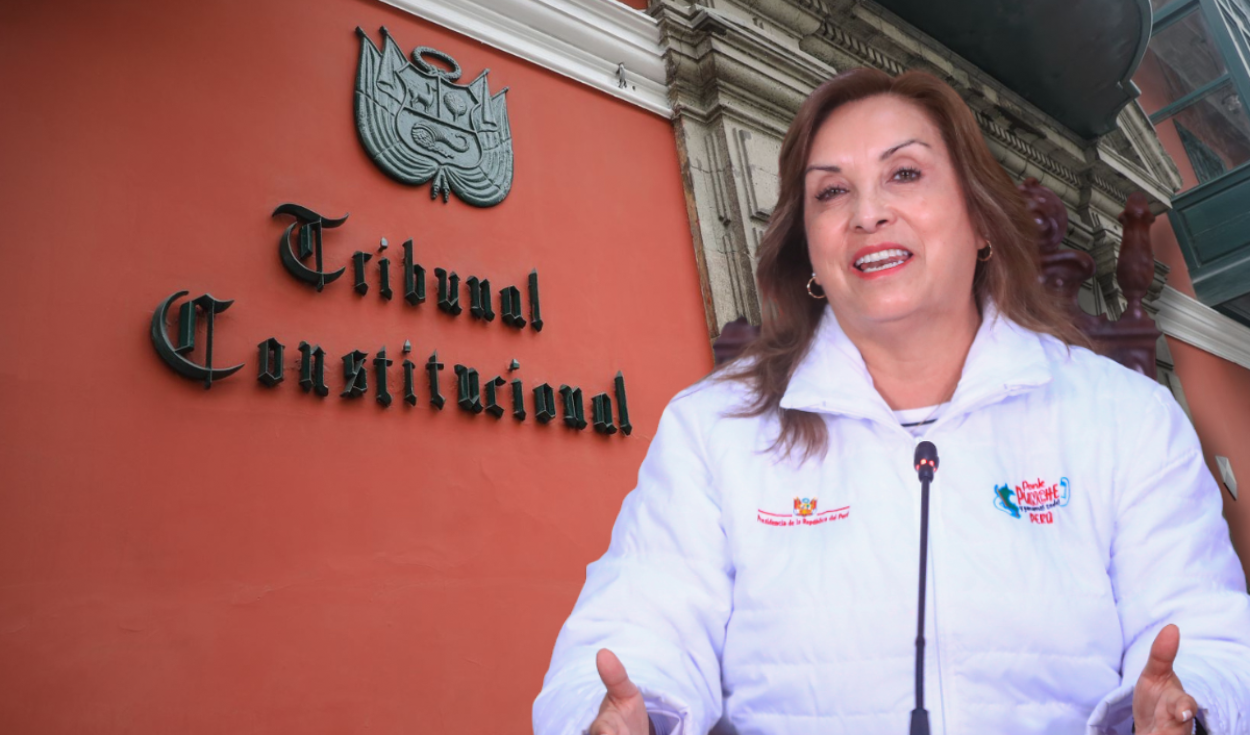
He Constitutional Court (TC) failed in favor of the competence demand presented by the government of Dina Boluarte and established that the Public Ministry and the Judiciary They have no powers to investigate a acting president. With this decision, the magistrates of the TC closed the door to the processes that the president faces for alleged crimes committed during their management, including the deaths registered in social protests.
The judgment, approved by a majority, interprets that article 117 of the Constitution limits any criminal action against the president exclusively to the Congress of the Republic. This interpretation gives a mantle of political and criminal immunity to Boluartearmoring it from the ongoing tax investigations and sitting a precedent that could benefit futures Heads of State In similar situations.
The failure represents a hard blow to the efforts of the Public Ministry for clarifying the alleged crimes committed during the social protests of 2022 and 2023, as well as to the investigations for illicit enrichment linked to the Case ‘Rolex’and for abandonment of functions indicated in the Case ‘Surgery’.
The competence demand was presented by the Executive in 2024 after the opening of several investigations against Boluarte. The process before the TC was backed by the Ombudsman, Josué Gutierrezwho pointed out that the Prosecutor’s Office violated the constitutional order by investigating it without authorization from the Parliament.
You can see: IACHR rejects amnesty law promulgated by Boluarte: “They are benefiting torturers, rapists, murderers”
Dina Boluarte promulgated amnesty law disobeying the Court IDH
Last August 13, Dina Boluarte promulgated the Amnesty Law which favors military, police and members of self -defense committees investigated and sentenced for violation of human rights during the period of the internal armed conflict. With this action, Boluarte disregarded the order of the Inter -American Court of Human Rights (IACHR)issued on July 24, in which it called the Peruvian State to suspend the promulgation of the law until its impact in cases such as La Cantuta and Barrios Altos be evaluated.
The law establishes amnesty for those prosecuted for crimes committed between 1980 and 2000 and grants benefits similar to adults over 70 years for “humanitarian character.” The IDH cut had requested at Peruvian state Stop the process of the law and had warned that, if not, the authorities should refrain from applying it until the court thoroughly analyzes its impact on the rights of the victims.
The promulgation of this law has been rejected by various organizations, including the National Human Rights Coordinatorthat qualify it as a decline in justice and reconciliation in Peru. In addition, the UN He has expressed concern, qualifying the law as a “setback” in the search for justice for victims of human rights violations.