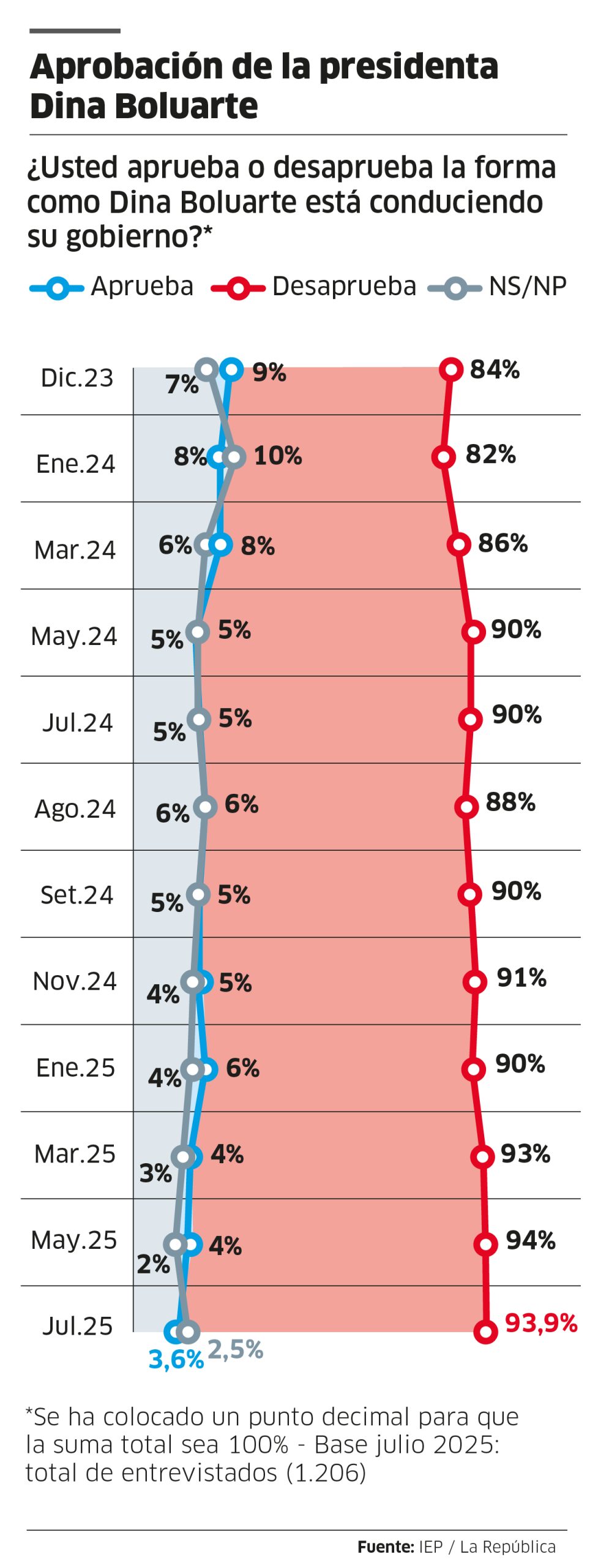
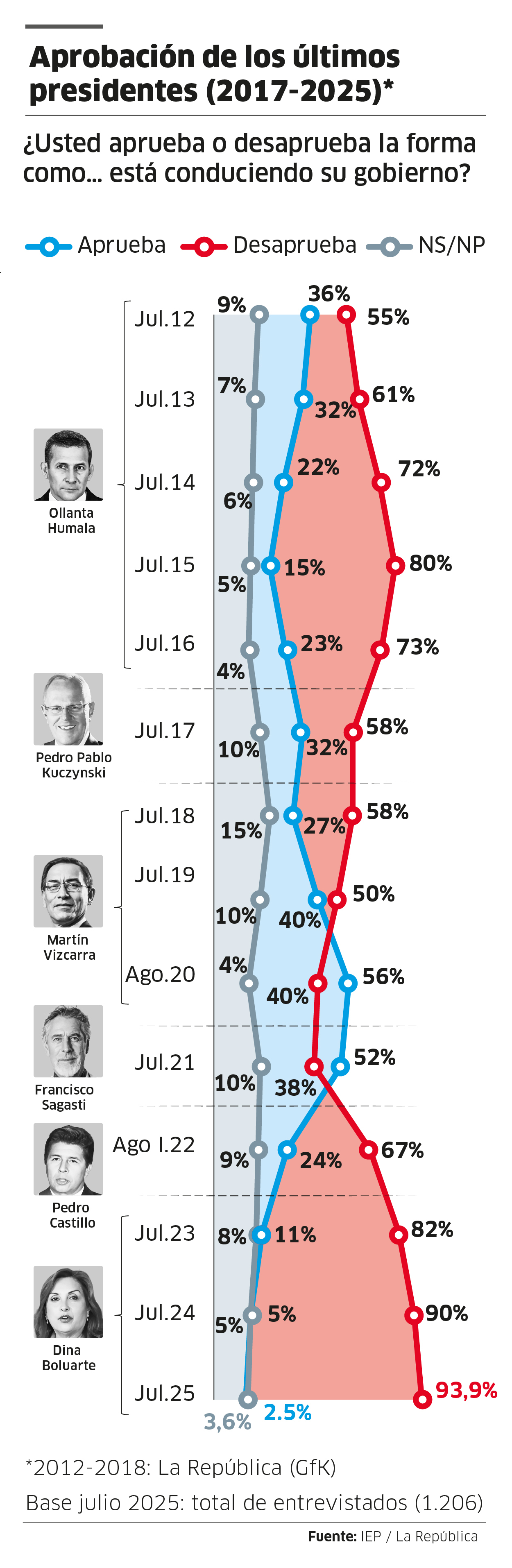
The closeness to National Holidays has not generated that the low approval of Dina Boluarte change. The latest survey of the Institute of Peruvian Studies (IEP), corresponding to the month of July, reveals that the president’s approval is 2.5%, a percentage similar to that of the previous months.
In this way, Boluarte Zegarra remains the president with greater disapproval In the last decade. They follow him Martín Vizcarra and Ollanta Humala with a 4% approval registered in their last years of government.
You can see: Harvey Colchado: “The lawyers of criminal organizations will apply for Congress”
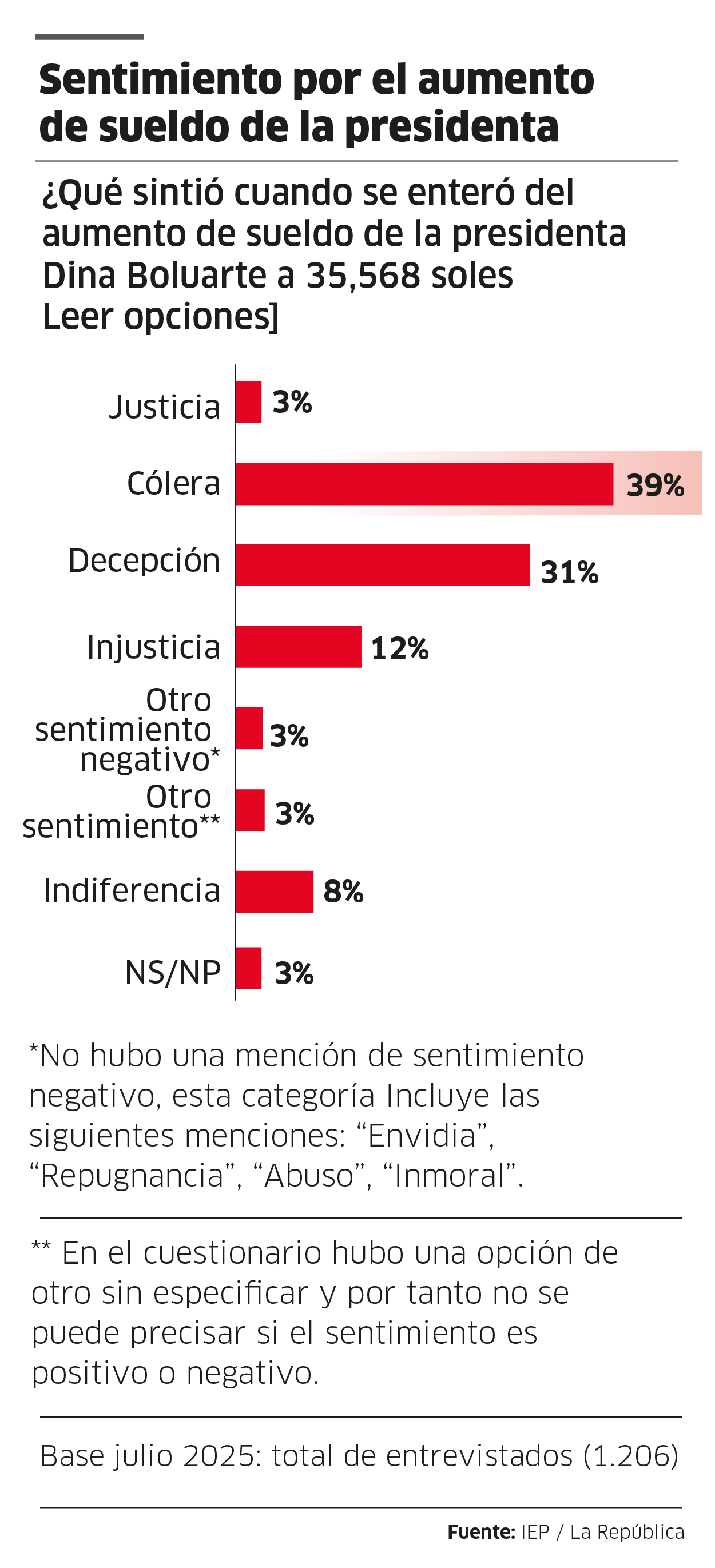
He rejection of the head of state is the same towards its salary increase. When the respondents were consulted what they felt to know that the president would gain S/15,600 to S/35,568, much of the answers were negative feelings.
39% of respondents felt anger/indignation; while 31% outrage, feeling especially present in the southern part of the country, in people of socioeconomic level A/B and those who have higher education. Only 3% considered that it is a fair measure.
Such opposition to the head of state has also been demonstrated in spaces outside a survey. Recently, two university students (PUCP and University of Huacho) protested against Boluarte in their graduation event.
Similarly, on his recent visit to the city of Chiclayo (Lambayeque) to inaugurate the Pope’s route, the president was rejected by citizens. In the midst of protests focused on the main park, where the official event was held, the protesters claimed to “use them” to “make a circus” and try to raise their approval.
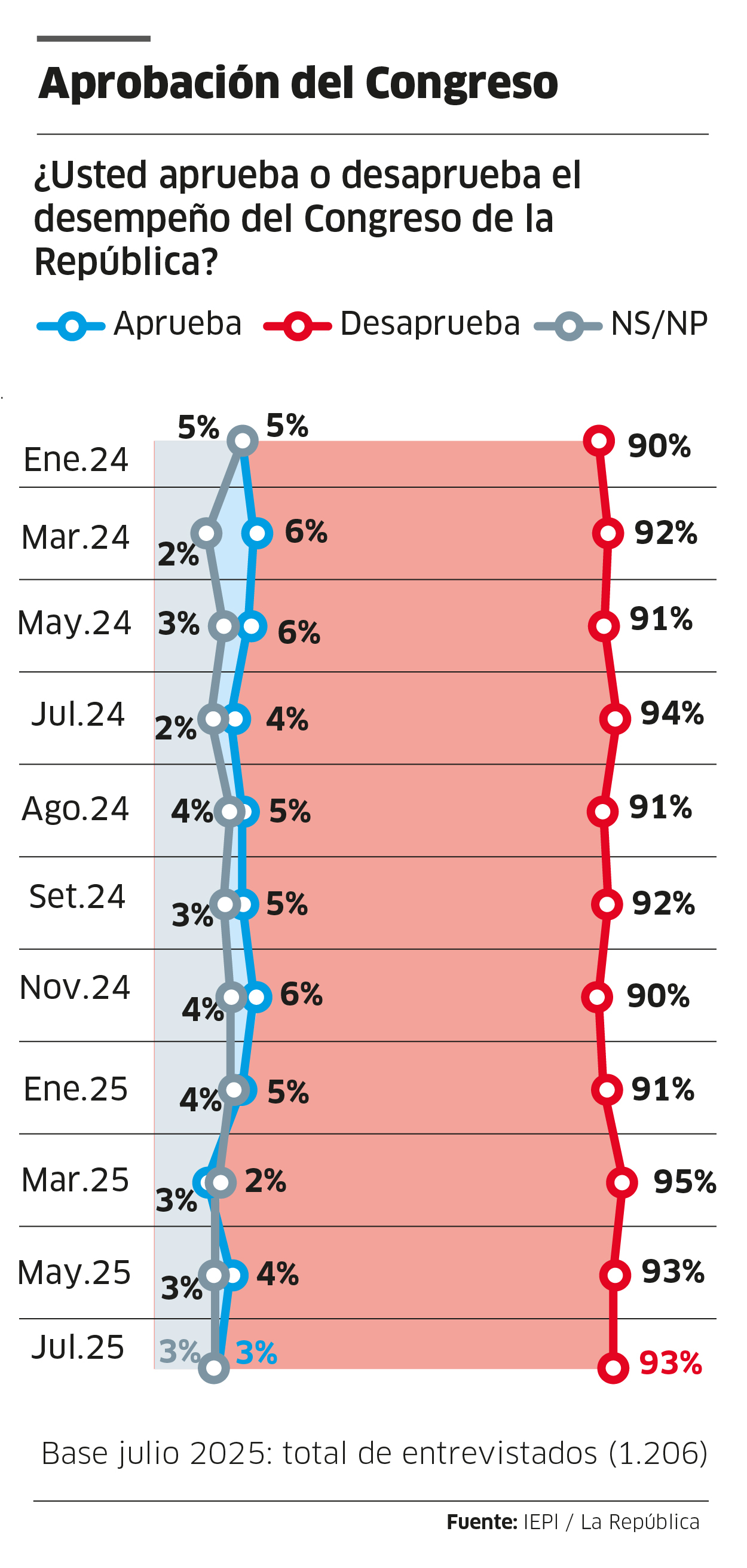
Congress has greater approval than Dina Boluarte
Regarding other state institutions, they share the same scale of disapproval that the dignitary.
Only 3% approves Congress, a highlight because in the previous governments the Executive always maintained a greater approval to the Legislative. According to the IEP analysis, one of the reasons is that it does not represent a real opposition to Boluarte, but on the contrary, they represent the same interests. Of course, shortly from the 2026 elections, some parliamentarians try to take distance from the president.
Low approval of justice system institutions
None of the main institutions of the justice system exceeds 20% of citizen approval.
June and July were the months in which the National Board of Justice (JNJ), led by Gino Ríos, tried to replenish Patricia Benavides as prosecutor of the Nation and, thus, withdraw Delia Espinoza from office, who was legitimately chosen.
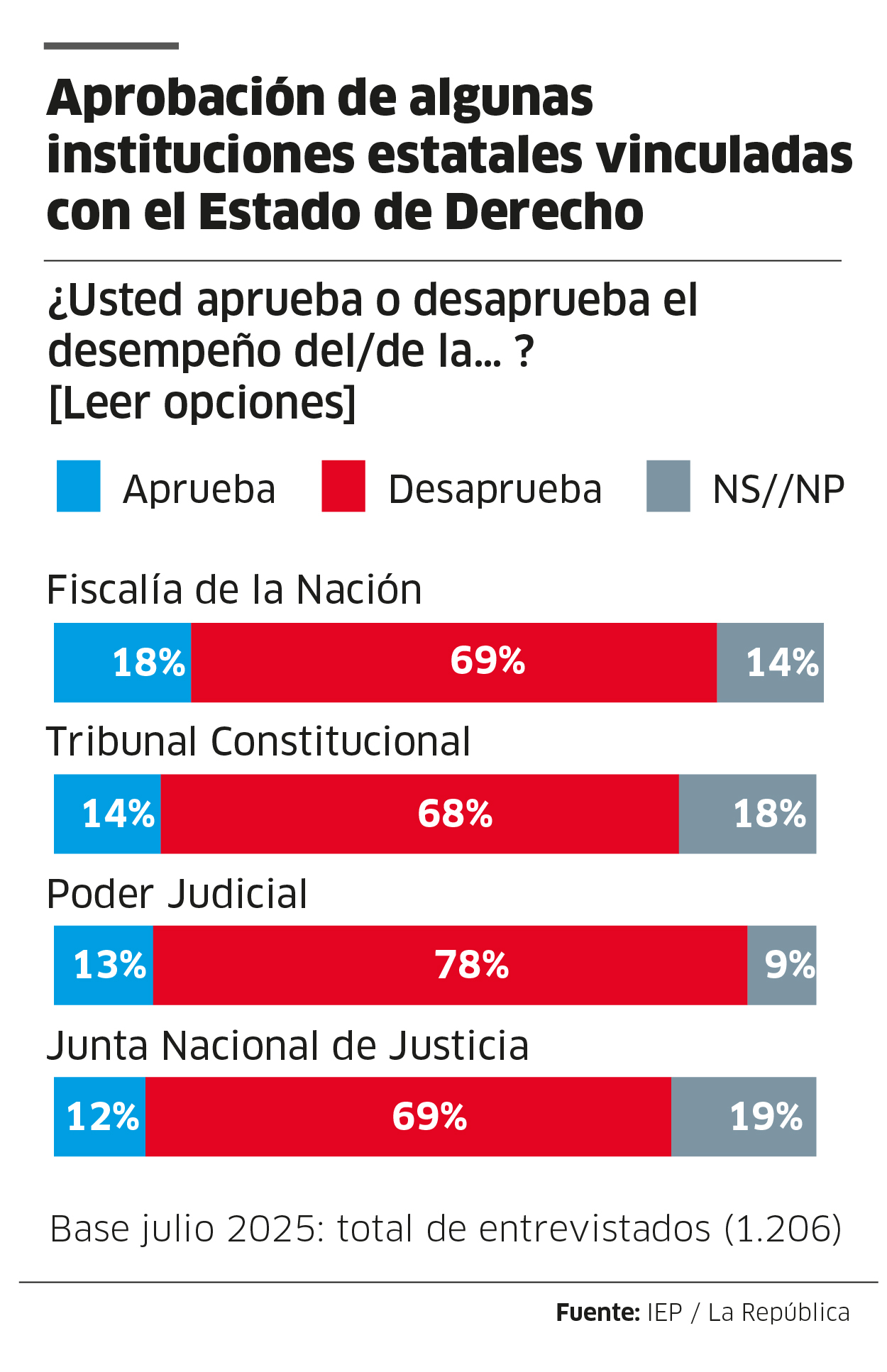
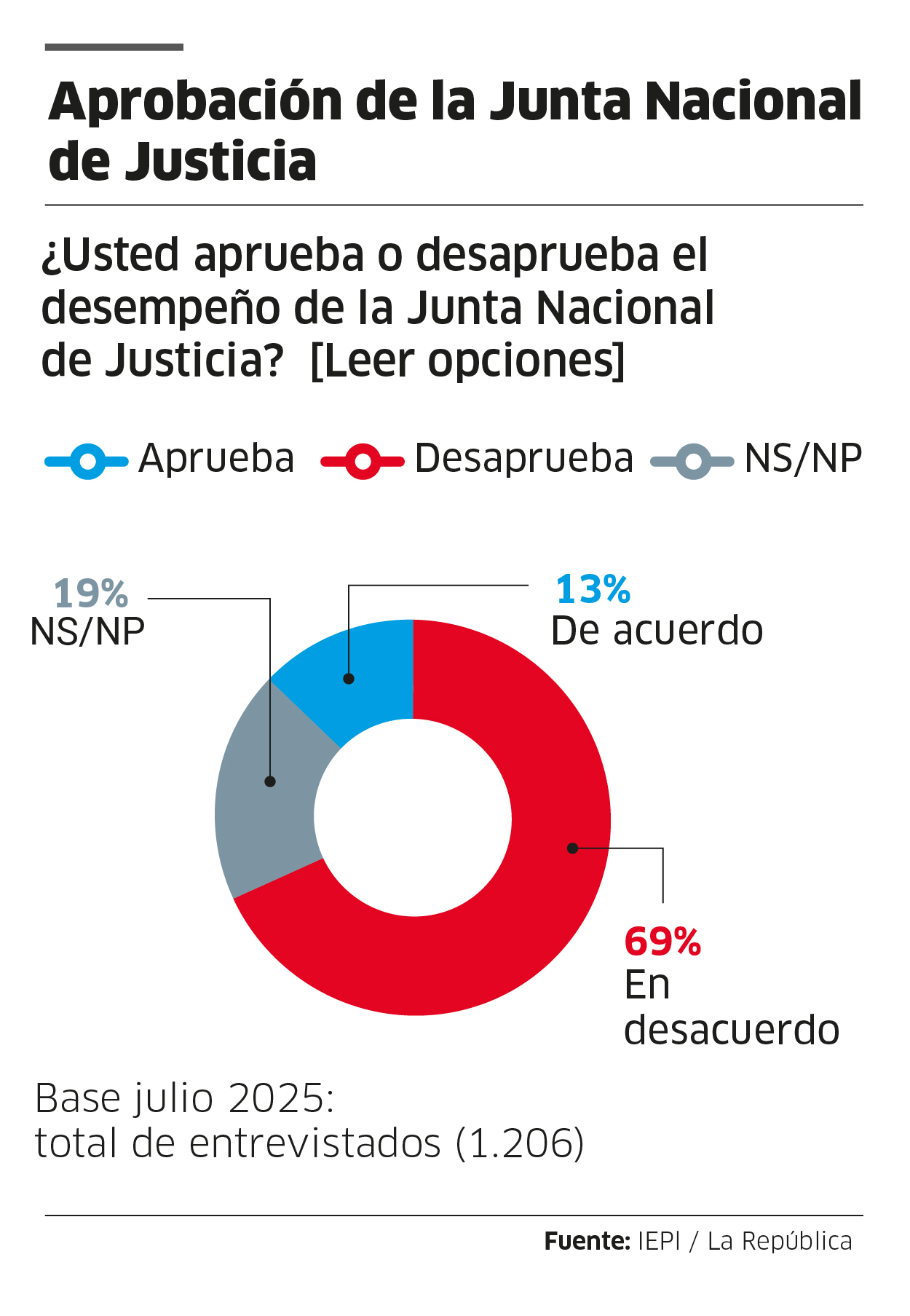
This situation was reflected in citizen perception. 69% disapprove of the management of the JNJ. The disapproval is higher in Metropolitan Lima and the southern part of the country, in people aged 25 to 39, at socioeconomic levels A/B and C, as well as among people who have higher education.
Specific sample of rejection is that 68% do not agree that the National Justice Board He has replied to Patricia Benavides as a prosecutor.
You can see: Congress: reveal more S/ 150,000 payments in favor of Somos Peru through José Jerí
In the case of the Prosecutor’s Office, led by Delia Espinoza, seven out of ten respondents disapprove of their management, especially in Metropolitan Lima and at the socioeconomic level A/B. Thus, only 18% approve the current management. Half of the percentage obtained in December 2022 (26%).
Meanwhile, the approval of the Constitutional Court decreases from 31 to 14% compared to December 2022 (year in which members were elected today). The approval is greater in Metropolitan Lima. The disapproval is greater in the south, in men, at the socioeconomic level C, as well as in people with higher education.