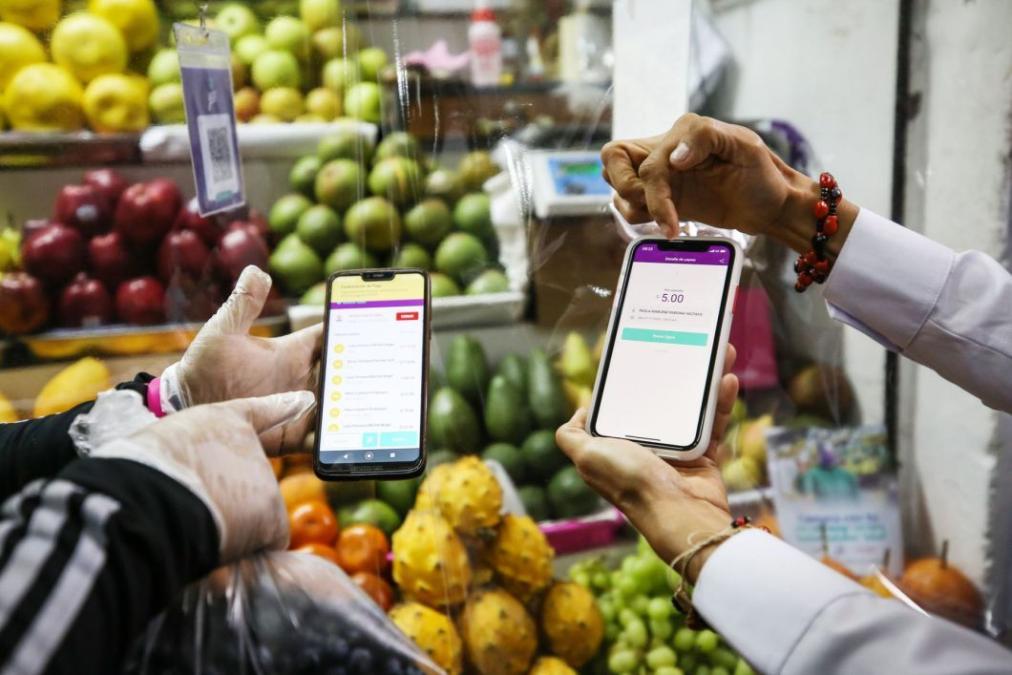
The growing investment of financial institutions in their digital transformation It has led them, on the one hand, to have more efficient operations and, on the other, to benefit users.
Although disbursements for technological conversion have been subject to the capacity of each company, these have been more than tripled compared to pre-pandemic levels. According to the BCR, the resources allocated for this purpose by both banking and non-banking entities increased S/168 million in 2019 to S/539 million in 2024.
This deployment has translated into operational optimization: the share of revenues destined to cover administrative expenses fell from 55% to 52% between 2019 and 2025, according to the SBS, even though the system today serves a greater number of users.
This advance in the productivity of the entities is analyzed in a study of the BCR economists Leonardo César, Marcelo Paliza and David Ramírez. The authors explain that the system’s ability to “serve more with less” derives directly from the investment executed, which not only optimized internal processes, but also enabled the product design previously unviable due to their high operating costs.
This transformation also facilitated the adoption of new channels of distribution to reach a massive user base, especially in sectors with low or no banking use.
As a result of this process, the digital payments and consumer microcredits They have established themselves as the most dynamic financial services in recent years.
Digital payments
The electronic payments ecosystem is undergoing accelerated expansion. As of September of last year, the country reached a historic milestone of 1.7 daily operations per adult, a figure that contrasts drastically with the almost marginal level of 0.1 transactions registered in 2019.
Behind this growth are digital walletswhich are distinguished by a favorable user experience, low commissions, interoperability and an extensive network of affiliated businesses.
Currently, the 65% of the population adult already has a mobile wallet and knowledge about these tools has doubled in the last five years, reaching 62% of Peruvians, according to the Credicorp Financial Inclusion Indexprepared by Ipsos.
The acceptance that digital wallets have gained is due to the simplicity of their use, a front on which financial institutions are constantly working. Cecilia JimenezDigital Channels Manager at BBVA Peruspecifies that in 2019 only 10% of the bank’s monetary operations were carried out via application; Currently, this participation exceeds 80%.
A result that, as he explains, responds to the “burst” generated by the interoperability of Plin. However, he clarifies that it is not the only success factor. He maintains that the search to provide a better user experience has led the bank to position Plin prominently on its platform through the functionality: “Payments at a touch”, which speeds up transactions.
Added to this is the reinforcement of security protocols and the deployment of digital advisors in offices to assist users, promoting an assisted migration towards digital channels.
Microcredits
The rise of digital wallets has generated a new source of transactional information which allows a more precise analysis of payment capacity. According to the BCR study, this prompted an expansion of consumer microcredit (less than S/500), reconfiguring the market structure: the average ticket fell from S/21,000 in 2023 to S/15,000 as of June 2025, while debtors grew by 40.8% to 4 million.
This opening has allowed us to reach traditionally underserved segments, such as young people and women with lower incomes. The greatest evidence lies in freely available credits, where the universe of debtors jumped from 918,000 to more than 2 million; of them, the 60.4% has balances less than S/500a resounding increase compared to 16.8% registered in 2023.
With this, this technological deployment is consolidated as the main driver of recent financial inclusion. The results of the Credicorp Index validate this trend: on a scale from 0 to 100, the inclusion of Peruvians reached 47 pointsachieving an advance of one point in the last year thanks, fundamentally, to the greater use of digital tools.
Challenges
Beyond the operational challenges that the BCR seeks to resolve in the payments ecosystem Through its policies, there are structural barriers that slow the speed of financial inclusion.
According to the Peruvian Institute of Economics (IPE), it is imperative to review the standard that establishes maximum interest rate capsa measure that, by excluding the highest risk profiles from the formal system, exposes thousands of people to the informal market and “drop by drop”.
Added to this scenario is the urgent need for policies that contain crime. Various studies show that the extortion Microcredit destined for MSEs has contracted, affecting the sustainability of small businesses.
Finally, closing the digital divide, promoting open banking and meeting the goals of the National Financial Inclusion Policy They appear as critical tasks to consolidate the technological advance of the sector.
RECOMMENDED VIDEO