In Colombia, the cell phone is no longer just a communication or entertainment tool and little by little it is becoming the new dataphone for commerce; as stated in the most recent edition of the Trends in Payment Methods report prepared by Nuek, which states that Between 60% and 70% of banked Colombians have already had contact with this payment method.
According to this payment platform from Minsait (Indra Group), in the region, the average usage reaches 62%, well above the 41% recorded in Europe; while the country takes hold among the leaders in Latin America in adoption of payments with mobile devices.
Check here: Consumer confidence increases at the start of the last quarter of the year
The phenomenon, which seemed reserved for large stores or technological platforms, has found its impetus in local commerce, which in simple terms, are neighborhood stores, craft fairs, cafes and local entrepreneurs are using their own telephone to collect, without the need for expensive equipment or complex technical installations.
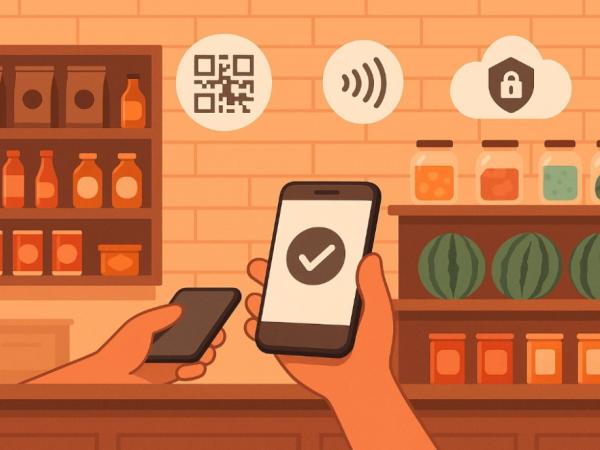
In conversation with Portafolio, José Pablo Gil Echavarría, Head of Clients – Andean in Nuek, He explained that “what we are seeing is a democratization of access to digital payment methods.” Previously, having a traditional POS implied expensive logistics and a technical dependency that limited many businesses and today, it is enough to install a mobile application on a smartphone with an NFC antenna to accept contactless payments from cards, watches or smartphones.
Mobile devices are becoming great allies of the financial system.
Image from ChatGPT
This expert noted that this simplification has been precisely what has been opening the door to thousands of businesses that were previously outside the digital ecosystem and that have now found an ally to boost their economy.
It is worth noting that the expansion of this technology occurs in a context in which the financial habits of Colombians have changed rapidly, given that more and more people receive their money through digital channels, make transfers from their cell phones and prefer payment methods that reduce the need to handle cash.
You may be interested in: Resignation of Giovanni Rubiano shakes up the panorama in the Health Superintendence
“This transition has forced small businesses to adapt so as not to lose sales and store owners understood that their customers no longer always have cash in their pockets, because money comes to them through digital means. If they want to remain competitive, they have to offer alternatives that allow them to charge in the way that is most comfortable for the customer,” explained Gil.
You no longer pay the same
The change is also transforming the way consumers perceive the act of paying. According to the report, 72% of the banked population in Latin America has received the cell phone payment option in small stores, which confirms that digitalization is penetrating from the base of commerce.

José Pablo Gil Echavarría, Head of Clients – Andean in Nuek
Courtesy – API
In Colombia, use is especially high among young people between 18 and 34 years old, with a reach of 50%, while among those over 55 years of age adoption falls to 37%. That generation gap, Gil acknowledges, continues to be one of the main challenges.
“For digital natives, using the phone to pay is natural; they do it with the same ease with which they send a message or shop online. But for older people, even handling a smartphone can be a barrier. More financial and technological education is needed, more accompaniment and communication so that they can participate in the same ecosystem,” he said.
More information: Dollar hits new floor: minimum price is below $3,900 this Wednesday
Despite this, he made it clear that the advance of mobile payment does not mean the disappearance of traditional methods. In fact, the physical card is not on the verge of extinction; but remains the basis of the entire payment system. It is what gave rise to all the digital forms that we know today.
“What changes is the channel through which the transaction is executed. Even many of us We still travel with a physical card as a backup, in case the phone dies or there is no connection. In that sense, what happens is not a substitution, but an expansion of the options available to the user,” said the Nuek spokesperson.

Mobile devices are becoming great allies of the financial system.
Image from ChatGPT
Lower operating costs
The report also shows how technological simplification has reduced operating costs for businesses, given that previously, accepting electronic payments required contracts with banks, rented devices and a fixed monthly cost; while today, applications that allow using the cell phone as a terminal make digital payments more accessible, flexible and sustainable for entrepreneurs.
Likewise, the impact is not limited to the point of sale and in the recurring payment segment, such as education, gym, entertainment or maintenance services, transfers have become the preferred means for Colombians. According to the study, this type of operations It stands out for its speed and control for the user, and for its operational simplicity for commerce.
Other news: Colombia lost ground in the world pension index
Gil relates this evolution to the advance of Open Finance, a model that allows accounts and payment methods of different entities to be integrated under a single interface, in which “the user values being able to have control over their payments. Transfers eliminate intermediaries, reduce costs and make the process more transparent. It is a natural step towards a more open and connected economy.”
In contrast, they warn that international e-commerce still faces obstacles in Colombia, Since although more than half of banked consumers have made purchases in foreign stores, cross-border transactions only represent 15% of total electronic commerce. All this, due to barriers such as lack of interoperability, additional costs due to exchange rates and frictions in authentication and security.

E-commerce
ISTOCK
However, they said that technologies such as tokenization, which replaces the real data on a card with encrypted codes, and biometric authentication have made it possible to strengthen user trust in digital media.
“Tokenization has been essential to protect transactions, both in mobile payments and in e-commerce, and this is complemented by verification systems such as one-time passwords or codes sent through secure channels. Today it is much more difficult than someone can intercept or manipulate the information of a transaction,” he concluded.
Also read: Will card usage go down? What comes with the implementation of Bre-B
In this way, the general panorama, both in Colombia and in the region, points towards a more inclusive and secure digitalization in which Latin America has become a laboratory of innovation in digital payments, driven by necessity and technological creativity; while countries such as Brazil, Peru and Colombia show similar adoption rates, while Europe advances more slowly due to the less flexibility of its local businesses.
DANIEL HERNÁNDEZ NARANJO
Portfolio Journalist