Fall of school performance; Lack of interaction between students; Anxiety and insecurity problems; social inequalities and exclusion; Posture problems. The list, which has eight more items, was made by students of the State School Pé de Mutum and placed on the classroom wall to alert about the disadvantages of mobile phone use at school.
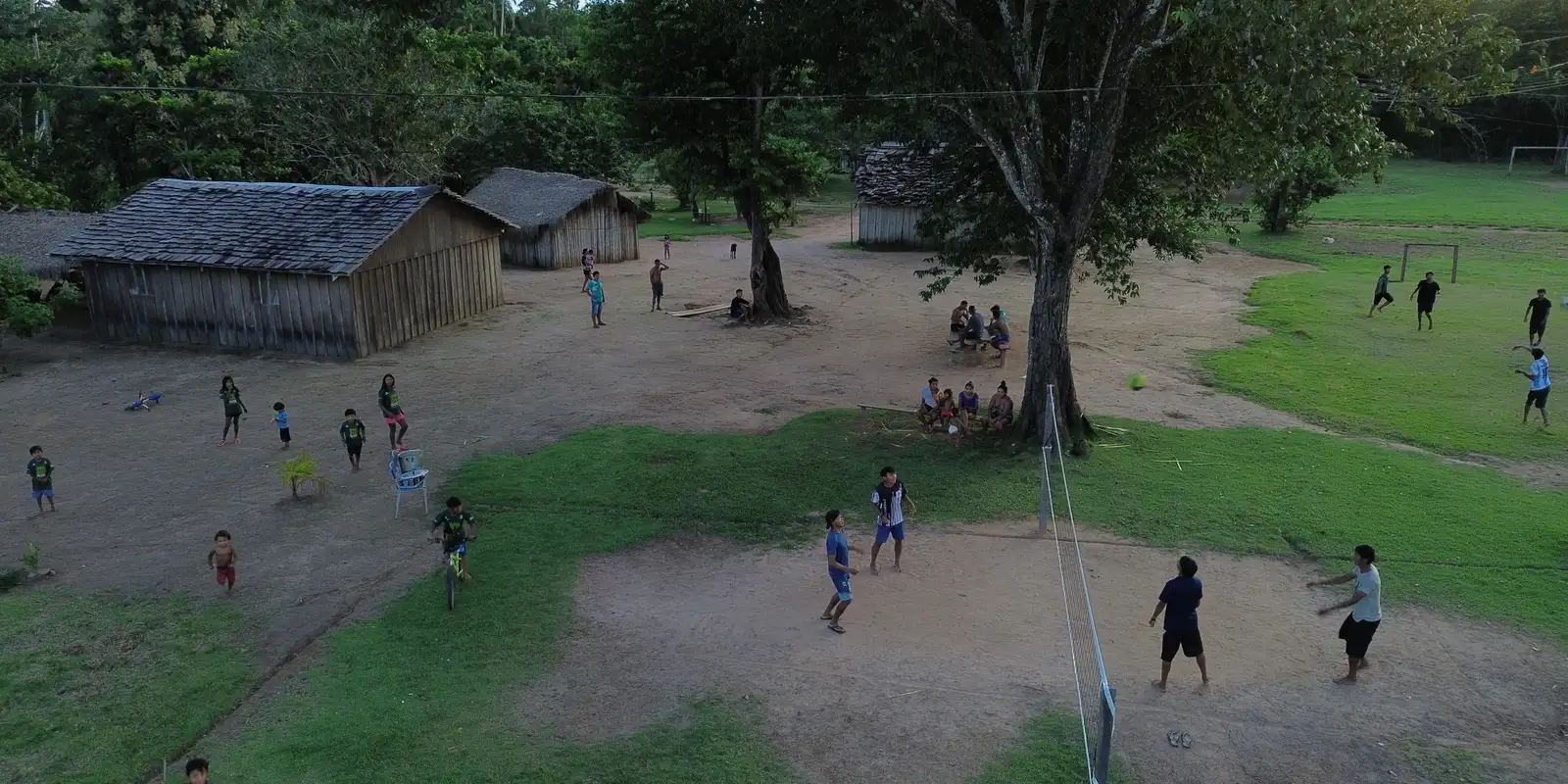
This year, The use of the mobile phone was restricted In all schools in the country, and was no different at the School of Pé de Mutum village, in the Indigenous Land (IT) Japuíra, in the northwest of the state of Mato Grosso.
In the village, the devices are in the hands of indigenous people of the most diverse ages, as well as the benefits and risks that technology can bring. One of them is debt in games and online bets. Given this increasingly connected scenario, both school and projects that are developed there seek to guide the population.
High School’s Natural Science Professor Edson Utumi says that, even with the ban and guidelines, students often use their cell phones. “If you circulate here through the school space, even in class, you’ll find some student distracted on your cell phone,” he says. According to him, it is the online games that distract the students most: “Many times, it’s on the cell phone playing and talking to the other [aluno] which is next door, but over the internet ”.
>>> Know more about the struggle of the Rikbaktsa people:
Online bets
The challenges go beyond school and reach the community. A young woman, who will have her identity preserved in this report, says she lost more than $ 3,000 in online bets.
“I won’t lie to you, no. From time to time, I play, yes. I bet about $ 4,000, 5,000. And I got $ 1,000,” he says. “It’s hard for us, because sometimes we have an account to pay and spend on that little game.”
Another young woman, who will not be identified either, lost at least $ 300 at once. “I play from time to time and I think I lost a lot, I lost a lot more than I won. I had once I spent $ 300 and lost everything. It’s because everyone was playing and saying that it gave money. It gives money, but then, if you keep betting, you lose everything,” he says.
In the Red Barranco village, in the Erikpatsa Indigenous Land (IT), Myhyyeymykyta State School also talks to students about the use of technology. According to Professor Givanildo Bismy, students have respected the rules. They have access to laptops at school, where they learn to use technology.
“Students respect a lot,” he says. “We have the class with them with the ChromebookSo they don’t have to take it. Even parents also help and say: ‘Ah, you can’t. At school, your obligation is to study, and not stir on your cell phone ‘. With that, they help us a lot. Today, we do not literate the student to stay at home, we form for the labor market. We ask them to finish [os estudos]that do a degree “.
Young communicators
Technology also brings benefits. One is to enable indigenous people to be protagonists of their own discourses, their own stories and disclosures, especially on social networks. Young communicators, developed in the indigenous land, is born with this goal.
“The idea is to help them have autonomy in what they produce content about themselves. Our intention is to enable them so that they can talk about the reality they live,” explains the head of the Biodiverse communication team, Paula Lustosa, one of the organizers of young communicators.
According to her, the intention is also that they can communicate the environmental impacts they have suffered. “It is important to know how to talk about climate change, like who is living within a territory, within a reserve.”
The action is focused on about 20 indigenous and riverside people who participate in online and face -to -face classes on the importance of territories and communication. The classes are taught by communication professionals, one of them the indigenous journalist Helena Corezomaé, of the Balatiponé de Mato Grosso people.
Josilaine Barkui, 20, is one of the members of the project. “I decided to participate in this project to understand about communication, to publicize our cultures, our knowledge, how we live here inside the village. And we have learned a lot, such as editing video, ethics, about communication,” he says.
One of the learning was like identifying the calls fake newsfalse news. “It has arrived a lot fake news. We try to know if they are in all sites [confiáveis]If someone in the village learned, whether it is true or not. We seek to know first and then publicize, ”he explains.
Biodiverse project
The Biodiverse Project is developed by the Organization of Civil Society of Public Interest (OSCIP) Pact of Water, with the objective to promote the sustainable use of sociobiodiversity, with indigenous peoples and traditional communities in the northwest of the state of Mato Grosso. The project is sponsored by Petrobras and is part of the strategy of mitigating global warming and climate change by defending forest conservation.
Young Communicators Action is one of those developed under the project, which aims to support 300 extractivists in the production of 800 tons of nuts, 90 tons of rubber and 15 tons of Copaiba oil, with good standard production practices and periodic technical assistance, by 2027. With this, it is expected to ensure the conservation of 1.4 million hectares in the Amazonian biome.
At the invitation of Petrobras, the team of Brazil agency He visited the Red Baran and Beira Rio villages, at Ti Erikpatsa and Mutum Foot, Ti Japuíra, on April 8 and 9.
*Agência Brasil team traveled at the invitation of Petrobras, sponsor of the Biodiverse Project