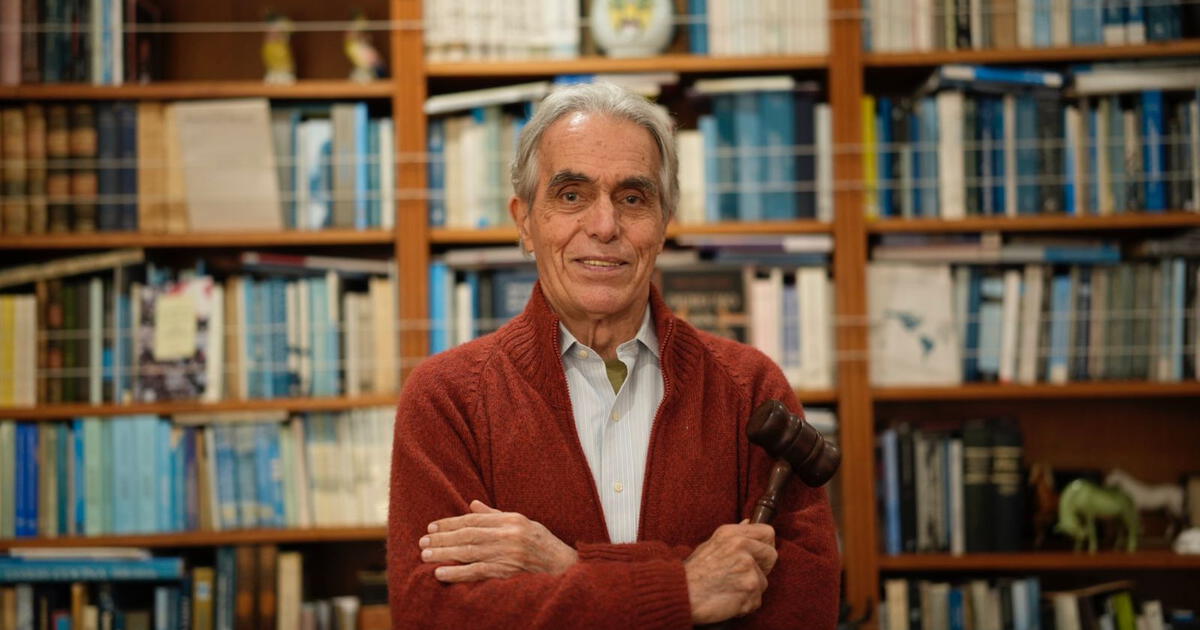
In the last edition of the Lima Book Fair, the renowned lawyer and columnist of the Republic Diego García-Sayán presented his latest book: Right in tension (PUCP editorial fund). In this publication, García-Sayán brings together articles in which, based on law, he threw a dialogue with historical and current themes of democratic life, and not only referred to Peruvian reality. From the moment this interview was agreed, until its realization, many things related to the theme of the book spent in a short time, such as the amnesty of Dina Boluarte to police and military accused of human rights violations. Deleted from history? Firefish to the CVR registration? What is behind this scenario? The Republic He talked with Diego García Sayán.
Listen to the newsText turned into audio
Artificial intelligence
-In Right in tensionwe have a chapter dedicated to the experience of the Truth Commission. After, for example, the recent amnesty given by the president and supported by Congress, it is unquestionable that there is a setback.
-When the idea of Valentín Paniagua arises to create a Truth Commission, the question we asked ourselves with Valentín was what the country’s feeling will be. Let’s do not only a survey, but also debates with local communities to see what things think. Then, we got an international fund to bring Peru as guests to people who had led other truth commissions in Argentina, Chile, Central America, in the previous years, to tell their experience in Huancayo, in Ayacucho, in Cajamarca, in Cerro de Pasco. And what we found was a unanimous feeling in favor of that had to be done, a unanimous feeling that this was a space that people wanted to tell their experience, their suffering, their pain and that there is someone to listen to them. Then, the Truth Commission was an immense catharsis. The testimonies that were collected by thousands are all available in the place of memory, so the LUM is a place so desired by the cavernary minds that have wanted to intervene there or ridicule the lum as if it were a tribute to terrorism. There is the memory of Peru, it is archived, it is available for those who want to know it, and it is a story of oppression, suffering, but also of reaction and communities that have managed to get ahead.
-A history of pain that is being erased.
-Many sons and daughters expect justice to be done against criminals such as those who in the Naval Base of Huanta, in Ayacucho, who went through to find out something, simply disappeared and killed him. It was every day’s bread in that hiding place of crime. So, all these things have come out in these meetings that have been, I think, one of the most important democratic expression processes in Peru in recent decades. All the assemblies that were throughout Peru with the CVR was to listen to something that is available, the recordings are in the memory place. I hope that the Ministry of Culture does not disappear and does not destroy them, because that is a piece that is worth gold and that is the living history of Peru through citizenship. There is no historian, a Jorge Basadre, a José Antonio del Busto who has systematized him, that is in the CVR report, but all those spectacular testimonies are there and I think it would be very good that this call DBA, which is so extremist, so ignorant and so unknown to Peru, a little mouth a little and listen to his testimonies.
-The CVR is clear in your speech, but do you think you have lacked better communication? For example, the DBA and even the right often say that the police and military are not represented and that the terrorists are victimized.
-Of course. The army has published its truth report as well. It is a document that has gone unnoticed, which is tremendously important, because, among other things, they mention ethnic discrimination that certain army detachments had against the Andean population in those years. That is, it is a very valuable testimony that has gone unnoticed and it is true the CVR was somehow satanized by right -wing extremists, as if it were a kind of testimony of NGOs. I believe that the CVR probably did not know how to adequately communicate its results and was basically perceived as an intellectual elaboration of its members who took a series of conclusions and recommendations. True, that is part of reality. But these conclusions and recommendations left thousands of testimonies and expressed experiences that are in the hundreds of CVR pages that very few people have read, but that should be part of a systematic communication to the population.
-What happened later?
–When those years of the transition end, a kind of rather dark wave comes. Everything that smelled of CVR, at review, to human rights, did not enjoy major sympathies for the governments that followed, such as Kuczynski or that of now, to put both extremes. Lagarradel Lum and respects it, promotes it and see that there is the memory of Peru, of the suffering of millions of people. The DBA thinks barbarities without having been informed.
“Right in tension.” (PUCP). Image: diffusion.
-Is the amnesty of Boluarte one of the biggest blows to the CVR?
–Well, there have been several of this nature and by the way an amnesty is not something that someone can be generically against, but one may be against not being investigated, that it has not been sanctioned. Let’s look at what is being done in Colombia. Army officers are recognizing their responsibilities and from there they do not go to jail. They are the subject of a public debate, public criticism, and society learns with that. I believe that this is something that we would have to do closely, we do not have to look at Sweden or Norway, but to see that, in Colombia, in transitional justice, there are former leaders of the FARC who are recognizing their responsibilities and society is learning with them and there is a piece of reconciliation to which it is contributing. In Peru it would seem that this should not have happened and horrendous things have happened, without investigation, without sanction, and an amnesty like this between roosters and midnight, from a government and a parliament of those who has less legitimacy in republican history, a corrupt pact where it is organized crime that has taken control of the Executive and the legislative.
-In this scenario, what is left as such: resist?
-Yes, that’s why there are international instances. If there is an amnesty that violates all principles, that amnesty has no international value. And if a democratic regime comes later, it will take into account that this amnesty is not worth it. That amnesty confronts basic standards of international law, of which Peru is part. It is not a foreign right. It has been built with the vote, signatures and approval of countries that are part of the inter -American system. A few days ago I wrote here in the Republic how was the international treaty with China in 1874when Peru began to review the atrocities that were being committed against the Chinese in Peru. Many were hung with chains, mistreated with nails on their feet. These Chinese-Peruvian mixed commissions were raising minutes that are available in the National Library and in the Foreign Ministry, which account for a horror where only an international treaty could allow that horror to be known. So we have in Peru, I would not say a curriculum, but a record as a country in which atrocities have been committed, where international links have been which has allowed us to know those atrocities and stop them.
-The book title is necessary to understand this context. Namely, it was unheard of that for a long time you do not know who was in charge of the Prosecutor’s Office. There was a feeling that anyone could do what they want with the right.
-The book title was a very intelligent proposal of the PUCP Editorial Fund. The law exists, but is in tension by absolute powers that want to mutilate it, cancel it. And it is key to satisfaction not of lawyers and jurists, but of a society that sees how the tools to make the right to work are demaded.
-It is as if corruption were in the same right.
-Of course. And that is why judicial independence is not an abstract philosophical value that concerns judges or lawyers, but concerns all citizens so that prosecutors and judges work in accordance with their responsibilities and obligations. And that is why it has already been during the management of the corrupt pact so tense with the National Board of Justice. Because just who designates the judges and judges, who evaluates the judges and judges, is where the true power of a democratic system is. And if that is attacked as it has been, systematically, during these years where there has not been a voice within the Government of Dina Boluarte to stop that, it means that we have a very serious offensive to tension the right, to sweep judicial independence, which is essential for the national community, that the judges resolve according to the law.
-A of the most recurring criticisms that make you, is that you endorse the liberation of terrorists.
-When I was Minister of Justice, all the liberated persons were innocent, duly qualified by the commission of Father Lansiers based on a law that had issued and applied Fujimori to free unfairly condemned innocents. You have to see the figures so that the people who say that nonsense see how wrong they are. The number of innocent people who had been convicted as liberated terrorists was much greater during the Fujimori government than during the Valentín Paniagua government. That is the truth, so that what is there the wound breathing is not the issue of terrorist liberation, but the transition to democracy that caused the corruption of Fujimori and Montesinos to end with judicial processes, with Fujimori finally imprisoned and condemned. That is the mother of the lamb.