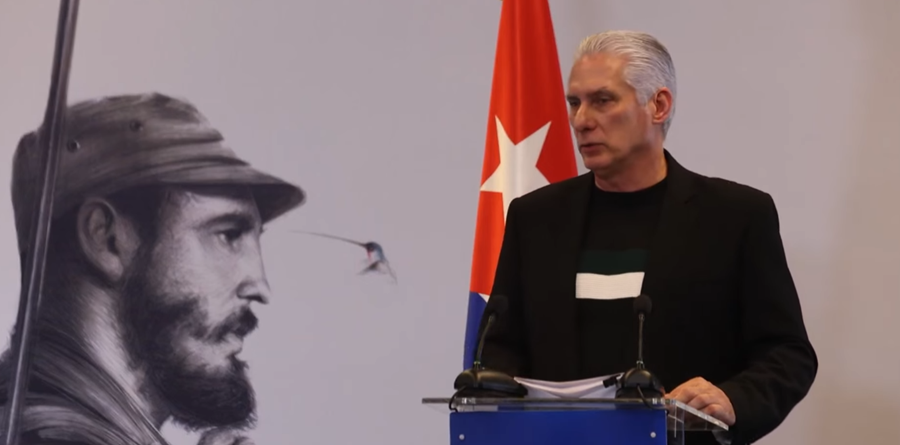
MADRID, Spain.- Cuban ruler Miguel Díaz-Canel appeared this Thursday morning before the press, in a broadcast on state radio and television presented as live, but evidently edited.
From the beginning, Díaz-Canel focused his speech on holding the United States responsible for the internal situation. He spoke of an “intense media campaign of slander and hatred that is being imposed at this time” and assured that the Government is acting to reverse the crisis, especially the energy crisis: “We are looking for a way to get out of this situation in the shortest possible time.” However, he did not explain how or in what terms, despite the context of prolonged blackouts and paralysis of daily life.
The president said that the authorities have held meetings at the highest level, but his words were limited to describing internal processes. “We have had to make assessments in the Political Bureau and in the defense council and now we have just had a meeting with the council of ministers to face an acute fuel shortage,” he said, without detailing specific measures to alleviate the energy crisis or the immediate impact on the population.
The appearance was moderated by Arleen Rodríguez Derivet and it unfolded as a long discursive exercise, in which references to meetings, analysis and assessments replaced any verifiable announcement of a solution.
Venezuela, political rhetoric and lack of answers
Asked about the “collapse narrative promoted from the United States” after the capture of Nicolás Maduro and the real relationship of dependence of Cuba with Venezuela, Díaz-Canel once again resorted to an ideological discourse. He stated that it is “the theory of the failed state” and maintained that “there is no failed state, but rather a state that has had to face the suffocation of one of the main powers in the world.”
The president insisted that the current crisis is a historical continuity. “In 67 years of Revolution, with the blockade, we are aware of economic asphyxiation,” he said, and reiterated that Cuba has always lived with “shortcomings and difficulties.” His message once again appealed to collective resistance: “We are going to live through difficult times, but we are going to overcome it together, with creative resistance,” a slogan reiterated in previous official speeches, without being accompanied by concrete actions and of which the Cuban people are fed up.
Regarding Venezuela, Díaz-Canel denied that a dependency relationship exists and stated that it is a collaboration based on complementarity, initiated during the government of Hugo Chávez. He mentioned agreements on food sovereignty, training of cadres, industry, telecommunications, and cultural and political exchange, and dedicated ample space to talking about ALBA and the Milagro Mission. These references diverted the focus from the immediate situation faced by Cubans, marked by the lack of electricity, fuel and food.
He acknowledged, however, that for years the provision of Cuban medical services was compensated by the supply of fuel, “practically all that Cuba needed,” and admitted that this support has decreased due to the sanctions that Venezuela faces. Regarding the future of that relationship, he stated that it will depend on what can be built “from the present situation” and assured that Cuba “does not impose collaboration,” without clarifying how the current energy deficit will be covered.
Alleged international support and dialogue without content
Díaz-Canel maintained that “the enemy is in pursuit of all the paths that can be opened to Cuba,” but affirmed that the country is not isolated. “I can assure you that Cuba is not alone, there are many governments and countries that are willing to work with Cuba,” he declared, without mentioning names, agreements or specific aid mechanisms. He added that it will be necessary “very strong, very creative work to overcome these obstacles,” another generic formulation without practical content. And he added: “I am sure that there are paths,” but he avoided specifying which ones.
Dialogue with the United States
Regarding a possible dialogue with the United States, he reiterated a known position. “Cuba is willing to engage in dialogue with the United States, without pressure, without preconditioning, in a position of equals and respect for our sovereignty and independence,” he stated, insisting that “a dialogue like that can be built.”
Energy situation
Asked specifically about the energy crisis and the existence of a strategy to confront it, Díaz-Canel appealed to the need to sustain the transition towards renewable energies. He spoke of the “importance of maintaining the country’s transition towards renewable energy sources,” but immediately recognized that the results of these investments are not perceived in the daily lives of Cubans.
“It was not possible to see the magnitude of what was achieved, the impact has not been seen, because it coincided with increasing capacity and not having had fuel,” he stated. As he explained, “we have now been at 0 distributed generation for four weeks,” and described that scenario as “a result that we could not take advantage of due to fuel problems, but it is there.” The statement once again revealed the disconnection between official plans and the reality of the national electrical system, collapsed due to the lack of basic resources.
Díaz-Canel also mentioned the repair of the country’s main thermoelectric plants, although these actions have had no visible impact. According to him, the fuel deficit has prevented the population from seeing improvements, despite the work repeatedly announced by the Government in recent years.
In the same sense, he insisted on presenting the advances in renewable energies as “notable results”, even though he recognized that they are not reflected in practice either. “Where I believe there is a notable result, which is also not perceived, is in renewable energy sources,” he stated, and assured that “we installed around 49 photovoltaic parks in the country.”
Blackouts in Havana: energy for the economy, not for the population
Asked about the increase in blackouts in Havana, his response made it clear that the Government has consciously chosen to sacrifice the electricity supply to the population.
“Until 2025 we worked on prioritizing the flow to the population, but we had the economy at a standstill,” he said. He then added: “We said, we have to put a little energy into the economy this year, knowing that it is at the cost of affecting the population.”
The president stated that blackouts have increased because energy is being diverted towards economic sectors, in a country where the majority of citizens do not perceive any productive rebound or improvements in their standard of living.
Díaz-Canel also announced the installation of “5,000 photovoltaic systems in homes of two kilowatts each” in areas that, he said, were not electrified. The data, far from showing progress, once again showed the structural precariousness of the country, where in 2026 there are still thousands of homes without access to the national electricity system. In addition, these homes will not have a stable supply comparable to that of the rest of the country, also subject to constant blackouts.
The president added that “5,000 more photovoltaic modules have been located in vital centers to provide services to the population, such as maternal and nursing homes.” The mention deliberately omitted the critical situation of Cuban hospitals, marked by a lack of supplies, broken equipment and blackouts that affect even sensitive areas, a reality repeatedly documented by the citizens themselves.
Díaz-Canel took the speech to an even more abstract level by presenting as a central argument something that is inevitable: the existence of air, sun and water. In a country mired in prolonged blackouts, the president appealed to something obvious as if it were an energy strategy.
“The country has to be able to sustain itself with the energy sources that we have,” he stated. And then he listed: “With renewable energy sources, we have air, we have water, we have sun, we have biomass… and that concept can then be applied to electricity generation.” According to Díaz-Canel, it is “a concept that updates what we are proposing on the subject of the energy plan.”
A message without solutions
In almost two hours of intervention, the president did not announce measures to confront the blackouts, the fuel shortage or the economic crisis that is hitting the population. The speech once again focused on slogans, external responsibilities and abstract promises, without offering clear answers or immediate solutions to the problems that affect the daily lives of millions of Cubans.