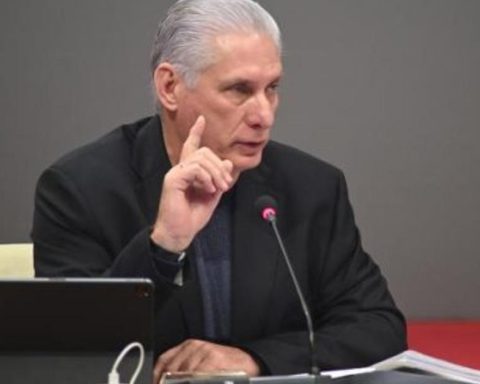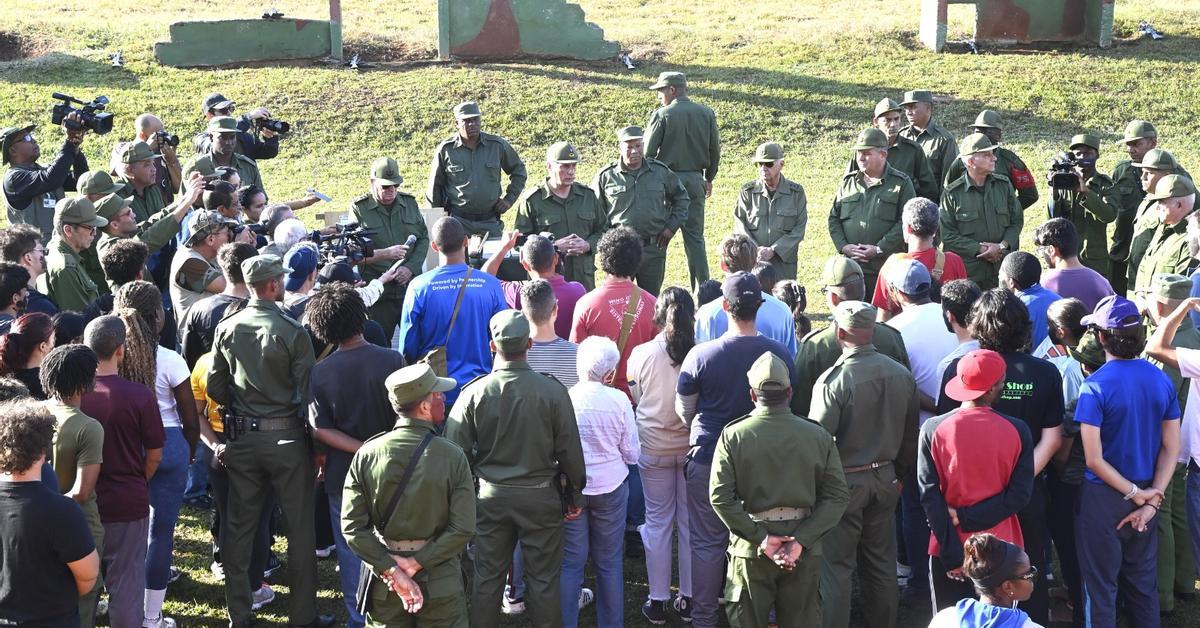
Havana/Once again, on a Saturday marked by fear and uncertainty at the top of Cuban power, Miguel Díaz-Canel wore the olive green suit to take charge of military maneuvers that the regime presents as “national defense rehearsals.” In reality, however, the deployment seems to respond less to a credible security strategy than to an urgent need for internal propaganda, at a time of extreme political fragility.
The day of January 24 included, according to information released by the state press, the observation of “tactical demonstrative exercises” with tanks, shooting practices with university students and combat drills, in addition to visits to air defense units. The official story insisted on linking these actions with the “hegemonic offensive” of the United States, after the military operation on January 3 in Venezuela, which ended with the capture of Nicolás Maduro.
“The best way to avoid aggression is for imperialism to have to calculate what the price of attacking our country would be,” Díaz-Canel said in front of the cameras. But if that operation in Caracas made anything clear, it was the deficiency of the Cuban military framework.
The speed with which the forces linked to the protection of Maduro were neutralized, the absence of a credible strategic response and the human toll of the operation – with dozens of Cubans dead in foreign territory – have had a devastating impact on the morale of those who still believe in the solidity of the island’s military apparatus. One thing is the cardboard epic that the Round Table propagandists repeat; What professional strategists discover when they analyze, without slogans, what happened in Caracas, is quite another. In military terms, it was a disaster for Cuba.
Most Cubans did not even watch the news
The transmitted images in the Noticiero Estelar reinforced that impression. Tanks raising columns of dust, a helicopter maneuvering over a fortified model and a soldier waving a flag from the roof of a half-ruined construction made up a scene closer to a low-budget war movie than a modern defense exercise. Even so, Díaz-Canel congratulated the participants for “the success” of the training, in a gesture that underlined the distance between official discourse and social perception.
In reality, most Cubans did not even watch the news. Some were mired in scheduled blackouts; Others have simply stopped paying attention to messages that they consider irrelevant to their daily lives. Soldiers camouflaged with dry grass, old officers observing with childlike amazement a rudimentary-looking drone, and militiamen instructing civilians in the use of obsolete rifles have served more as raw material for memes on social networks than as a demonstration of deterrent force.
Díaz-Canel’s constant return to the olive green uniform also reignites an ambiguity carefully managed for years. When he was appointed president in 2018, biographical profiles circulated that presented him as a retired lieutenant colonel and former internationalist combatant in Nicaragua. Over time, official biographies softened that profile. They acknowledged his stay in Nicaragua between 1987 and 1989, but describe him as “civilian” and avoid detailing functions, rank or military setting. If before it was convenient to erase his military footprint and sell him as a technocratic and modern leader, now the regime once again emphasizes his image as a “commander”, in an attempt to confer martial authority to an increasingly eroded leadership.
Beyond the bellicose rhetoric, the question persists: what real meaning does this deployment have for the Cuban population? And who feels truly threatened?
This narrative has historically served to justify the lack of freedoms, economic failure and the repression of any dissent.
From Havana, the official discourse continues to feed the idea of an imminent aggression by “imperialism”, the euphemism with which the United States has been designated for more than six decades. This narrative has historically served to justify the lack of freedoms, economic failure and the repression of any dissent. Today it is recycled in the midst of a real regional crisis, but it seems to respond more to the fear of internal fractures than to a concrete threat of foreign invasion.
In parallel to the maneuvers, the National Defense Council approved “plans and measures” to give way to the so-called “State of War”, a figure shrouded in opacity. No details have been offered about its scope, duration or legal implications for citizens. Official media such as Cubadebate and Granma They presented it as part of the “War of All the People”, without explaining what rights could be affected or under what conditions it would be activated.
This secrecy refers to other moments in recent history when the regime has resorted to grandiose terms – “maximum alert”, “economic war”, “revolutionary offensive” – to justify internal measures aimed less at facing real threats than at containing social discontent and internal betrayals.
But that theater has limits. The majority of Cubans know, from their own experience, that “defending the homeland” does not translate into food on the table, medicines in hospitals or salaries sufficient to live on. The great threat to the Cuban population does not seem to come from the north. It comes, rather, from the inability of the system itself to solve structural problems. In this context, the display of military muscle functions only as a distraction from a citizenry that demands, with less and less patience, real answers.