Matanzas/Challenging the deterioration of the structure, Leónides crosses every morning the rotating bridge of the city of Matanzas from his home in the Pueblo Nuevo neighborhood to the viaduct area. Although last May the beginning of the restoration of the work filled holders of the official press, today they do not see workers working or stacked resources near its restoration.
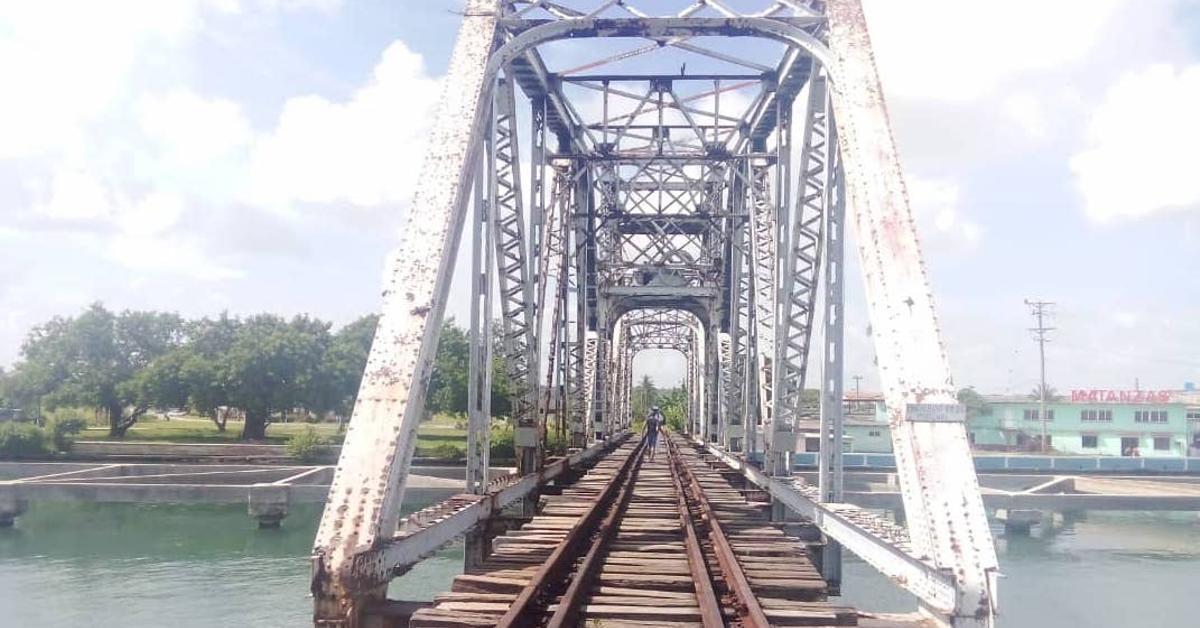
“There is a stretch that I have to get in the railway line to cross because the outside is impassable,” he explains to 14ymedio Leónides, 69. Although he no longer has the brios of his youth, the matancer is taking some jumps until reaching the wooden naughty and in order to avoid the gaps that dot the entire bridge. Under his feet runs the San Juan River, crowded by drought and contaminated by city’s waste.
When a few months ago Eduardo Rodríguez DávilaMinister of Transportation of Cuba, reported on his Facebook account that preliminary works had begun to return his splendor, many residents near their hands, Leonides was one of them. “It helps me to cut off the way, because I do not have to take a tremendous return, besides that it is very beautiful.”
The Matancero who does not have a photo of his childhood in this rotating bridge is rare
Built in 1904, the Matancero who does not have a photo of his childhood acoded in this rotating bridge is rare. With its dentated wheel system connected to an engine that allowed it to make a turn of up to 180 degrees, the structure was the pride of the city and part of its unmistakable profile. “My sister was already loved to see him move, but it happened to us, getting older and more bland.”
The oxide It has taken over the metal pieces that were brought from the United States to lift the structure. With more than two decades without receiving maintenance and three years without being used by rail transport, the deteriorated Mole has been left only as a way for intrepid pedestrians as Leonoides and for children to play climbing in their beams.
“It is a danger. If they are not going to repair it, at least they close it,” considers a neighbor in the vicinity. A few days ago, the woman read an article in the local press that spoke of a prompt “capital restoration to recover its functionality and preserve their particular significance”, but those promises fail to dissipate their skepticism. “As the economy is, I think they don’t have for that.”
“If they are not going to repair it, at least they close it”
The Matanzas architecture and engineering project company will be in charge of starting a repair that in the eyes of the Matancos has been too postponed. With financial support from the Ministry of Transportation, the works will have to be of a wingspan that costs to imagine in times of narrows and budget cuts. “What nobody wants is to come and put only a little painter,” adds the neighbor.
Neither a crane, nor a mountain of new mischievous to replace the corroded, nor engineers with helmets and tablets in which they write down the damage, none of that is seen anywhere. Leonides is formed, he says, with which they fix the base. “If you don’t turn again, you don’t turn, but at least you can go through it,” he says. Given reality, cutting dreams seems the most pragmatic. At least in the photo he has with his sister on the edge of San Juan you see the moment when the bridge has moved to let a couple of boats pass on the then clean waters.