Although the Colombian labor market closed Julio with an encouraging fact on the surface, since it marked a slight setback against last year’s dynamics, there are several disturbing data at the bottom of this report, which makes it clear that informality It is a persistent scourge and still hitting the most vulnerable populations.
According to the National Administrative Department of Statistics (DANE), the national unemployment rate was 8.8% during this period, which meant a reduction of 1.1 percentage points compared to the same month of 2024. Similarly said, the number of employed reached 24 million people, that is, 766,000 more than a year ago.
See here: In Congress they get moved to prevent the country from continuing to borrow
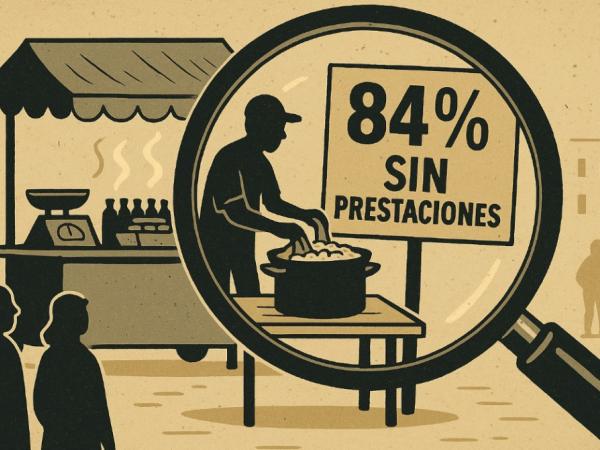
However, behind that achievement a structural problem is hidden that continues to mark The dynamic of the country and is informality, since the same statistical authority revealed days after April-June of 2025, 55% of those occupied in Colombia are informal and that even more serious, this percentage is triggered at 84.6% in micronegocios, the backbone of much of the urban and rural employment.
This implies that, although more and more Colombians manage to link to the labor market, most do so without access to benefits, social security or stability, configuring not only a non -protection scenario for more than half of Colombians who have a job, but translates into less resources for social security.
Gender gaps are also persistent in the labor and informality market.
Chatgpt image
“Unemployment can be going down, but the quality of employment remains precarious,” summarizes José Garcéa Guzmán, professor of Economics at the University of America, who warns that the country is caught in a dynamic where the reduction of unemployment lives with the expansion of unprotected work.
A break in the figures
Dane data show that the rebound in the number of employed was concentrated in sectors of strong dynamism, although also with high informality, since activities such as accommodation and food services (+0.8 pp), transport and storage (+0.7 pp), professional activities and administrative services (+0.5 pp) and trade and vehicle repair (+0.4 pp) were the ones that contributed the most contributed to the increase in employment.
It may interest you: Artificial Intelligence: How to use it to improve personal finances?
These branches, however, are dominated by small and medium productive units that operate with little regulation. In fact, in micronegocios, which can range from family restaurants, neighborhood stores, workshops or informal transport, eight out of ten workers lack Social Security.
“This contrast is the most important alert signal,” says Garcia, for whom, “Colombia’s challenge is not only to create more jobs, but those jobs are formal and productive”, in order to generate stability and growth in the economy and better living conditions in homes.

Gender gaps are also persistent in the labor and informality market.
Chatgpt image
These figures also highlight the deep territorial inequalities, since in the 13 main cities and metropolitan areas, the informality rate is 41.7%, while in Populated centers and dispersed rural areas scale 83.4%.
In addition, there are significant differences between cities, since while Sincelejo (68%), Riohacha (63.6%) and Valledupar (63.6%) lead at informality levels, others such as Quibdó (24.3%) record relatively low rates, although compensated with higher unemployment rates (14.4%).
More information: Lack of credit and digital fraud: the walls that stop the SMEs
These contrasts reflect what Garcia calls a “structural heterogeneity” of the labor market, explaining that “policies must be differentiated, because the reality of a capital like Bogotá is not the same as that of an intermediate municipality or a rural area. We cannot expect a single measure to solve problems that are deeply different in each territory.”
The mirage of the downward
Although the Dane informality bulletin indicates that there was a slight reduction compared to the same period last year; It should not be overlooked that when crossing this fall with the new busy of July, a disturbing fact arises and that of the 766,000 new positions, about 420,000 would be informal.
Other news: Tax Reform: How could you cut the $ 10 billion that are no longer going?
In other words, the engine of employment in Colombia remains the same, occupations without stability, without benefits and with high rotation; So Garcia warns that “we can talk about a drop in informality in percentage terms, but complete photography shows that informality is which absorbs a good part of the new labor. It is a mirage that we must read carefully. ”
Meanwhile, beyond the global figures, the gaps continue to mark the panorama if one takes into account that informality hits women with greater force, which are more likely to work in micronegocios or in retail trade and domestic services. It also affects the rural population, where the absence of contracts and quotes is the norm more than the exception.

Gender gaps are also persistent in the labor and informality market.
Chatgpt image
“The combination of these factors reinforces a vicious circle in which those who enter the market Labor in informality conditions are usually trapped in low productivity and low social mobility jobs. And although the country celebrates an unemployment rate at its lowest level in more than a decade, the quality of employment remains a pending debt, ”said Professor José Garcéa.
With all this, it can be said that the country remains in the middle of a juncture in which on the one hand, it must maintain the downward trend in the unemployment rate, which has shown positive results and on the other, it has to accelerate the process of labor formalization, to ensure that the new jobs not only add in quantity, but also in quality.
Read here: Debt Management in Minhacienda: Temporary solution or anesthesia?
For this analyst, the above requires fund differentiated regionals that recognize the particularities of each territory.
“If you do not advance on this front, we run the risk of celebrating occupation figures that actually hide precariousness,” he warns, while closing, highlighting that the conclusion is clear and suggests that the Colombian labor market is improving in quantity, but not in quality, since there are more and more people occupied, but too many do so in informal conditions that perpetuate vulnerability and limit access to basic rights.
Daniel Hernández Naranjo
Portfolio journalist