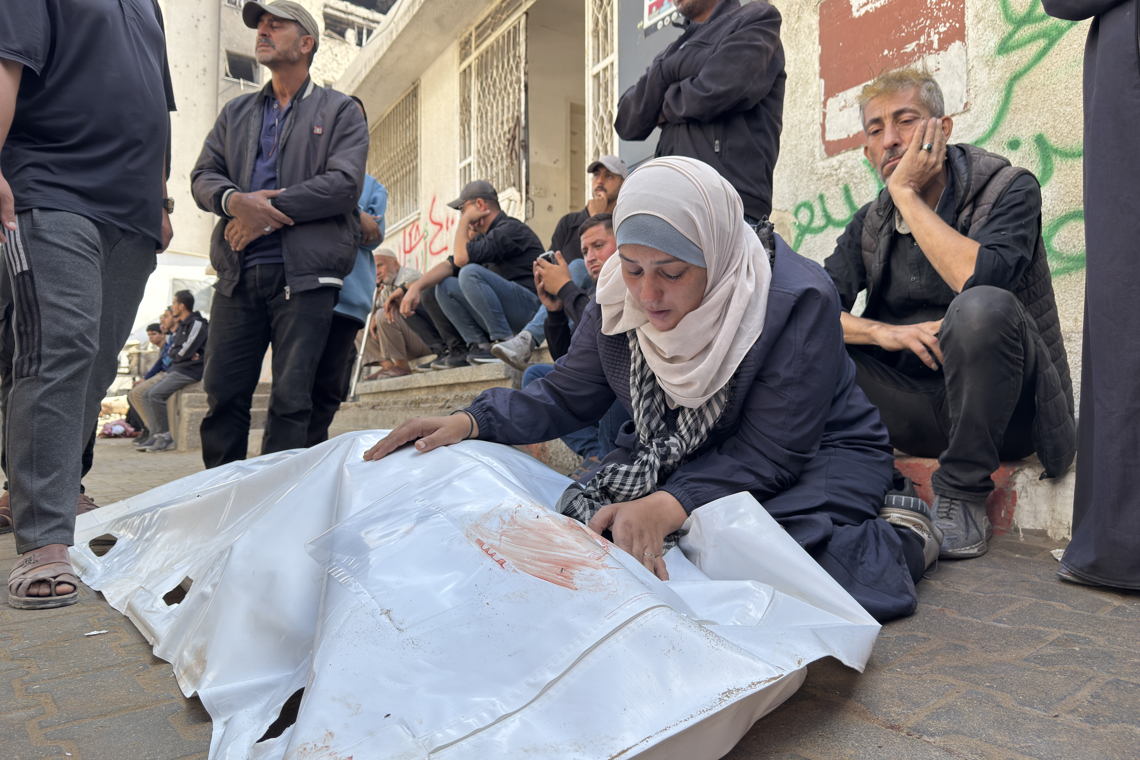
The truce in Loop It has become a bloody fiction. Despite having publicly affirmed its commitment to the US-backed ceasefire, Israel launched new airstrikes and ground bombardments this Thursday in several areas of the Palestinian enclave.
The pattern repeats itself: promises of peace followed by fire. And while international mediators try to sustain an agreement that is crumbling, the deaths are piling up and the colonization of the West Bank has been advancing unchecked for decades.
Palestinian witnesses, cited by international media, confirmed that Israeli planes carried out at least ten attacks in the east of Khan Younis, in southern Gaza, while tanks bombed areas to the east of Gaza City, the main city of the Palestinian enclave.
Although no casualties were reported in this latest offensive, the attacks on Tuesday and Wednesday left 104 dead, including 46 children and 20 women, according to the Gaza Ministry of Health.
Israel justified the bombings as “precise attacks” against “terrorist infrastructure that posed a threat to troops.” However, the yellow line – an area agreed upon as the limit of military operations – was crossed, according to Hamas, which denies having violated the agreement.
The Gaza government’s media office accused Israel of carrying out a “systematic disinformation campaign” to cover up “crimes against civilians.” Meanwhile, the Israeli army published a list of 26 militants supposedly killed, including a commander who allegedly participated in the October 7, 2023 attack.
Hamas and the delivery of bodies: a truce with obstacles
Amid growing tension and fear of a definitive breach of the ceasefire, Hamas delivered two coffins to the Red Cross this Thursday with the bodies of Israeli hostages.
The Israel Defense Forces (IDF) received the remains in Gaza, draped them with national flags and held a brief ceremony before transporting them to the Abu Kabir Forensic Institute in Tel Aviv for identification.
This gesture is part of the peace agreement proposed by US President Donald Trump, which came into force on October 10. The pact included the release of all hostages—living and dead—and the withdrawal of Israeli troops.
Hamas freed the 20 hostages alive, but the delivery of bodies has been slow and conflictive, which has generated friction with Israel and complaints from Hamas. The Palestinian group alleges difficulties in reaching the burial sites, given the continuous harassment by the occupants and the lack of security and means to operate in the tunnels where the hostages would be buried.
West Bank, a colonization in full truce
As Gaza suffers bombing, the West Bank faces a silent but equally devastating offensive: the expansion of Israeli settlements.
On Thursday, Hamas condemned the approval of a plan to build 1,300 new homes in the Alon Shvut settlement, south of Jerusalem. The project includes schools, parks and shopping areas, and was hailed by the Gush Etzion Regional Council as an “adequate response” to housing demand.
Hamas denounced that this initiative is part of a “campaign led by the Israeli Minister of Finance, the ultra-radical Bezalel Smotrich, “to fragment the West Bank and isolate Jerusalem” from its Palestinian environment. The Islamic organization described the plan as a “flagrant violation of international law” and called on the international community to act.
The situation in the West Bank has worsened with attacks by Israeli settlers against Palestinian villages, burning of vehicles and attacks during the olive harvest season.
October has been the most violent month since the UN began documenting these incidents in 2013 and also this month the Israeli parliament has pushed for the annexation of that territory.
Israeli Parliament approves in first vote project to annex Palestinian territory of the West Bank
This Thursday, the Israeli army killed a 15-year-old Palestinian teenager in a military operation in the West Bank city of Silwad, northeast of Ramallah, amid the increase in military incursions into this territory following the Palestinian attacks of October 7, 2023.
According to United Nations data, in 2024 the deaths of nearly 500 people were recorded in the West Bank, while so far this year the deaths of more than 200 have been reported in the context of the occupation and the conflict that broke out in 1948, just with the creation of Israel.
Furthermore, since the start of the war in Gaza, Tel Aviv has installed nearly a thousand barriers in the West Bank, according to the Commission on Resistance to the Wall and Settlements. Obstacles include metal gates, concrete blocks and military posts that restrict the movement of Palestinians. The IDF claims these are “management and surveillance” measures, but residents report arbitrary closures and forced isolation.