Carlos Miguel Pérez Reyes, founder and president of the MSME Dofleinia private software company, and deputy to the National Assembly of People’s Power for the Playa municipality, in Havana, called on the institutions and the government to unite in “a truly transformative project, for the benefit of the majority of Cubans.”
Pérez Reyes published a “chronology of the dollar in Cuba” from the 60s to the present in a post from your Facebook account and called on the authorities not to continue “vacillating” with the Cuban exchange rate policy.
In what can be considered an unusual statement coming from an active deputy, he described that currently “we are experiencing a partial dollarization of the economy that requires USD for fuel, cigarettes, stores, hotels, beer, imports due to the shortage of national production, etc.”
“However, there is no legal mechanism to obtain foreign currency other than remittances. The economic activity of the population is sustained by the illegal purchase of foreign currency, in plain sight of the entire world, for years,” he said.
He recalled that while the dollar was prohibited in Cuba from the 1960s until 1993, its possession constituted a crime punishable by prison sentences, something that the majority of those who lived through that time reproach the authorities.
Pérez Reyes acknowledges in his post that his mother “hid the dollars in the handlebars of the bicycle so that a Guatemalan friend would buy me a pair of shoes.”
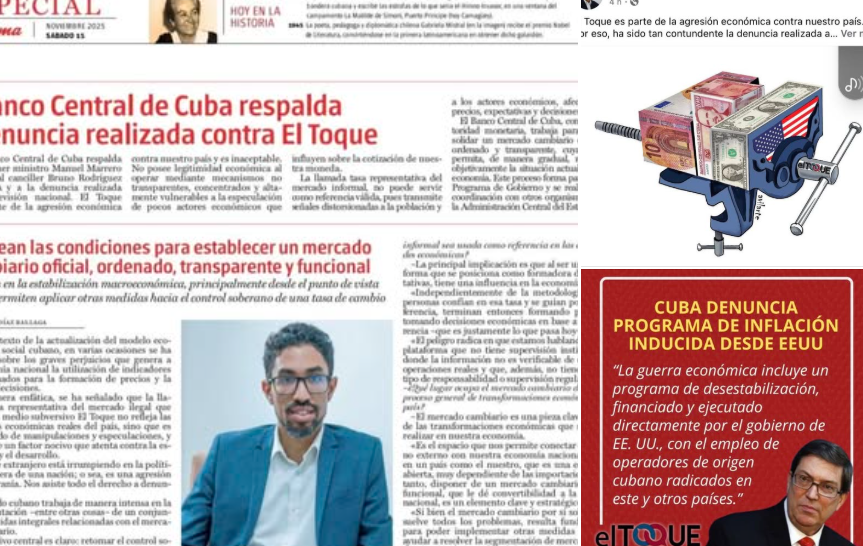
This statement comes at a time when the government once again increased its campaign of accusations against the opposition media. The Touch which publishes a dollar exchange rate based on purchase intentions monitored in forums and social networks and which, according to authorities, influences the growing devaluation of the Cuban peso and the inflationary dynamics in the country.
Carlos Miguel Pérez: “If MSMEs did not exist we would not be better off”
The 39-year-old Cuban parliamentarian, one of the youngest in the National Assembly of People’s Power, described the panorama of recent years after the failed Ordering Task, in this way: “The informal rate skyrockets, El Toque gains strength as a reference and the government is unable to operate a stable exchange market due to the lack of foreign currency and the high risks.”
“I am one of those who believe that El Toque and company will disappear the day our institutions and the government come together in a truly transformative project, for the benefit of the majority of Cubans and that, along with that, we send not only El Toque, but also the failed economic policies, to the garbage dump of history,” said Pérez Reyes, distributing reproaches.
He added that “it is a genuine demand from our people, from the National Assembly, from the business sector and from everyone who wants this country to move forward. Do we take control, or what?”
Cuban government accuses El Toque of “currency trafficking and tax evasion”
Last week, Prime Minister Manuel Marrero accused The Touch of being part of a “currency trafficking and tax evasion scheme in Cuba”, after the broadcast on state television of a documentary which also points to Miami’s means of receiving US funds to destabilize Cuba.
“This is a comprehensive economic war program organized, financed and executed directly by the US Government,” said Marrero.
Marrero described the rate as “a farce” and “the result of crude manipulation.” The media and several officials and activists close to the Cuban Government make accusations of “mercenarism”, “illicit enrichment”, “exchange manipulation” and of acting “against the well-being of the Cuban people”.
Since 2022, the official fixed rate is 1 dollar per 24 Cuban pesos for legal entities and 1 USD per 120 CUP for individuals The Touch currently gives a fluctuating exchange rate of 1 USD for an increasing value, approaching 500 CUP.
In Cuba, the vast majority of informal monetary transactions take as reference the rate of The Touch, in the absence of official information provided by the financial authorities.